From America to New Zealand, it’s become a familiar, frustrating reality: The world quickly needs more infrastructure, but there aren’t enough engineers to do the job.
That constraint is why Bentley Systems CEO Nicholas Cumins says the company has put engineering productivity at the heart of its AI strategy. AI can automate time-consuming tasks and, in some cases, compress months of work into days or hours. AI agents also offer a glimpse of the future, one where engineers simply describe what they want, AI generates the instructions, and Bentley applications perform the engineering work. Human engineers, of course, must remain firmly in control.
In a call this month to discuss the company’s second-quarter results, Cumins and Executive Chair Greg Bentley outlined their thinking on AI and productivity. In particular, they stressed the importance of hybrid systems.
“Our applications and today’s AI models are far more powerful together than apart, because each does something the other cannot,” Cumins said.
Bentley applications, Cumins said, are deterministic: “They perform the engineering itself—the modeling, the analysis, and the simulation—and that work is trusted because it has been proven over decades.”
AI models, by contrast, are probabilistic. “What they contribute is natural language processing, high-level reasoning, and the ability to break a problem down and generate the instructions that our applications then execute with engineering precision,” he said.
But together, they divide the work according to their strengths: AI models reason and generates instructions, Bentley applications perform the engineering work—like modeling, analysis, and simulation—and engineers direct the process and verify the results.
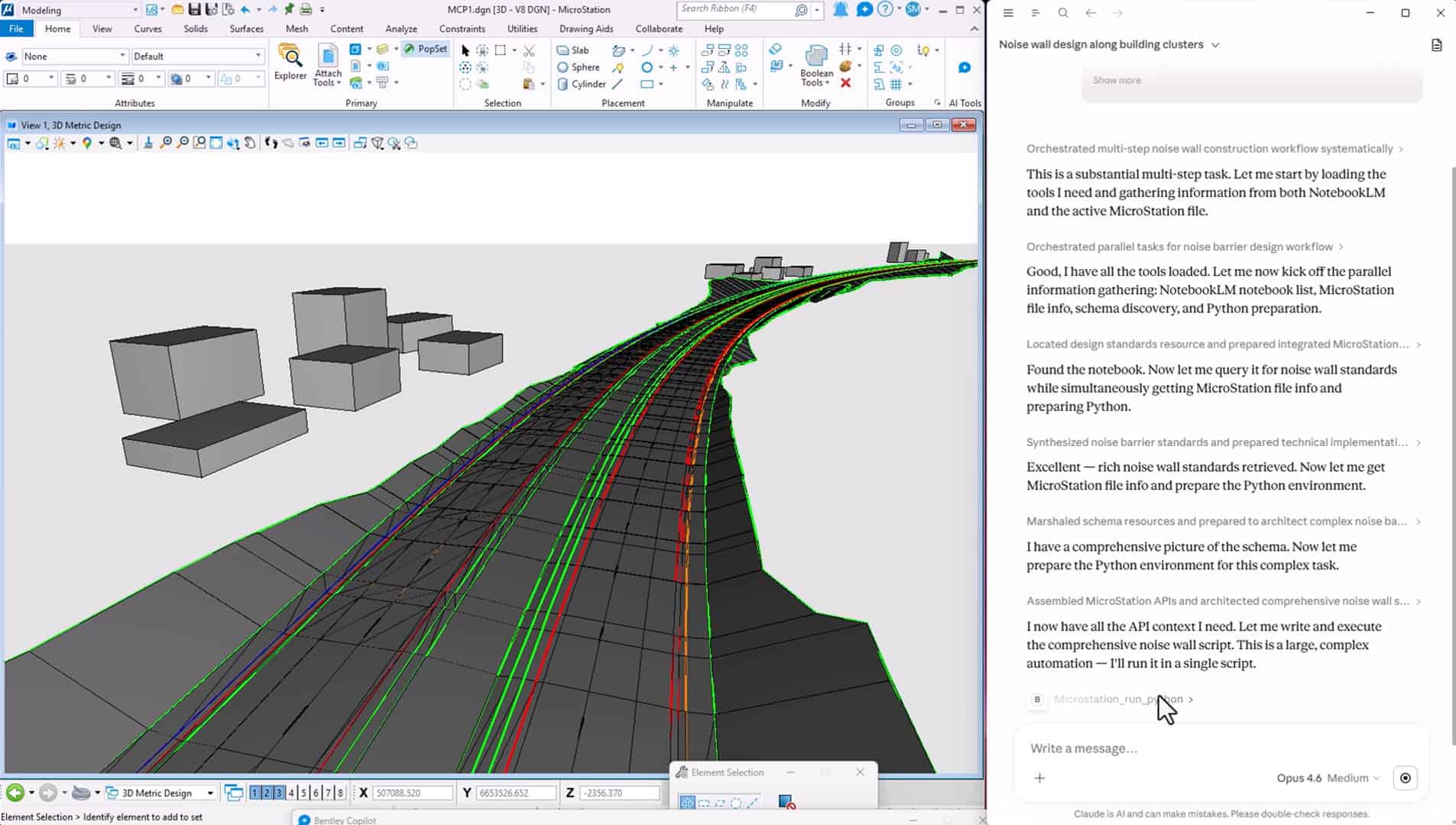
Model Context Protocol, or MCP, is the bridge between them, the interface. Bentley’s MCP servers connect engineers’ preferred AI assistants and models to Bentley applications, allowing engineers to direct workflows in plain English.
Earlier this year, Bentley released its first MCP server for its STAAD.Pro structural analysis software. Since then, Cumins said, the company has released several more MCPs, with others to come.
Engineering firms are moving quickly to improve efficiency and effectiveness, Greg Bentley said. “But they understand the best way to get there is a hybrid approach where their AI assistants, their own agents, would take advantage of established functionality,” he said.
His prediction: “Every day for every engineer will become increasingly valuable, at the helm of ever more specialized AI-leveraging applications.”
The results are beginning to appear in engineering workflows, product deployments, and Bentley-led experiments. Here are 10 recent stories showing what that human-AI partnership can look like.
Would You Trust An AI To Design Your Bridge?
In much of the clerical and creative industries, an AI that’s “mostly right” is generally OK. But in structural engineering, that could get you into big trouble. So how does infrastructure adopt AI without losing the precision and reliability needed for a bridge or power grid? Bentley CTO Julien Moutte has an answer: Keep human engineers in the lead. Bentley built a Model Context Protocol (MCP) server for its STAAD structural analysis software, letting AI agents directly interact with the validated engineering tool. AI automates tedious and time-consuming tasks, while human engineers bring professional judgement and expertise. In one analysis, AI found a design that cut steel weight by 40%. In another test, Bentley automated a tedious, error-prone task. This frees engineers to focus on more complex design challenges. Human feedback also trains the AI, making it smarter, safer, and more reliable over time.
AI Is Rewiring the Way Engineers Design Infrastructure
AI is making rapid advances in infrastructure engineering. Tools like Claude and Copilot are allowing engineers to start automating their workflows, saving time and lowering the barrier to entry. And new technology could eventually enable AI agents to make the coding step unnecessary altogether. Key to that is the MCP, which lets AI assistants talk directly to engineering software. An engineer can type a command in plain English (“optimize this steel frame”) and the AI automatically carries it out inside the software. (Of course, engineers must verify the results.) More than 2,000 engineers from around the world recently signed up for Bentley’s second “MCP webinar” to hear more about how AI is rewiring their field. The registrations were double the number as the first webinar held in May.
Inside the AI Experiment That Recreated London’s Iconic Gherkin Tower
Two decades ago, Stuart Milne was on the team that built the Gherkin, one of London’s most famous skyscrapers. Now a product manager at Bentley Systems, Milne returned to the Gherkin’s design in June. This time, he didn’t start with a pencil or a desktop workstation—he started with an AI agent. It recreated the Gherkin at a rapid clip, with Milne checking and verifying the design. And he used an MCP to connect the AI agent to Bentley’s MicroStation software—the same Bentley tool used on the real Gherkin more than 20 years ago.
The Quebec Bridge Rises Again: AI Agent Recreates Engineering Wonder
When its last rivets were driven in 1917, the Quebec Bridge was hailed as one of the world’s greatest feats of bridge engineering. More than a century later, Bentley engineer Louis-Martin Losier, working with modern engineering software and AI, recreated the bridge’s geometry and prepared it for structural analysis—all within a matter of days. Like Stuart Milne did with the Gherkin, Losier used an MCP to connect an AI agent to Bentley’s MicroStation. Losier directed the agent in plain English, and it controlled the software to create the model of the Quebec Bridge.
The Grading Problem: How AI is Solving Infrastructure’s Toughest Staffing Challenges
Engineering is facing a “silver tsunami” of early retirements—just as firms are struggling to find new talent. One of the toughest staffing challenges is in site grading, the intricate process of shaping land to prepare it for construction. That’s one reason why Stantec, one of North America’s largest engineering firms, became an early adopter of Bentley’s OpenSite+. The AI-powered software automates the time-consuming aspects of site design, including those vital for site grading. Stantec’s engineers remain firmly in control by reviewing, validating, and refining the results before they move forward.
An App Built in Three Days Could Help Fix America’s Decades-Long Bridge Crisis
Speaking of talent shortages: America has more than 220,000 bridges that need repair or replacement, but the engineers trained to do the work are retiring and not being replaced fast enough. A recent hackathon at Bentley’s London offices offered a glimpse of a solution. Over three days, engineers from Bentley and Collins Engineers built a virtual bridge-inspection training app. Using an AI coding assistant helped the team compress months of work into days. The app allows inspectors anywhere in the world to navigate photorealistic 3D digital models of real bridges to help identify cracks, spalls, and other structural defects.
What Does the Future of Construction Look Like? A Lot Like AI, Robotics, and Extended Reality.
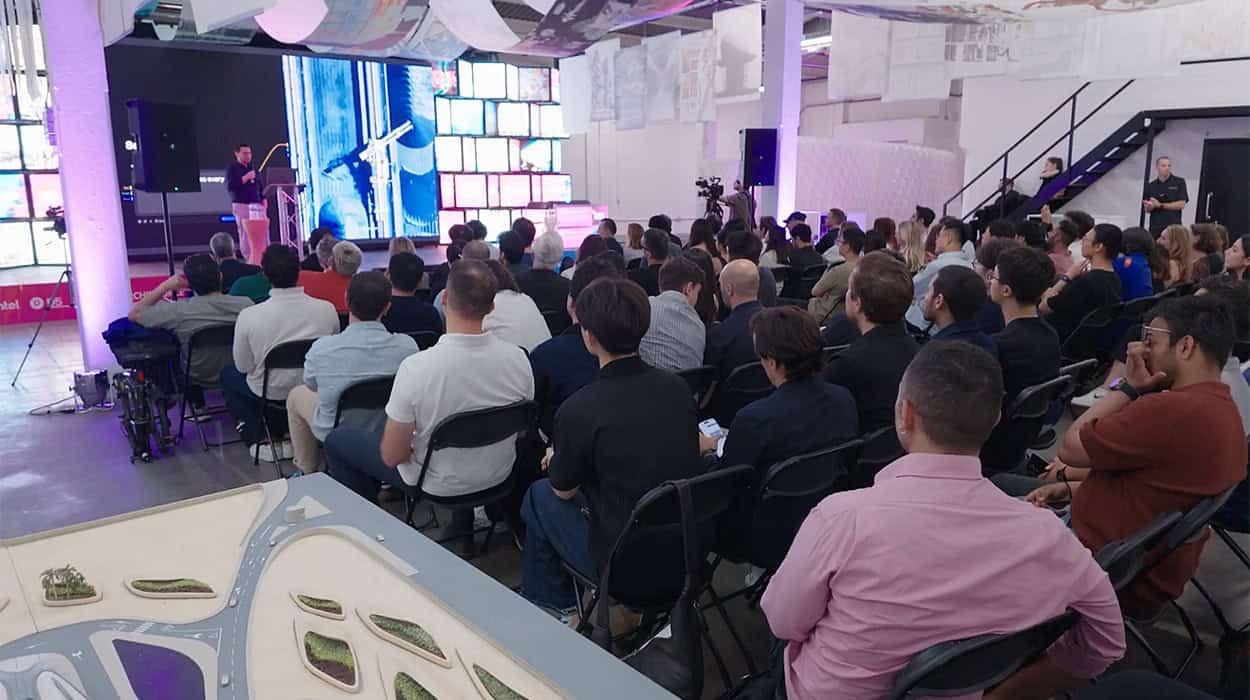
From 3D-printed towers to AI-powered autonomous bulldozers, the next decade of construction was put on display at the recent Future of Construction symposium in Switzerland. Bentley sponsored the event at ETH Zurich, the birthplace of many digital fabrication tools, with Bentley’s Greg Demchak among the speakers. Demchak, Bentley’s vice president of emerging technologies, said AI and robotics can lower the cost of quality and complexity, helping the builders of the future bring beauty back to even the most ordinary structures. One case in point: Vaulted, a firm cofounded by ETH professor Philippe Block. Vaulted’s innovation is a prefabricated concrete floor stiffened with interlocking geometric ribs that echo the vaulted ceilings of Gothic cathedrals. While earning his Ph.D. at the Massachusetts Institute of Technology, Block was struck by the ingenuity of the medieval masons who raised those ceilings with no steel to stiffen them and no computers to design them.
AI Takes Up The Watch On South Africa’s Storm-Battered Roads
The roads in and around Cape Town are getting a new set of eyes with the help of Bentley and AI. South Africa’s Western Cape region is enlisting Bentley’s AI-powered Blyncsy platform to scan 5,000 kilometers of roadway for hazards. Blyncsy uses crowdsourced dashcam imagery and machine-learning models to flag dangers ranging from damaged guardrails to missing street signs and debris—a growing concern as the province is battered by more frequent and severe storms. The move is a first in Africa for Blyncsy, which is already helping governments manage roads in the U.S. and Europe.
America Quickly Needs More Power Than Ever. Tech Can Cut the Long Wait to Build It.
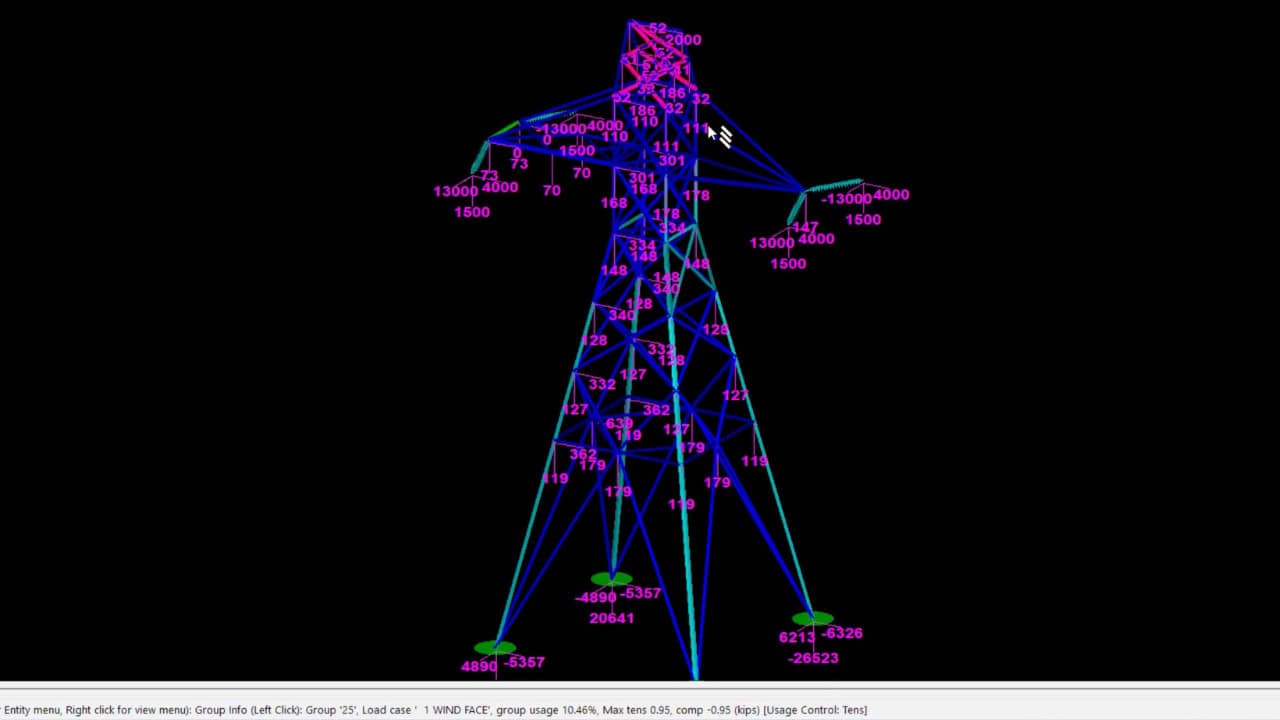
Designing a power line used to take months. Nowadays, thanks to digital tools, engineers can do the same job in just hours. So why does it still take more than 10 years to build a transmission line? The answer, writes Otto Lynch, head of Bentley’s Power Line Systems, is permitting. Clearing this regulatory bottleneck is an increasingly urgent task, given the surge in demand for electricity: AI alone will drive a 165% increase in demand by 2030. Luckily, Lynch writes, the same digital tools that speed up engineers’ design work can help cut permitting delays. Bentley’s PLS software is now used in the design of nearly every new transmission line in the world.
An AI Rebuilt a 2,000-Year-Old Computer. The Real Prize Is Your Next Bridge.
We already know that AI can recreate imposing engineering marvels like the Quebec Bridge or the Gherkin. But it can also redesign lost, pocketsize gems. Our final story describes how a Bentley expert using an AI agent and the company’s MicroStation MCP server rebuilt the world’s oldest computer: the 2,000-year-old Antikythera mechanism. The long-lost ancient Greek mechanism is thought to have been able to predict solar eclipses and model the movements of the planets. The experiment points to what engineers will be able to do in the “real” world: say what they want in plain language, with AI helping translate that intent into a design, almost as fast as they can describe it.