 Collins Engineers used Bentley’s iTwin Capture platform and AI to identify cracking in the bridge structure.
The achievement builds on Collins Engineers’ innovative work with the Minnesota Department of Transportation. A few years ago, MnDOT hired Collins, along with engineering and consulting firm Michael Baker International, to inspect the Robert Street Bridge—a beloved 100-year-old landmark that stretches 1,429 feet across the Mississippi River in downtown St. Paul—ahead of a major rehabilitation. Collins dispatched drones that captured more than 57,000 images of the bridge’s surface, then used Bentley’s iTwin Capture and iTwin Experience software to build a photorealistic 3D digital twin and connect it to AI. The AI automatically identified and catalogued concrete cracks, spalls, and other defects across the entire structure. By the time engineers arrived on site, they already knew where to look.
“The ability to use artificial intelligence to automatically find, quantify, and communicate concrete crack information is the largest leap forward in bridge inspection since formal bridge inspections started in the United States in 1971,” Lovelace says.
The approach cut on-site inspection time by at least 20% and saved more than $90,000 in labor costs. By sharing the precise 3D model with potential contractors, Collins expects to save MnDOT up to $15 million during the rehabilitation and reduce construction materials by 10%.
That project became the foundation for a training program Collins developed for MnDOT bridge inspectors. “We’re still relying on our inspectors and their experience,” Lovelace said. “But we’ve changed from discovering a lot of these defects in the field to just verifying that they’re there, and that the pre-inspection information and the artificial intelligence correctly identified the defects.”
 Robert Street Bridge is shown highlighted with digital road markings after an inspection. Image courtesy of Collins Engineering.
The program worked, but toggling between the training website and Bentley’s iTwin platform still required more engineering. So Lovelace reached out to Greg Demchak, Bentley’s vice president of emerging technologies and head of Bentley Labs, and his colleague Scott Becher, a senior solutions architect. Together, they set out to build a platform that bridge inspectors in Minnesota—or anywhere around the world—could use to complete their training online, Lovelace says.
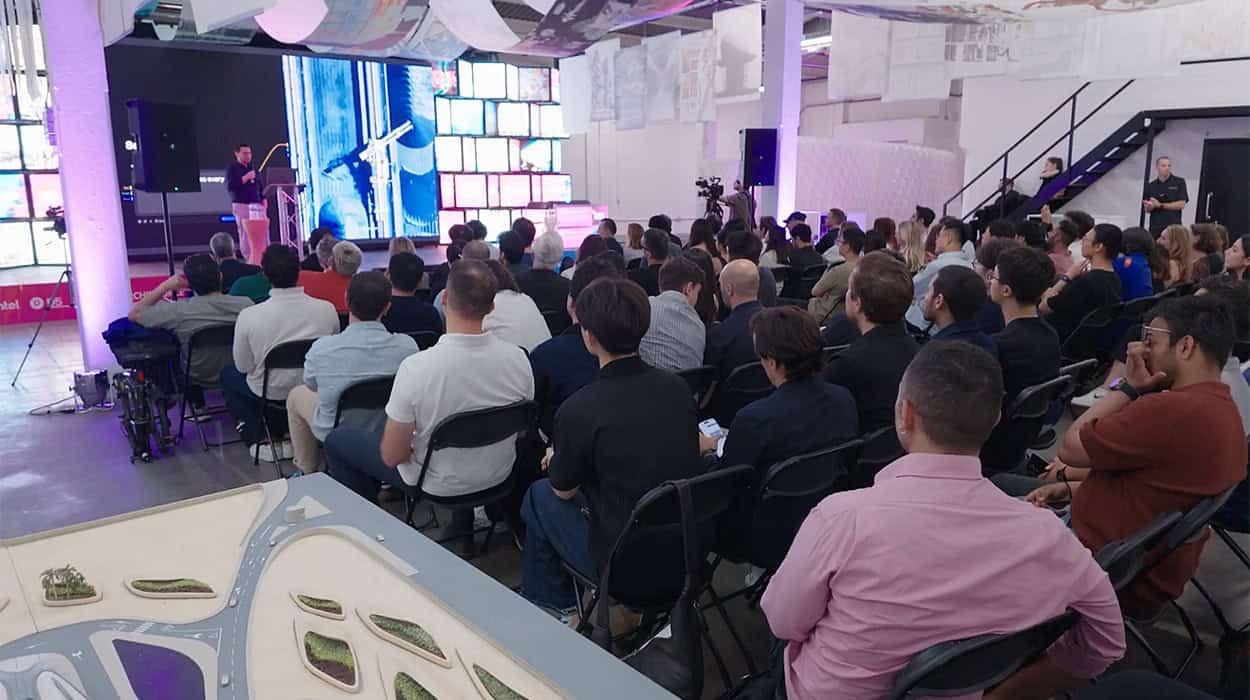
In London, the hackathon team delivered on that goal. They used an AI coding assistant, a technique known as Spec Driven Development, and natural-language prompts to generate code that allowed them to bring the training data and Bentley tech together. The new training platform, accessible through a web portal, leverages Cesium and iTwin reality models for interactive 3D experiences. The team also created a version of the platform that runs on VR headsets like the Apple Vision Pro. Collins provided data and digital twins of actual bridges, while Lovelace guided Bentley Labs’ creative technologists in real time, answering questions about how inspectors would use the tool as the code was being written. “We all just basically worked together for three days to come up with the spec, and then these agents went to work,” Lovelace says.
Though the platform was built for Minnesota, it isn’t limited to MnDOT inspectors. Different U.S. states face different challenges: New Mexico’s bridges contend with heat and drought, while Minnesota’s must withstand harsh winters and road salt. Lovelace says the platform is designed to be customized for each, and he plans to adapt it for other states and eventually other countries. “We didn’t just build one training for one bridge,” Lovelace says. “It’s a platform that can provide training in the future.”
With America’s bridge crisis deepening and the engineering workforce shrinking, that future can’t come soon enough.