
 “What you don’t know CAN hurt you…”
There is a cost that does not appear on your project budgets. It does not show up in your maintenance accounts. It is not captured in your risk registers. And yet it compounds, quietly, with every capital project your organization executes, every modification your operations team makes, and every year that passes without deliberate intervention.
It is the cost of not knowing what you have, where it is, and whether the information describing it can be trusted.
This is the problem of engineering information debt on brownfield infrastructure assets — and it is significantly larger than most executive teams appreciate.
On a typical brownfield asset, engineering and operational information is fragmented across a constellation of repositories that were each implemented to solve a specific problem at a specific point in time, with no overarching architecture connecting them.
There is a maintenance management system — SAP, Maximo, or similar — that contains equipment hierarchies and work order history, but whose records have not been systematically updated to reflect physical changes made over the years. There is a GIS that knows approximately where the assets are, but not to the engineering accuracy needed for design. There is a document management system, or a SharePoint site, or a network drive, containing drawings of variable vintage and unknown currency. There is a process historian containing continuous operating data of extraordinary richness that the engineering team has no practical access to. And there are spreadsheets — an enormous number of spreadsheets — maintained by individuals, containing critical asset data that exists nowhere else and that will be partially or entirely lost when those individuals retire.
 Multiple maintenance management systems— SAP, Maximo, SharePoint, GIS—hinder engineering teams ability to make quick and informed design decisions.
These systems do not talk to each other. The same physical asset has a different identifier in each one. Nobody knows, for any given data attribute, which system contains the authoritative value. And capital projects, rather than improving this situation at handover, typically make it incrementally worse — delivering documents rather than data, transmitting rather than integrating, and departing before the information problem they have inherited and amplified is resolved.
This is the information environment within which your engineering teams are making design decisions, your operators are making safety-critical decisions, and your executives are making capital allocation decisions. The question is not whether this costs money. The question is how much.
There is an industry that solved a version of this problem decades ago, under conditions far more demanding than most infrastructure operators face. It is instructive to understand how, and why.
Boeing, Airbus, NASA, and SpaceX operate in environments where information failure is not a cost overrun. It is a catastrophe. An aircraft that has been built to a drawing that does not match the physical configuration is not a maintenance liability — it is a safety emergency. A launch vehicle assembled from components whose specifications have drifted from their digital records does not deliver a late project — it delivers a mission failure.
 Product Lifecycle Management (PLM) consists of the physical asset, design requirements, and documentation at every stage of that asset’s life.
These organizations developed, over many decades and at enormous investment, a discipline called Product Lifecycle Management — PLM. At its core, PLM is built on a deceptively simple proposition: the digital description of a physical asset must be authoritative, current, and trusted at every stage of that asset’s life, from initial design through to retirement.
When a software development team wants to build a new feature without breaking the working application, they branch the codebase. They take a controlled copy of the current state, work on it in isolation, test it, and then merge it back into the main trunk when it is ready. The main trunk continues operating during this process. The branch tracks its divergence from the trunk. The merge is a deliberate, governed act — not an accident.
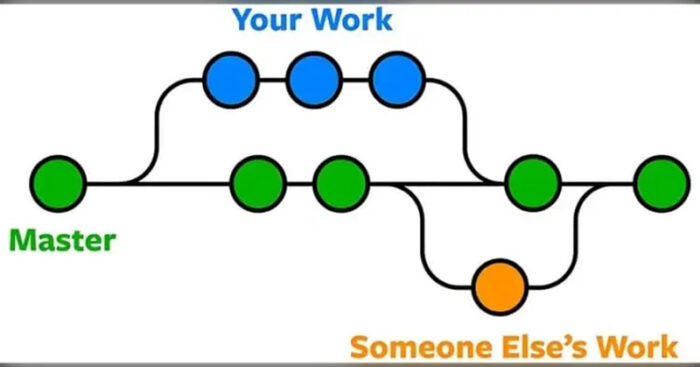
The same logic should govern engineering information on a brownfield capital project. When a project commences, the relevant portion of the asset’s information environment — its drawings, its P&IDs, its equipment records, its data — should be formally branched. The project works from this branch, developing the design and tracking changes against the baseline. The operating asset’s master information environment continues to reflect the as-operated state, updated as operational changes occur. The two are maintained as parallel, simultaneous representations of the same physical systems, with a formal interface governing changes that cross the boundary between them.
Then, as the project moves through commissioning, the branch is progressively merged back into the asset’s master information environment — system by system, milestone by milestone, with verification at each step that the information being returned accurately reflects the physical reality that has been constructed. This is not a single handover event at the end of the project. It is a sequenced, scheduled activity that runs in parallel with the commissioning program and is treated with the same rigour as physical completion milestones.
Where this discipline is applied well, each capital project improves the asset’s information environment. The as-built record is better than what existed before. The data repositories are more complete and more accurate. The operating team takes handover with confidence in the information they have been given.
Where it is not applied — which is most brownfield capital projects today — each project adds physical scope while leaving the information environment in a state of greater fragmentation than it found it. The next project starts from a worse baseline. The cost of that degradation is paid in every project that follows.
The term “digital twin” has been colonized by vendors selling visualization platforms and dashboard tools. This is worth addressing directly, because the vendor framing obscures what is actually valuable about the concept and leads organizations to make technology investments that do not solve the underlying problem.
A digital twin, properly understood, is not a piece of software. It is a business strategy for maintaining a trusted, current, connected digital representation of a physical asset across its entire operational life — including through the capital projects that modify it. The technology is an enabler. The governance, the data standards, the organizational commitment, and the process discipline are what make it work.
 The digital twin workflows lifecycle.
The organizations that have genuinely realized the value of this approach share a common characteristic. They did not start by buying a platform. They started by establishing what information they actually need to operate and maintain their assets reliably, what quality that information needs to be, and who is responsible for maintaining it. They built data standards and enforced them. They created a connected data environment — not a single monolithic system, but a governed set of repositories linked by common asset identifiers and maintained by named custodians with real authority. And they embedded information quality requirements into their capital project contracts with the same rigor as physical completion requirements.
The technology investment followed the governance investment, not the other way around. This sequence matters enormously. A sophisticated platform built on poor data and absent governance will faithfully and expensively replicate the fragmentation it was purchased to solve.
The ROI case for better engineering information management is not complex, though it requires thinking across project cycles rather than within individual project budgets.
When the information environment is reliable, projects start from a better baseline — less time spent verifying existing conditions, fewer unknowns, fewer RFIs and variations driven by information gaps. When data is structured and connected, operational decisions are better — maintenance is more targeted, capacity is better understood, failure risks are better anticipated. When handover is treated as a merge rather than a transmittal, each project builds on the value created by the last rather than compounding the debt.
The aerospace industry did not develop PLM discipline out of an abundance of caution. It developed it because the cost of information failure — in rework, in delays, in liability, and ultimately in safety — exceeded the cost of maintaining the information environment properly. Infrastructure organizations are operating under similar dynamics, at a different risk profile, and most have not yet reached the same conclusion.
The organizations that reach it first will have a structural cost and performance advantage over those that continue to absorb the hidden cost of information debt — one project, one variation, one information failure at a time.
 The aerospace industry developed a PLM discipline to mitigate the cost of information failure.