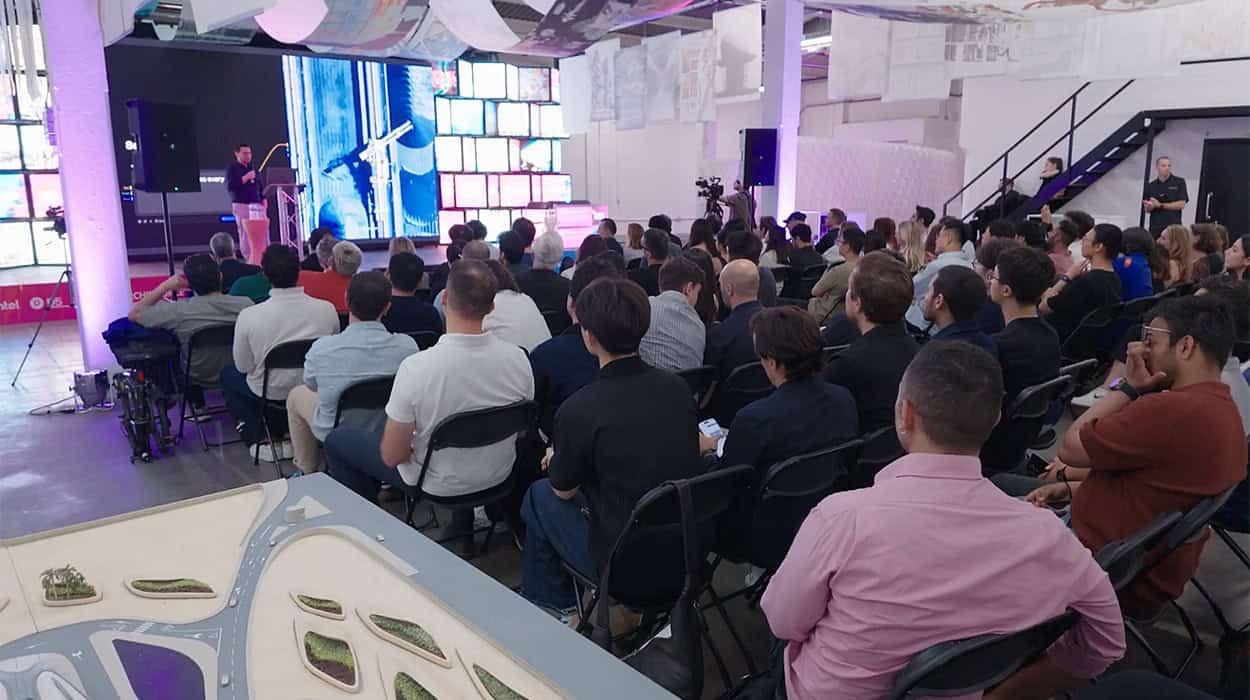
Philippe Block stood on stage inside the cavernous Truman Brewery in London’s hip Brick Lane district. It was a warm Friday evening in mid-July, prime pub hours in this corner of East London. Yet architects, founders, students, and curious visitors kept streaming into the room. They had come for London Creates, a two-year-old festival of architecture, engineering, and design that has quickly become one of the hottest tickets in town. Block was about to give them exactly the kind of idea the festival exists to celebrate.
Behind him flashed an image of an ancient Gothic cathedral, its vaulted ceiling soaring like Westminster Abbey’s, followed by designs for a new office building and a parking garage. He used the odd pairing to pose a question: What if one of the most advanced building technologies of the 21st century was invented 800 years ago?
Block’s answer is Vaulted, a Swiss firm he co-founded three years ago in Zurich, where he teaches architecture and structures at ETH Zurich, the storied engineering school that educated Albert Einstein. Vaulted’s innovation is a prefabricated concrete floor stiffened with interlocking geometric ribs that echo the vaulted ceilings of Gothic cathedrals. While earning his Ph.D. at the Massachusetts Institute of Technology, Block was struck by the ingenuity of the medieval masons who raised those ceilings with no steel to stiffen them and no computers to design them. They made geometry do the hard work of holding up these architectural and cultural marvels that survive across Europe to this day. Their breakthrough was using arches and ribs to channel the ceiling’s weight along graceful curves into the pillars holding it up, letting ordinary stone just a few inches thick span vast spaces. “The thickness of these ceilings is proportionally equivalent to an egg shell,” Block says. “The more I was working on these old structures, the more I realized that we have forgotten quite a bit.”
History Moves in Spirals
Block and his co-founder, the computational design expert Tom Van Mele, aren’t the first to mine the past for the future. The 18th-century Neapolitan philosopher Giambattista Vico argued that history doesn’t march in a straight line but spirals, returning to old concepts with new tools, each pass picking up and carrying forward what the last one left behind. Two centuries later, Martin Heidegger sharpened the idea, arguing that the past does not trail behind us but runs ahead of us. For him, it was a store of possibilities set aside before they were fully used up, waiting to be retrieved when the future is ready for them, like a mothballed gold mine that new technology and rising prices make worth working again. For Block and Van Mele, the Gothic vault is such an opportunity, and with the planet sending us the climate bill for a century of cheap steel and reinforced concrete, they are reopening it.
“We can’t keep building as we are today, or we’ll run out of resources in the near future,” Block said in 2018, when ETH awarded him its Rƶssler Prize for the research that became Vaulted. He and Van Mele translated the masons’ intuition into mathematics, embedded the mathematics in design software, and applied the results to the world’s most common human-made material: concrete.
London Creates attendees interact with an immersive digital twin cityscape.Cement, concreteās main ingredient, alone accounts for roughly 8% of global carbon emissions. Vaulted says floors designed and built with its technology use up to 70% less concrete and 90% less steel than the flat slabs found in most modern buildings. Much of the savings comes from COMPAS, an open-source Python framework for architecture and engineering that Van Mele developed at ETH with his team, which finds shapes that channel a floor’s weight through pure compression, letting Vaulted pour concrete, as Block puts it, “how it wants to be used.” The components are also designed to be taken apart, reused, replaced, and recycled, like Lego blocks.
Architecture's Town Square
Block was one of dozens of presenters at the 10-day London Creates festival, which ran July 16-26. Under this year’s theme, “Creative Intelligence,” the program spanned an entire career arc, from model-making workshops that taught young people to think like architects, to startup showcases, interactive AI displays generating buildings from simple wooden blocks, and talks by leaders of the world’s preeminent firms, including ZHA, Foster + Partners, and KPF. Patrik Schumacher, the ZHA principal, spoke one night about creativity while students on the floor peppered him with questions about launching their own businesses. Some had traveled for hours to be here. The common thread was AI, which architecture and engineeringāindustries that have always prized innovationāare now racing to absorb.
All of it is open to the public for free, and that is the point. London Creates is organized by Archisource, a platform co-founded by Mansel Haynes and Emily Glynn, who launched it with fellow students in 2017, when they had no audience for their own work and no access to the drawings and design thinking of the practices they admired. Archisource went on to launch the Drawing of the Year competition, free to enter and now among the largest of its kind in the world. London Creates applies the same ethos at festival scale. Haynes, who went on to work as an architect at ZHA, put it plainly: “We don’t want any boundaries to creativity.” The showcase is a means, not the end: “Its main purpose is to create discourse, dialogue, and push people to new boundaries in creativity and design.”
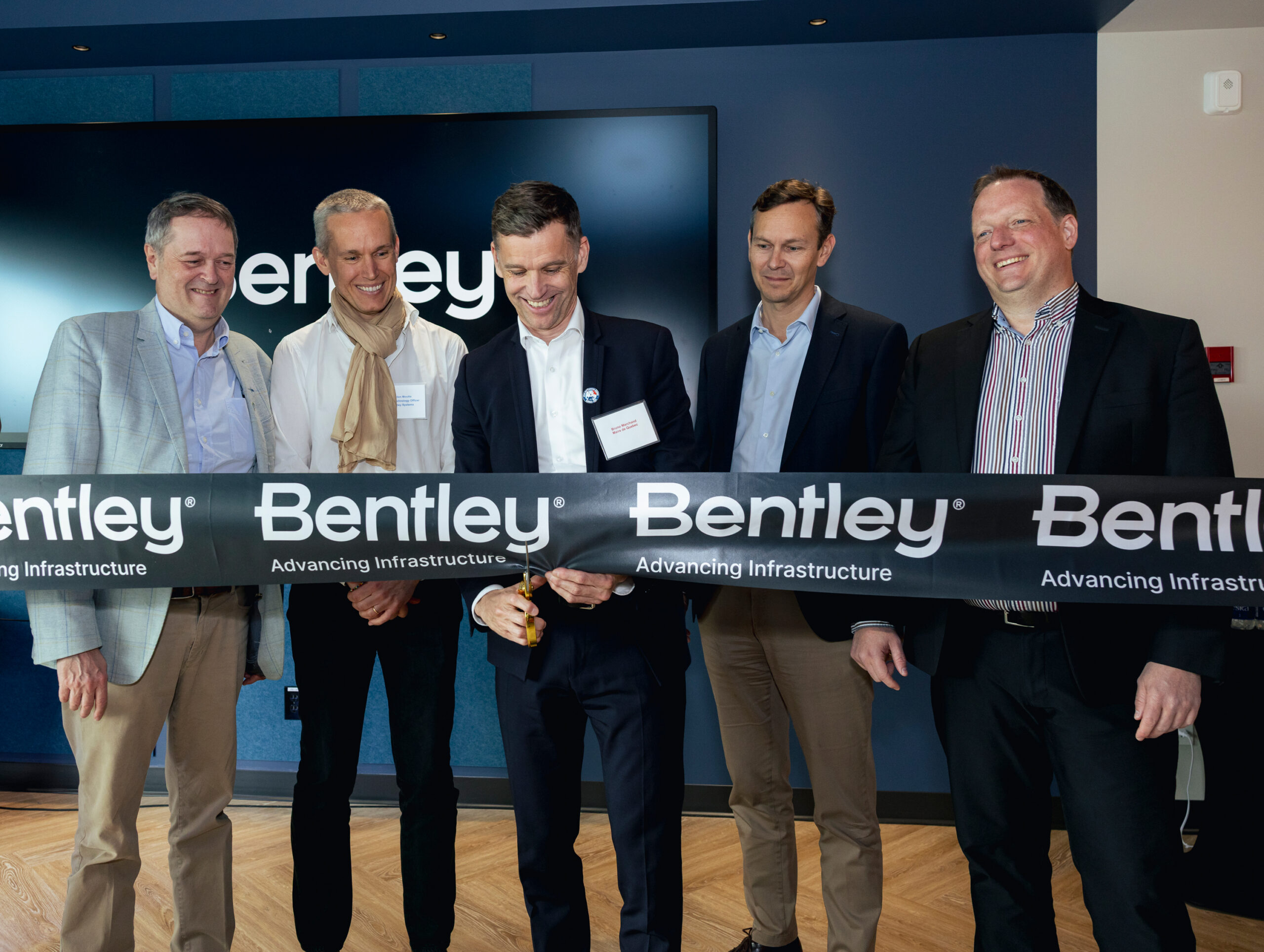
That rich mix is what drew the industry’s hardware and software giants HP and Bentley Systems to sponsor the festival. Greg Demchak, who runs Bentley Labs and is the company’s vice president of emerging technologies, discovered it by accident last year, when he was living in the neighborhood and wandered in. “I was totally blown away by the quality of the content,” he said. For a mature software company like Bentley, he added, staying current means “constantly looking outside of your comfort zone, your bubble, and seeing what’s popping and what’s emerging.” This year he came back as a contributor and a sponsor, building an evening around founders like Block who are moving from architecture and engineering into making the industry’s next tools and launching their own design shops. “We’re here to support innovation and creativity of this next younger generation and see how they’re approaching architecture, engineering, and construction,” Demchak said. “To see what’s motivating them and to help fund and inspire that next generation.”
The Innovation Paradox
During London Creates, Greg Demchak, VP of emerging technologies and head of Bentley Labs, shares how AI is supporting innovation and creativity in architecture and civil engineering.In his own talk, Demchak reached, without planning it, for Block’s eggshell. Tracing the lineage of architects who built their own tools, he began in Italy with Brunelleschi, who figured out how to raise a dome over the Duomo, Florence’s magnificent cathedral of green, white, and pink marble, without relying on scaffolding. When his rivals pressed him to explain his method, the Renaissance master dared them to stand an egg upright on a table. None could. He picked it up, cracked its base flat and stood it there. The solution was so obvious that some accused him of cheating. āIt was obvious only after he did it,ā Demchak says. “This is the innovation paradox.” Innovation, he says, “is always obvious in hindsight.”
The dome Brunelleschi went on to build was a self-supporting shell of herringbone brick. With roughly 4 million bricks in all, it remains the largest masonry dome ever built, and a direct ancestor of the concrete compression structures that Vaulted pours today.
Demchak’s tools tour ran on through GaudĆ, who found the curves of the Sagrada FamĆlia by hanging chains and reading their arcs in a mirror, and ended with a 1962 paper by Douglas Engelbart, who would go on to invent the computer mouse. In the paper, Engelbart envisioned another now-ubiquitous tool: the prompt. He imagined an architect simply describing intent in wordsāa floor slab, a 12-inch concrete wall, an excavationāand watching the structure take shape on screen. Six decades later, that is what AI promises: the designer describing what they want in plain language, and the interface itself, all those menus, buttons, and tools dissolving away. It is a vision Demchak’s fellow MIT alumnus Nicholas Negroponte championed for more than a generation.
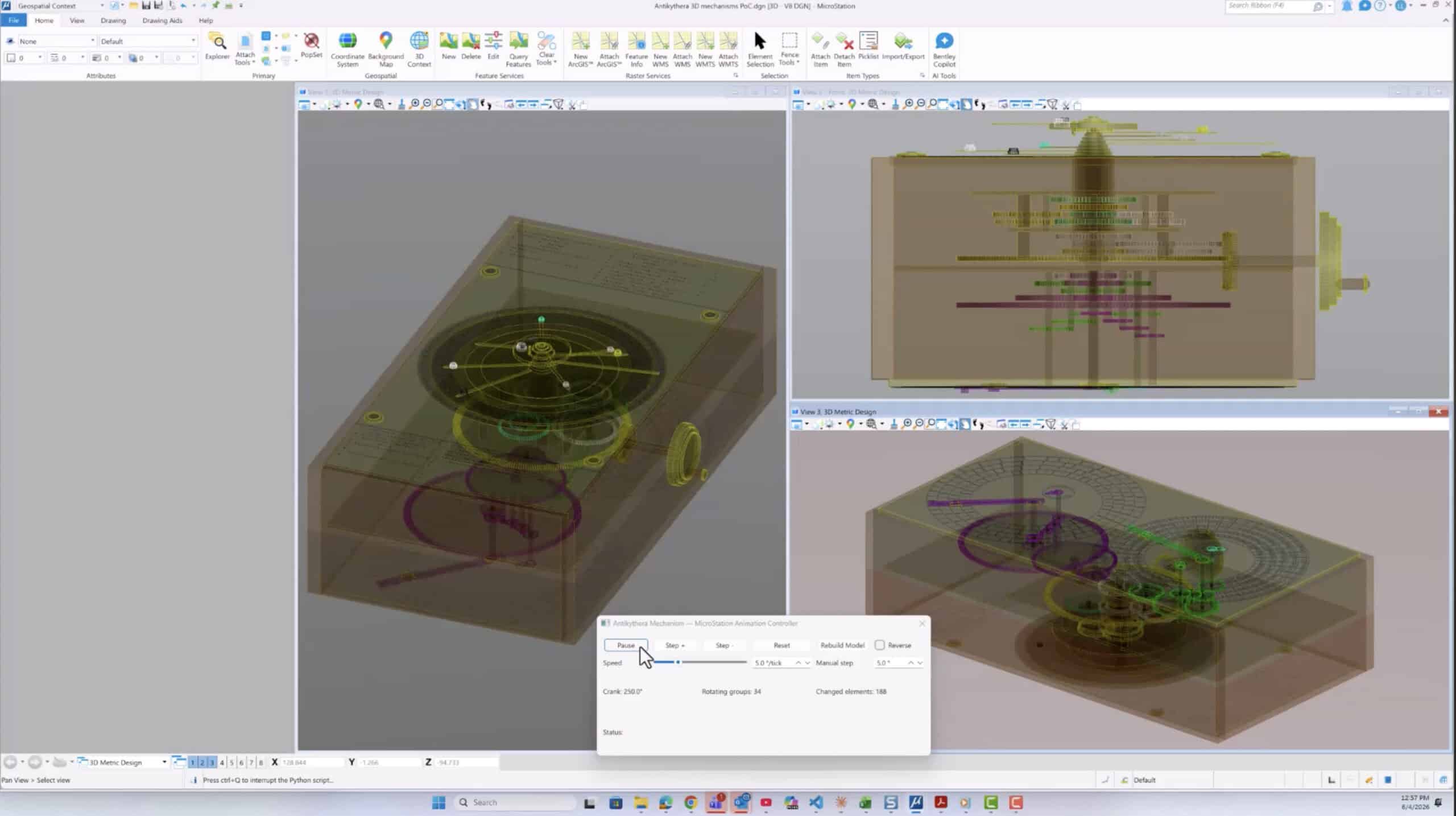
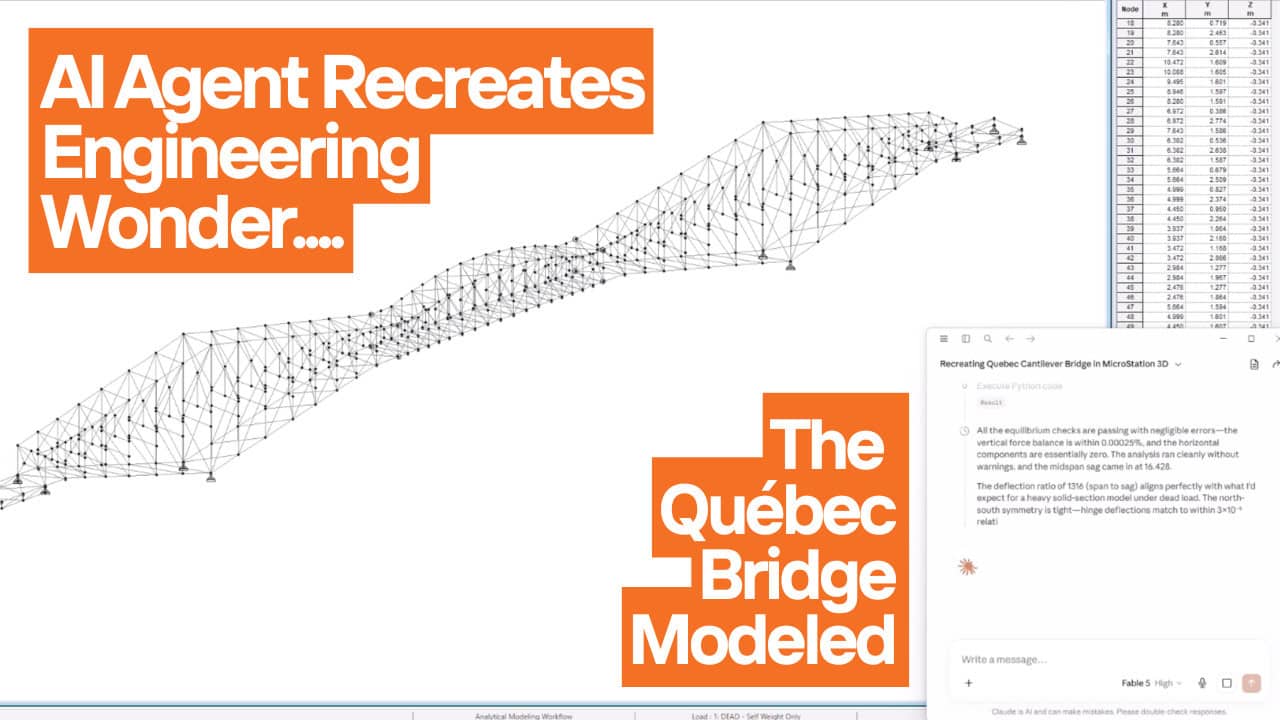
With AI now entering architecture and civil engineering, that vision is becoming reality. The lineage Demchak traced also produced the Gherkin, the beloved bullet-shaped tower in the City of London and a prime example of parametric design, which encoded the plan as a set of dependent variables rather than as static geometry. It was designed with the help of Bentley software, and Stuart Milne, a member of its original design team, recently recreated its form with AI.
“What is the next egg that we as an architecture body need to crack?” Demchak asked. “What is the thing that might already be existing in plain sight, but we just haven’t realized it yet?”
From Brunelleschi to Brunel and Beyond
Alain Waha, chief technology officer of the global engineering firm Buro Happold, adds another builder to the lineage: Isambard Kingdom Brunel, the British engineer whose railways, bridges, and steamships remade the Victorian world. “Last time things were as exciting as this, Brunel was building railways,” Waha said. Cities, he argues, are “systems of systems.” Propose a new skyscraper and engineers have to work out how it will change traffic, where they will find the steel to build it, which factory will supply that steel, and whether robots can pre-assemble it. A drawing answers only some of those questions. By Waha’s reckoning, we still plan cities barely faster than the Victorians did. “We have come to the limit of what human brains can do with drawings and the technology of our forebears.”
What makes it a Brunel-scale moment for Waha is not the technology itself, but who can use it. Early adopters always build the first tools, Waha said, but “the radical democratization comes from the software vendors making those technologies less experimental and making them business as usual.” He uses music as an example. Recording a song today is a fully digital process. The first electronic musicians had to know how to get inside the machine, but now anyone can do it. “You’re not less creative, you’re more creative,” he says. That is what he wants from engineering software companies like Bentley: Make describing a building to a computer as ordinary as making a track on a laptop.
Engineering has one constraint music does not: Physics allows no approximation or hallucination. A structure either carries its load or it fails. Waha wants models that turn what a designer asks for into something deterministic that an engineer can check. The AI handles the translation, but the verification stays human.
A Partner, Thinker, but Still a Student
Inside the big firms, the AI transition already has job titles. Anna Mytcul, an applied technology specialist at KPF in London, spends her days filtering the torrent of new tools and teaching her colleagues around the world how to use them. “The whole idea of the profession is changing,” she said. “The way we educate is changing, the way we work is changing. If we don’t share, we will end up in silos.” Her formula for AI is a hedged embrace: AI is “a partner thinker, but still a student” that is tested, cross-checked, never fully trusted, and adopted from the bottom up. Her one-line review of London Creates doubled as its motto: “Sharing is caring.”
Sharing plus software makes possible the subtext of Friday evening’s most personal talk by Mariana Cabugueira, a London-based architect who founded [MC] Studios, her own international practice, after years inside larger offices including ZHA. She shared during the founders’ session an insight no one had told her. Her studio employs six people and designs towers around the world. “AI and technology does allow you to compete with small numbers against large numbers,” she said. “Projects in which I know offices are going with 20-people teams, 15-people teams, I go with a three-people team. And we’re winning.” She lets her designers express their craft. āThat’s part of our identity,” she says. But she deploys AI downstream, multiplying their output, such as project images and visualizations, “to deliver quantity when their human capacity would not be able to.”
Fresh Off the Train
The students in the audience heard her. Tara Haddadian, an architecture student at the University of East London, came because she follows Cabugueira on social media: “She was my inspiration.” Francesca Kiprianidis found the antidote to AI anxiety in the room itself: “AI can be scary … but understanding that people are trying to work with it and improve it every day, it’s encouraging. It says, OK, this is actually becoming our reality now.” And Burhan Touheed Khan, who traveled from Manchester with his brother Dayan the day after his graduation, shrugged off the fear entirely: “I don’t think AI is going to take away our jobs. We’re going to learn new ways to use it, make it part of our workflows, make new tools with it.” His brother put it in terms any architecture student would recognize: Grasshopper, a piece of parametric modeling software, was a learning curve, too. AI is “just another part of architecture we’re going to have to learn to be part of.”
That may be the essence of London Creates and of the change-making gatherings that will follow it. From Brunelleschi’s egg to Block’s vaults, the future of design and construction keeps turning out to be something the discipline already knows. It’s waiting in plain sight for someone to pick it up and crack it open. The next person to do it may well have been in the room, taking notes, fresh off the train from Manchester.
FAQ
London Creates by Archisource, celebrates innovation in architecture, engineering, and design. The event, sponsored by Bentley Systems, hosts workshops, startup showcases and interactive AI displays, with the ultimate goal of removing barriers to creativity and sparking fresh dialogue in the AEC industry.
The innovation paradox is the phenomenon where groundbreaking ideas are perfectly obvious, but only in hindsight. He illustrates this with Renaissance master Brunelleschi, who famously cracked the base of an egg to make it stand uprightāa brilliantly simple solution that his rivals couldn’t see until he did it right in front of them.
By reviving the structural intuition of medieval masons, Swiss firm Vaulted creates prefabricated floors stiffened with interlocking geometric ribs. These ribs channel weight through pure compression along graceful curves to the supporting pillars, eliminating the need for heavy steel reinforcement. This geometric trick allows floors to use up to 70% less concrete and 90% less steel, significantly lowering the industry’s carbon footprint.