Twenty-six years ago, on the first construction project of his career, Ricardo Munguia Alvarez asked for the drawings of the building he was working on. When he laid his engineering plans for the structure, utilities, and mechanical systems over the architectural blueprint, nothing matched.
“I remember going to the architect: ‘Hey, look, you’ve placed a bathroom in the middle of a structural column,'” he says. “He took a pencil and changed the whole architectural layout in front of us in 30 minutes, without considering the structure, the utilities, anything. And we just delivered, with all that uncertainty, and everybody accepted the risk, the responsibility, the cost, everything. You cannot imagine that now.”
Munguia is now global head of digital construction and data management at Ferrovial, the global infrastructure company. His job, in essence, is to make sure the pencil never comes out again.
A Bright Light in a Madrid Attic
Ferrovial is now valued at roughly $45 billion and joined the Nasdaq-100 index last year. But the company started modestly in 1952, in an attic office in Madrid, replacing wooden railroad ties for Spain’s national railway. From there, it quickly gathered speed: By 1958, its crews were laying 18 miles of track in 30 days. Ferrovial went on to build the Guggenheim Museum Bilbao, Frank Gehry’s billowing landmark clad in 33,000 titanium panels. Holding up the museum took sinking 665 concrete piles into rock. And in 1999, Ferrovial made the bet that defines it today: The company won a 99-year concession to run Toronto’s Highway 407, the world’s first all-electronic, barrier-free toll road. There are still about 72 years left on that contract, longer than the company had existed when it signed.
Ferrovial is also a family story. Founder Rafael del Pino y Moreno sent his son Rafael del Pino Calvo-Sotelo—the current chairman—to apprentice on a project in the Libyan desert, the toughest posting Ferrovial had. Next, the younger del Pino polished the experience by earning an MBA from the Massachusetts Institute of Technology. That son later dispatched his own son to help run a Dallas highway before bringing him onto the board. Three generations of executives, every one of them schooled in the dirt first.

A business model with no room for error on Nasdaq
Ferrovial has long prided itself on entrepreneurship and innovation, and the Highway 407 deal turned it into a new breed of infrastructure company: an enterprise that designs, finances, builds, and then operates infrastructure for decades. In the U.S. alone, these assets include toll highways in Texas and North Carolina, and the New Terminal One at New York’s JFK airport. The terminal is a $9.5 billion, 2.4-million-square-foot international facility currently under construction, with partners including state departments of transportation and the Port Authority of New York and New Jersey. By stock-market value, Ferrovial ranks second among construction companies in Europe and fifth in the world, according to a recent presentation.
The economics of the business model are compelling. Ferrovial’s concessions run 35 to 72 years, and the company estimates that operating highways accounts for about 80% of its stock-market value because the projects throw off predictable—and generally rising—toll revenue for generations. By controlling design, construction, and operations under one roof—its construction business delivers projects to Cintra, its concessions arm—Ferrovial captures value at every stage. Each retired risk lowers the discount rate that investors apply to decades of future tolls, creating value without pouring another yard of concrete, Munguia explained at Bentley’s Illuminate conference in Berlin in April.
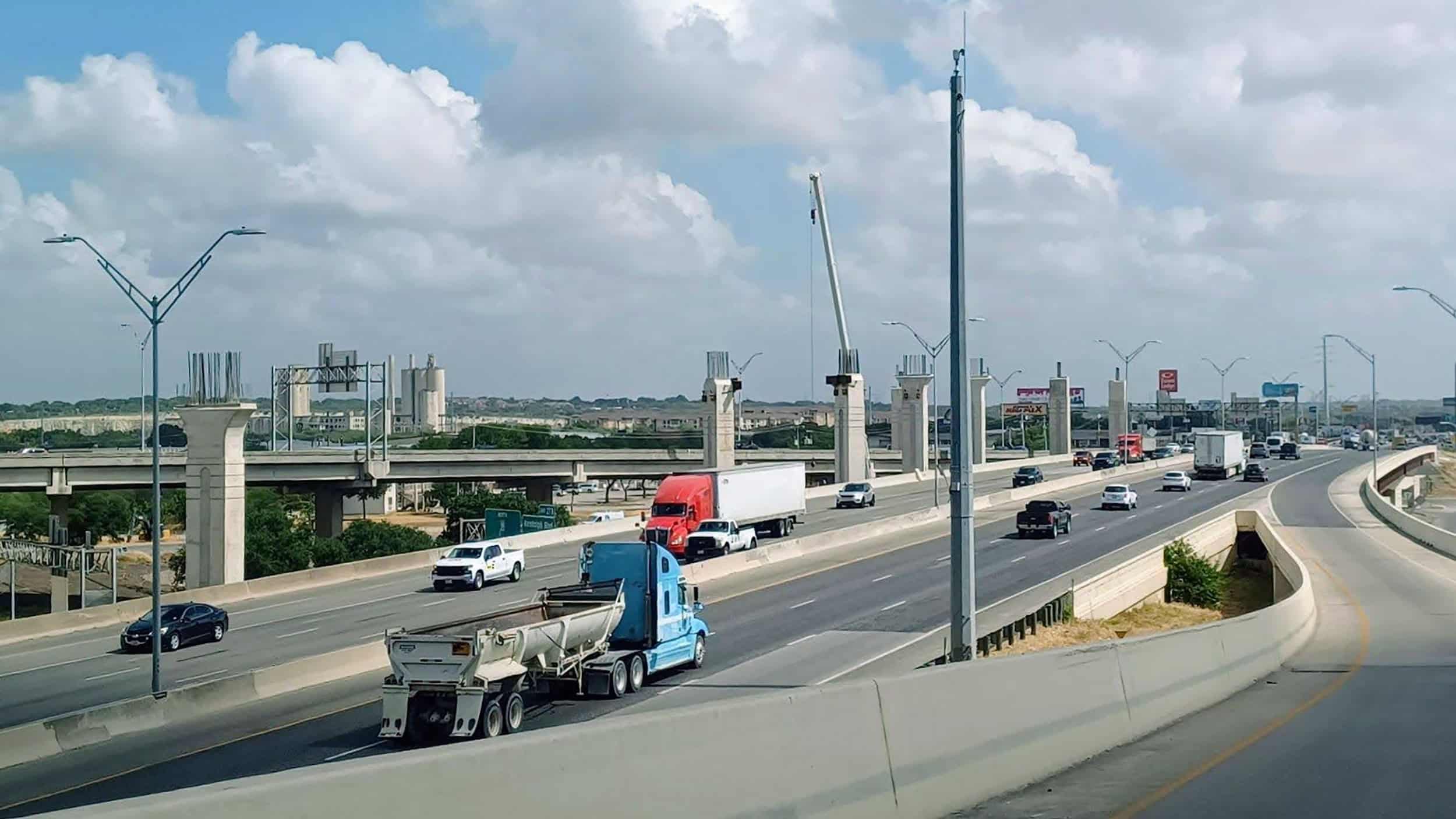
But the model is unforgiving, as delay and lost revenue compound each other. A missed deadline can be a triple financial whammy: cost overruns on the build, lost toll revenue from an unfinished asset, and an earnings miss that can spook the market and raise the cost of financing the next project. Consider the Interstate 77 Express Lanes in Charlotte, North Carolina. The $697.9 million project is a 26-mile public-private partnership with the North Carolina Department of Transportation that Ferrovial’s local company financed, designed, built, and now operates under a concession running to 2069, according to its website. The lanes opened in 2019, about a year behind the original schedule, after weather and supply-chain setbacks. That translates to a year of tolls that never came back.
“Remember that even though I am in construction, our main revenues come from concessions,” Munguia says. “We are the developer; we take the risk in our concessions.”
Technology, he argues, is how the company de-risks that bet.
Billions at stake, not enough builders
The pencil-and-redraw era died for good reasons. Projects now arrive wrapped in claims, environmental mandates, and contract requirements, demanding far more work before construction crews start digging. “These projects, we are talking about billions of investment, you cannot do the same without technology, without data, without digitalization,” Munguia says. At the same time, the industry is running out of people: “There are not enough civil engineers, architects, data specialists, labor,” he says. And demand for infrastructure keeps growing. The World Economic Forum estimates a $15 trillion gap between current infrastructure investment and what the world will need by 2040.
When he took over Ferrovial’s data department in 2021, Munguia spent months drawing up a company-wide data strategy with graduate students and professors from the MIT Sloan School of Management. (The company has supported the university since the chairman studied there.) The validation of the plan came in late 2021 in Houston, on the Grand Parkway toll road. There, Munguia ran into an old acquaintance from Chile who was managing survey work on a 14-mile stretch of highway with a single assistant, using drones, LiDAR, and Bentley Systems’ OpenRoads civil-design software.
“I asked him, ‘Why are you implementing all these things?’ And he said, ‘Look, we are two people. Without technology, it’s impossible to manage all this. I don’t care about cost, I would need 10 people to do this work without the technology.'”
That became the doctrine and the strategy launched by the company in 2022, with one core principle: digitalize every project the same way. “Technology is a way to manage a huge amount of information, to deliver better, to make fewer mistakes, and to focus on the priority, which is not the manual processes but the management process,” Munguia says.
The proof is in Texas. In May, the company won a new construction contract on the Grand Parkway toll road valued at about $1.5 billion.

The End of Starting Over
The backbone of Munguia’s strategy is software from Bentley Systems, the global infrastructure engineering software company. Designs live in ProjectWise, Bentley’s collaboration platform—a single shared home for engineering data—and the same data stays there through construction. Ferrovial’s nearly 800 in-house design engineers—a rarity among contractors, and a competitive weapon in bidding—work in the same environment as the field teams.
The payoff is the demise of one of construction’s oldest rituals: losing data at every handoff, then paying engineers to recreate what already existed. Typically, surveyors receive 2D drawings from an outside design firm and then build the entire project as a 3D model in OpenRoads. That can translate into three to four months spent reconstructing information the designers had all along. At Ferrovial, all the data is one place. “If you have the same information during design and construction, quantities, for example, there is no debate,” Munguia says. “You don’t have to work out why I’m saying 10 and the other guy said eight.”
The digital thread runs past ribbon-cutting. Ferrovial and its toll road subsidiary Cintra spent months defining exactly what asset data operations would need, so the model is ready for maintenance from the first design stage. Ferrovial’s own asset-management tool reads data directly from ProjectWise, and the link runs in both directions: move a traffic signal in the field, and the model updates. Machine operators see the 3D model on tablets; surveyors can view it through augmented reality. Paper drawings still get produced, but mostly because state department of transportation contracts require them.
A Partnership Sealed in Valencia
Bentley is not the only company in Ferrovial’s software stack, but the two have a special relationship that has quickly evolved over the last five years. When Ferrovial started using Bentley software, the company was just another vendor. But as Bentley’s software grew central to Ferrovial’s plans, Munguia wanted a true partnership. And because Ferrovial operates around the world while Bentley ran separate regional fiefdoms, that meant changing how Bentley did business, too.
Munguia found his moment at an industry conference in Valencia, when he happened to be seated on stage next to Julien Moutte, Bentley’s chief technology officer. He had just presented Ferrovial’s technology map and strategy. With Moutte beside him, he extended a public invitation: Ferrovial was ready for something deeper than a vendor contract. “When the presentation ended, he said, ‘I heard you. I will figure out how to get it done,'” Munguia recalls. Moutte’s fix reached across Bentley’s own org chart, uniting its U.S. and European teams behind one agreement. “He managed to align things internally on his side, I was able to align things on ours, and we signed the new agreement. That has enabled a lot of collaboration, and I feel we are working very well together. So Julien is part of our success.”
The partnership illustrates the power and benefits of working with the industry’s innovative users. “Ferrovial is a trailblazer: They already cover the whole lifecycle of an infrastructure asset, from design to build to operate,” Moutte says. “That puts them in the best position to understand the value of a continuous digital thread.”

The AI Dividend
All that connected data is now paying a dividend: It is exactly what artificial intelligence needs. Ferrovial has rolled out tools like Copilot and Claude to office staff and built its own construction AI platform. The company pools its project data in one repository where every piece is labeled and linked: one number is a quantity of concrete; another record is a traffic signal and its vendor. This “semantic model” allows an AI agent to know not just the data, but what it means.
The next step is the Model Context Protocol, or MCP, an open-source standard that lets AI agents talk to other software. An MCP server is the connector that plugs an agent into a specific program. Bentley is building them for ProjectWise and other products, and Ferrovial has asked for early access. In effect, the servers are a bridge between a civil engineer who can express intent in plain words and software that once demanded specialists: ask an agent how the design is progressing, query quantities or clashes, and get an answer drawn from the model. The human always stays in the loop.
Ferrovial’s roadmap already has a name for the destination—the “agentic site,” where AI agents work alongside construction crews. “I’m sure in the future it will be AI,” Munguia says. “You will ask a device: ‘Hey, tell me, what’s the progress on the construction site?’ And it will answer you.”
By boosting efficiency and enabling new AI workflows, the technology will also help chip away at the engineering shortage problem.
More than seven decades separate the Madrid attic where Ferrovial mortised railroad ties and the digital model that will hand JFK’s Terminal One to its operators. The pencil was the old way of talking to a project, and Munguia already knows what’s next. “AI will be the new human interface with technology,” he says.
FAQ:
Ferrovial organizes its project information into a labeled semantic model so artificial intelligence tools can understand the specific meaning of project data. By using Model Context Protocol (MCP) servers, open-source connectors plug AI agents directly into engineering software like ProjectWise. This allows civil engineers to query design progress, clashes, or material quantities using plain language, moving toward a future agentic site where AI works directly alongside construction crews.
Ferrovial uses Bentley software like ProjectWise and OpenRoads to maintain a single digital thread across the asset lifecycle. Design and field teams work in the same shared environment, eliminating data loss during handoffs and keeping operational models synced with real-world site updates.
Because operating long-term concessions accounts for roughly 80% of Ferrovial’s stock-market value, delivering projects on schedule is a financial imperative. Missing a deadline leads to cost overruns, forfeits expected toll revenue, and raises the cost of financing future projects.