
She spoke to the right crowd because the event host, Cesium, has a fix in mind. The 3D geospatial company, acquired by Bentley Systems in 2024, builds open technology for streaming, gathering, and visualizing enormous amounts of 3D geospatial and other data. Its founder, Patrick Cozzi, now Bentley’s chief platform officer, said the point of bringing Cesium and Bentley together was to create an open platform where developers could assemble comprehensive digital twins of the entire physical world, from natural terrain and subsurface conditions to the roads, bridges, and buildings that people design, build, and manage over time.
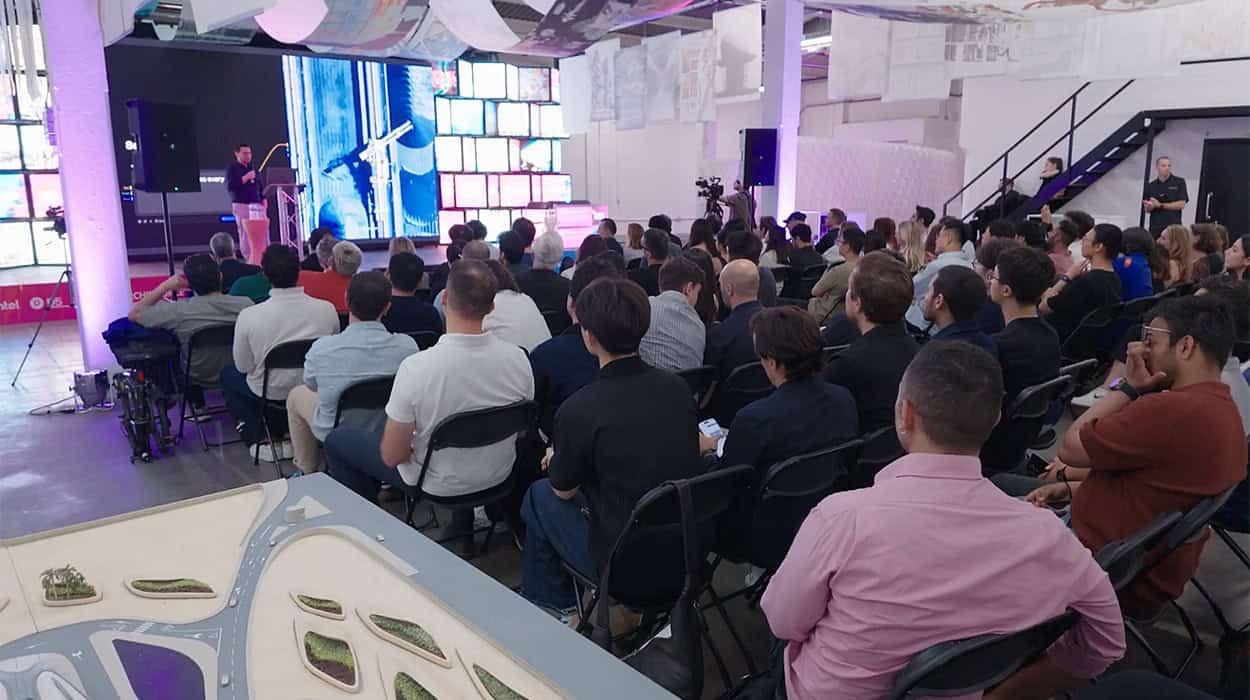
 Patrick Cozzi, Bentley Systems’ chief platform officer, shares the new design model formats in Cesium ion during the 2026 Cesium Developer Conference.
That ambition—and the question of what happens when 3D visualization, engineering data, and AI all work together—drew developers from many different fields to the Philadelphia conference. The event, which Cozzi hosted in his hometown, featured about 80 presenters, three-quarters of them from the community. He described it as a celebration of the 3D geospatial community, built on “inspiration, idea sharing, and gaining knowledge.”
Not surprisingly, one of the biggest themes this year was artificial intelligence. “We’re seeing AI go from experimentation to production, and when you look at the opportunities that we have for building in our platform, they’re pretty endless,” Cozzi said. Experienced developers who already know how to work with Cesium can combine their domain knowledge with agentic AI to move faster, he said, while community members who have big ideas but little programming experience can lean on AI agents to build prototypes. “It’s really cool to see AI bringing new creators and new developers into the ecosystem,” Cozzi said.
Much of the technical news came from Amanda Morgan, Bentley’s senior director for open standards, who co-chairs a working group at the Khronos Group, an industry consortium. She highlighted 3D Tiles 2.0, a coming standard with features such as voxels and extensions designed to bridge building information models and the wider geospatial world. A centerpiece is Gaussian splatting, a technique that turns ordinary photographs into strikingly realistic 3D scenes, capturing fine details like wires and fences that older methods miss.
 3D Gaussian splats enable high-fidelity accurate visualizations of thin-and-long assets like cranes, building materials, power stations, and cell towers. This crane is depicted with Cesium for Unreal.
That realism, paired with AI, was on display in one demonstration where iTwin Capture and AI worked together to track changes across sprawling Gaussian splats of an entire oil refinery. “We focus on the key technology and then we compete on the implementation,” Morgan said.
For many conference attendees, the draw was as much the crowd as the code. Steven Phillips, an independent visualization developer, called the gathering “passionate.” Epic Games’ Alban Bangerre, who traveled from Montreal, summed it up in a single word: “community.”
Williams, the expert from Kimley-Horn, said the event started with “innovative, visionary, the art of the possibility,” and then kept going. “This conference is really cool, and it’s different from anything that I ever attend, because I generally go to engineering conferences or state DOT conferences,” she said. “To be at a developers’ conference where you’re getting that front end and those intelligent minds all working towards the same goal, it’s really exciting and it’s invigorating. It’s just exciting to see and interact with people who are helping us make the impossible possible.”