Oliver Thomas spent two decades watching architects struggle with their software—so he started a movement.
The British architect, who worked at major global firms before launching his own companies, founded the Archi-Tech Network (ATN), a global community for architects, technologists, and designers. ATN is focusing on the intersection of architecture, technology, and entrepreneurship, and Thomas’ mission is to help a new generation of architects develop useful technical and entrepreneurial skills. Thomas, who serves as ATN’s CEO, is also pushing software companies to make their products more open and interoperable, so teams can work better together with seamless workflows.
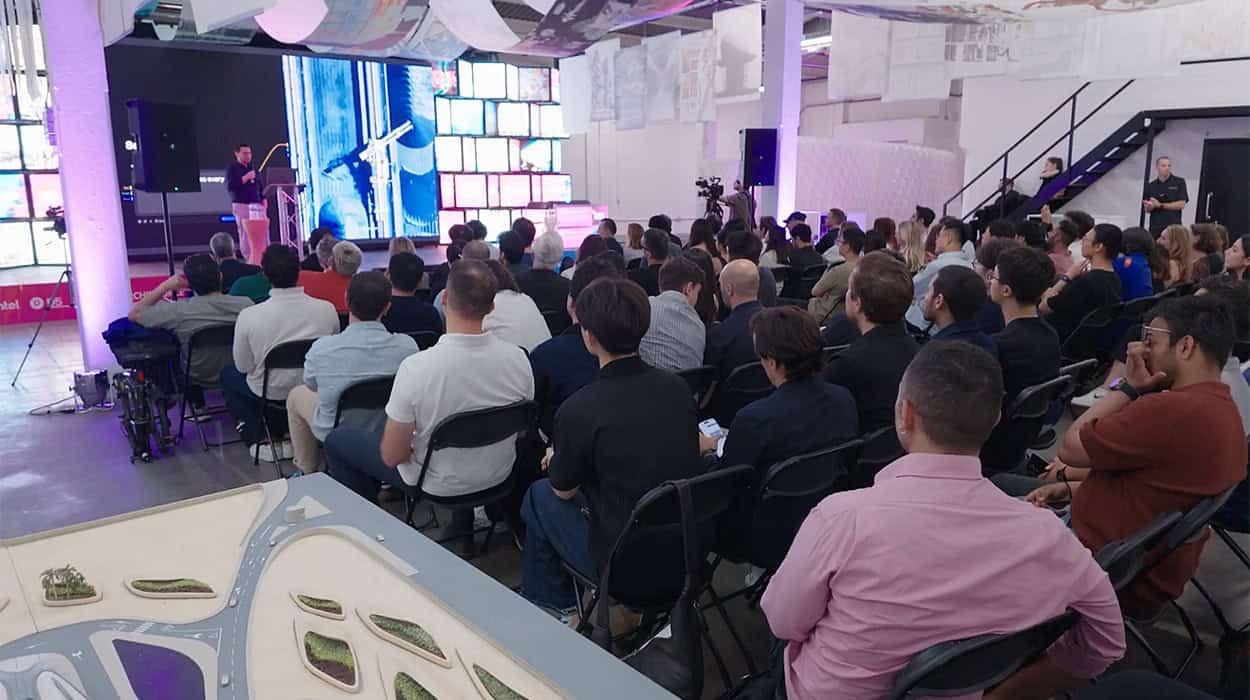
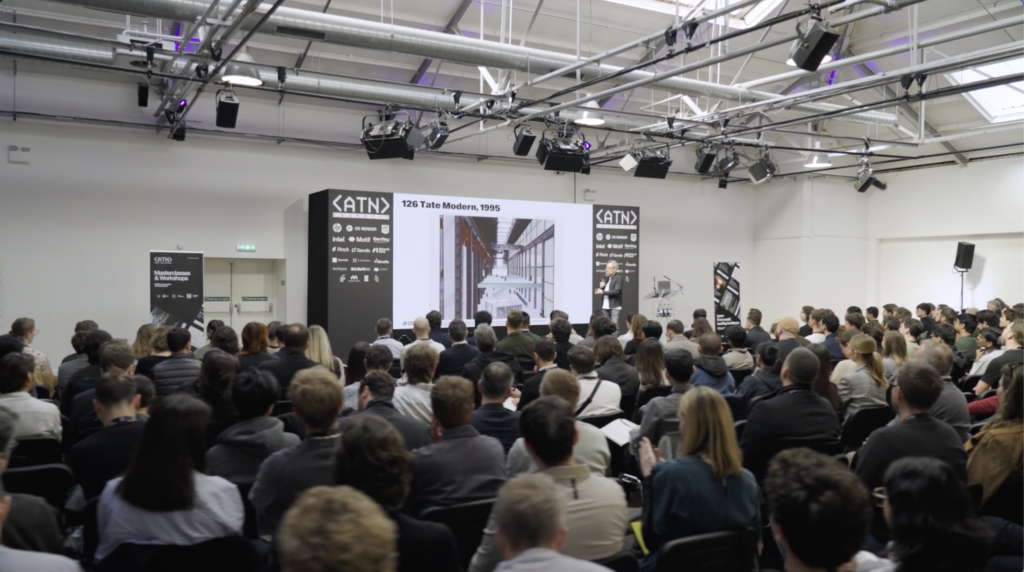
The movement is striking a nerve. ATN has reached more than 100,000 people through its training, podcasts, videos, and events. In March, ATN held a week full of events in London, including the first ATN Summit in the city’s trendy Shoreditch district. More than 500 architecture activists gathered for two days in the area’s Protein Studios to demand software be built around interoperability and open data, debate the role of artificial intelligence (AI) in design, and confront the industry’s big challenges, including how technology will reshape the built world.
“A lot of people are unhappy with the tools they’re using,” Thomas says. “People are trying to disrupt the space with online platforms hosted in the cloud [which are] intuitive to use, collaborative and open, with joined-up workflows, so everyone can be in the design at the same time.”
A Movement Finds Its Footing
ATN draws its power from an informal, knowledge-sharing approach. The network regularly uses the PechaKucha format—a Japanese storytelling presentation style—to let members share ideas, form partnerships, and build relationships.
On the eve of the Summit, about 50 ATN members gathered on the 43rd floor of 8 Bishopsgate, Bentley Systems’ London office high above the city. They shared their latest developments and breakthroughs over sweeping views of the city.
Its storytelling bent served as a fitting prelude to the summit itself, which was held one block from the site of Shakespeare’s first London theater. The event opened with a challenge. Aaron Perry, head of industry strategy at Qonic and co-author of the influential Future AEC Software Specification paper, took the main stage first. The paper, backed by 28 architecture firms, lays out what the profession wants: a common data framework, collaborative modeling capabilities, charging for usage rather than subscription, and software that can handle modern prefabrication and modular construction methods. Perry argued that architects spend too much of their day toggling between disconnected software programs that limit collaboration, require lengthy rework, and produce painfully slow renderings.
AI Will Not Replace the Architect
One of the Summit’s most anticipated speakers was Martha Tsigkari, senior partner and head of applied research and development at Foster + Partners. Tsigkari has spent years researching deep neural networks and genetic algorithms in design, working on everything from responsive materials to performance-driven urban planning. She addressed the profession’s anxiety about AI.
Human empathy, she argued, is the one thing a machine will never replicate. “AI will never feel the cold in a poorly heated building,” she said. “AI will never understand the nuance in a contentious client meeting and be able to be truly reassuring. Only a human will be able to read between the lines and truly understand what’s going on. Only humans can actually experience the impact of architects’ work.”
Later, Sanne van der Burgh, who leads research, development, and climate work at MVRDV, showed how her firm and others are advancing the quantification of climate impact from building designs, including through the open CarbonSpace platform—another example of the open, collaborative ethos driving the movement.
Bringing the Stakes to Life
The software debate extends beyond the profession. Nowhere was that clearer than in the immersive experience that Bentley brought to the summit.
When Hurricane Sandy struck New York City in 2012, it knocked out power across lower Manhattan, flooded streets, took dozens of lives, and caused an estimated $19 billion in property damage. One of the city’s responses is a carefully engineered coastal resiliency project involving several architecture and engineering firms like the Bjarke Ingels Group and Arcadis. One section of the project, designed with help from Bentley software, includes walls and gates protecting populous neighborhoods and key infrastructure like a power plant in downtown Manhattan operated by ConEd, New York City’s primary electricity provider supplying some 10 million people across the metropolitan area. During Hurricane Sandy, water flooded the power plant, forcing ConEd to cut power to much of lower Manhattan for several days.
Bentley’s iLab team, working with National Geographic photographer Aaron Huey and Bentley chief storyteller Tomas Kellner, built a virtual reality experience that placed ATN Summit attendees inside that story. “Aaron used a 3D camera to capture aspects of the lower Manhattan coastal resiliency project,” Kellner explained. Greg Demchak, Bentley’s vice president of emerging technologies and iLab, and his team then worked with Huey to turn these 3D photographic point clouds into Gaussian splats—the latest 3D visualization technology—and put them into the Unreal Engine, an immersive game-like environment. The result could be explored inside Apple Vision Pro headsets or projected floor-to-ceiling onto the walls of the iLab space at the Summit.
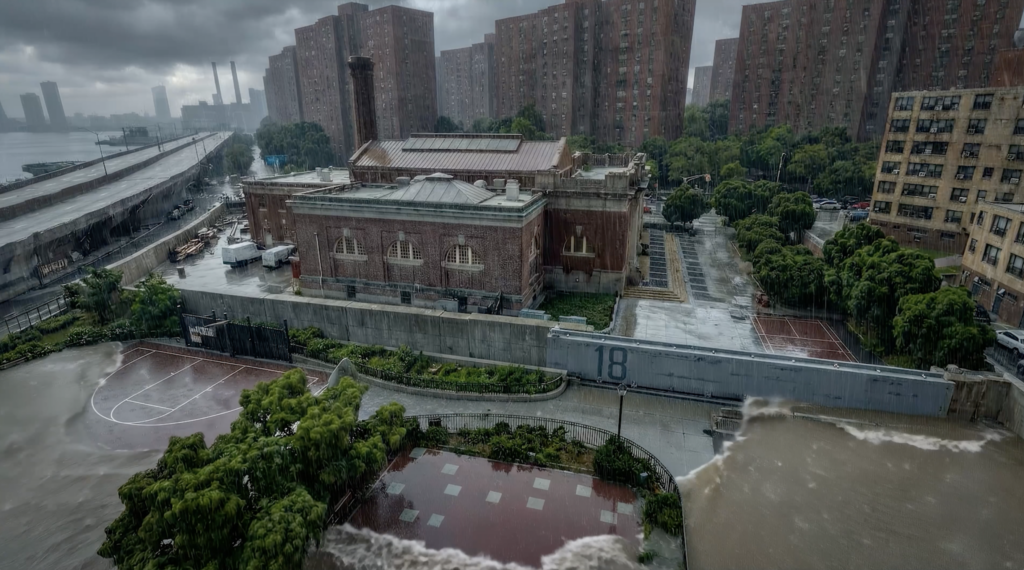
The experience transported viewers into the ConEd power station operations room, which flooded during Hurricane Sandy and knocked the power plant offline, causing large sections of downtown Manhattan to lose power for days. Standing waist-deep in virtual floodwater, participants could then watch how the new flood defenses work when the next storm arrives: gates swinging and slowly sliding shut, sports pitches filling with water and holding it away from the streets. The city, this time, is ready.
“The civic infrastructure built one to two hundred years ago was often created with beauty and pride, and represented a genuine leap forward for city dwellers,” said Demchak. “I like to think that this kind of visualization is part of a new era of pride in civic infrastructure. We are enabling stakeholders to experience how the storm gates will work when they are most needed—something very few people should ever have to witness firsthand. We’re doing it with open tools and open data formats, and that really makes an architect’s user experience easier and faster.”
For the architects packed into Protein Studios in London, it was a visceral reminder of what is actually at stake—not just better software, but better cities built for a more unpredictable world.
FAQ:
The Archi-Tech Network (ATN) is a global movement founded by British architect and entrepreneur Oliver Thomas to bridge the gap between architecture, technology, and entrepreneurship. With a reach of over 100,000 people, Thomas and the ATN are pushing for a future where design software is more open, intuitive, and collaborative.
Many architects are frustrated with disconnected programs that force them to toggle between windows, leading to redundant rework and sluggish rendering speeds. To fix this, leaders like Aaron Perry are advocating for a common data framework and software that supports modern prefabrication and modular construction through interoperability.
Bentley’s iLab team used 3D camera captures and “Gaussian splat” visualization technology to create a virtual reality experience of lower Manhattan’s coastal resiliency project. Participants wearing Apple Vision Pro headsets could stand waist-deep in virtual floodwater to witness how new storm gates and flood defenses protect the city’s power grid.