The 2026 FIFA World Cup will be contested in 16 stadiums across North America, making it the most geographically expansive tournament in the competition’s history. To help showcase the event, Bentley Systems built an interactive 3D experience of each stadium using Cesium’s open-source geospatial technology. So you can now fly between every host city, explore each venue, and survey the surrounding neighborhoods—all from any device, in one sitting.
Built on Cesium, a Bentley company, the experience turns real-world geospatial data into accurate digital replicas of each venue. The same open platform used to map the stadiums in Canada, Mexico, and the U.S. also helps engineers worldwide design, manage, and analyze infrastructure at a global scale. “Cesium for us is a very powerful technological foundation because it allows you to bring all of those data points, the ones that you produce with our engineering applications, but also the ones you collect from the field or from people who are collaborating on the project,” says Bentley Systems CTO Julien Moutte.
Canada
BC Place Vancouver
The arena opened in 1983 as one of the world’s largest air-supported domed stadiums, meaning it was primarily held up by air pressure. In 2011, a major renovation gave BC Place a cable-supported retractable roof, and the revitalization helped the venue land the 2015 FIFA Women’s World Cup final. Home to the Vancouver Whitecaps FC and BC Lions, the stadium can hold 54,000 fans for the 2026 World Cup.
Toronto Stadium
BMO Field, called Toronto Stadium during the tournament, is Canada’s national soccer stadium. The facility has steadily grown since its opening in 2007, as has the sport it was built to serve. The stadium expanded to accommodate the Canadian Football League and has undergone further temporary expansion ahead of 2026, pushing capacity past 45,000. Home to Toronto FC and the Toronto Argonauts, it’s a compact venue with a strong soccer identity.
Mexico
Mexico City Stadium
Few stadiums carry as much history as Estadio Azteca, now called Estadio Banorte. It opened in 1966 in Mexico City, and hosted the 1970 and 1986 World Cup finals. Pelé’s Brazil and Maradona’s Argentina both claimed titles here. In 2026, with a listed capacity of 83,000, it becomes the first stadium ever to host World Cup matches across three separate tournaments. No other venue on this list comes close to its place in the sport’s history.
Guadalajara Stadium
Known as Estadio Akron, the arena’s exterior was designed to evoke a green hillside or volcano. When it opened in 2010 as the new home of C.D. Guadalajara (Chivas), it replaced the older Estadio Jalisco and gave the club a purpose-built venue with a strong architectural identity. Located in Zapopan just outside Guadalajara, it holds 48,000 for the tournament.
Estadio Monterrey
Located in northern Mexico, Estadio BBVA’s metallic exterior and open sightlines frame one of the most dramatic backdrops in world soccer: Cerro de la Silla, the saddle-shaped mountain that defines Monterrey’s skyline. Home to CF Monterrey (Rayados) since 2015, it can hold 53,500 fans for the 2026 games. It is widely considered one of the best club stadiums in Latin America.

United States
Atlanta Stadium
One of the more architecturally distinctive venues in U.S. sports, the Mercedes-Benz Stadium, called Atlanta Stadium during the World Cup tournament, is defined by its roof—a camera-aperture design of eight overlapping panels that retract to reveal the sky above the field. A massive circular halo video board rings the interior. Home to the NFL’s Atlanta Falcons and Atlanta United FC, the stadium can hold 75,000 people for the World Cup and has won numerous design and architecture awards.
Boston Stadium
Known to sports fans as Gillette Stadium and located 30 miles south of Boston in Foxborough, Massachusetts, this arena is regarded as one of the NFL’s most intense venues. It opened in 2002 as the home of the New England Patriots and the New England Revolution soccer team. It can hold 65,000 people for the 2026 tournament. A major 2023 renovation transformed the original lighthouse into a 22-story, 218-foot landmark with a 360-degree observation deck, giving the stadium a striking new silhouette.
Dallas Stadium
With a FIFA-listed capacity of 94,000, AT&T Stadium is by far the largest venue on the 2026 World Cup roster. Home to the NFL’s Dallas Cowboys in Arlington, Texas, since 2009, it’s built for spectacle: a retractable roof, massive end-zone doors that open to the plaza outside, and a center-hung video board that was the world’s largest when it debuted. Bentley played a role in the stadium’s construction: The engineers who built the facility used Bentley’s PLAXIS 3D software to simulate and validate the foundation design.
Houston Stadium
Houston’s NRG Stadium was the first NFL venue with a retractable roof, a practical response to the Texas city’s heat and sudden storms. The roof allows the stadium to host the NFL’s Houston Texans and events like the Houston Livestock Show and Rodeo regardless of weather conditions. It will hold up to 72,000 for the World Cup tournament.
Kansas City Stadium
GEHA Field at Arrowhead Stadium has been one of the NFL’s most feared road environments since it opened in Missouri in 1972. Home to the Kansas City Chiefs, the NFL team’s fans set a Guinness-recognized outdoor stadium noise record of 142.2 decibels in 2014, a mark that still stands. The stadium is listed at a capacity of 73,000 for 2026.
Los Angeles Stadium
Built beneath a translucent canopy that stretches beyond the stadium’s outer walls, SoFi Stadium in Inglewood, California, just outside Los Angeles, is one of the most technologically ambitious venues in American sports. Its centerpiece is the double-sided Infinity Screen by Samsung suspended above the field. Home to two NFL teams, the Rams and Chargers, it can hold 70,000 people for World Cup 2026 and has set a new benchmark for what a modern NFL stadium can look like.
Miami Stadium
Hard Rock Stadium in Miami Gardens, Florida, may be the most versatile event venue in the U.S. Since opening in 1987, the facility has hosted NFL Super Bowls, college football championships, international soccer, the Miami Open tennis tournament, and Formula One’s Miami Grand Prix. Home to the NFL’s Miami Dolphins and the University of Miami Hurricanes, the stadium can hold 65,000 for the 2026 tournament.
New York New Jersey Stadium
Located just outside New York City in East Rutherford, New Jersey, this sports and entertainment colossus will host the 2026 World Cup final on July 19—a fitting assignment for the tournament’s largest metropolitan market. Known to locals as MetLife Stadium, the facility opened in 2010 and is one of the few NFL stadiums in full-time use by two separate franchises, the Giants and the Jets. With a listed capacity of 82,500, it will be the biggest stage in the sport when the final kicks off.

Philadelphia Stadium
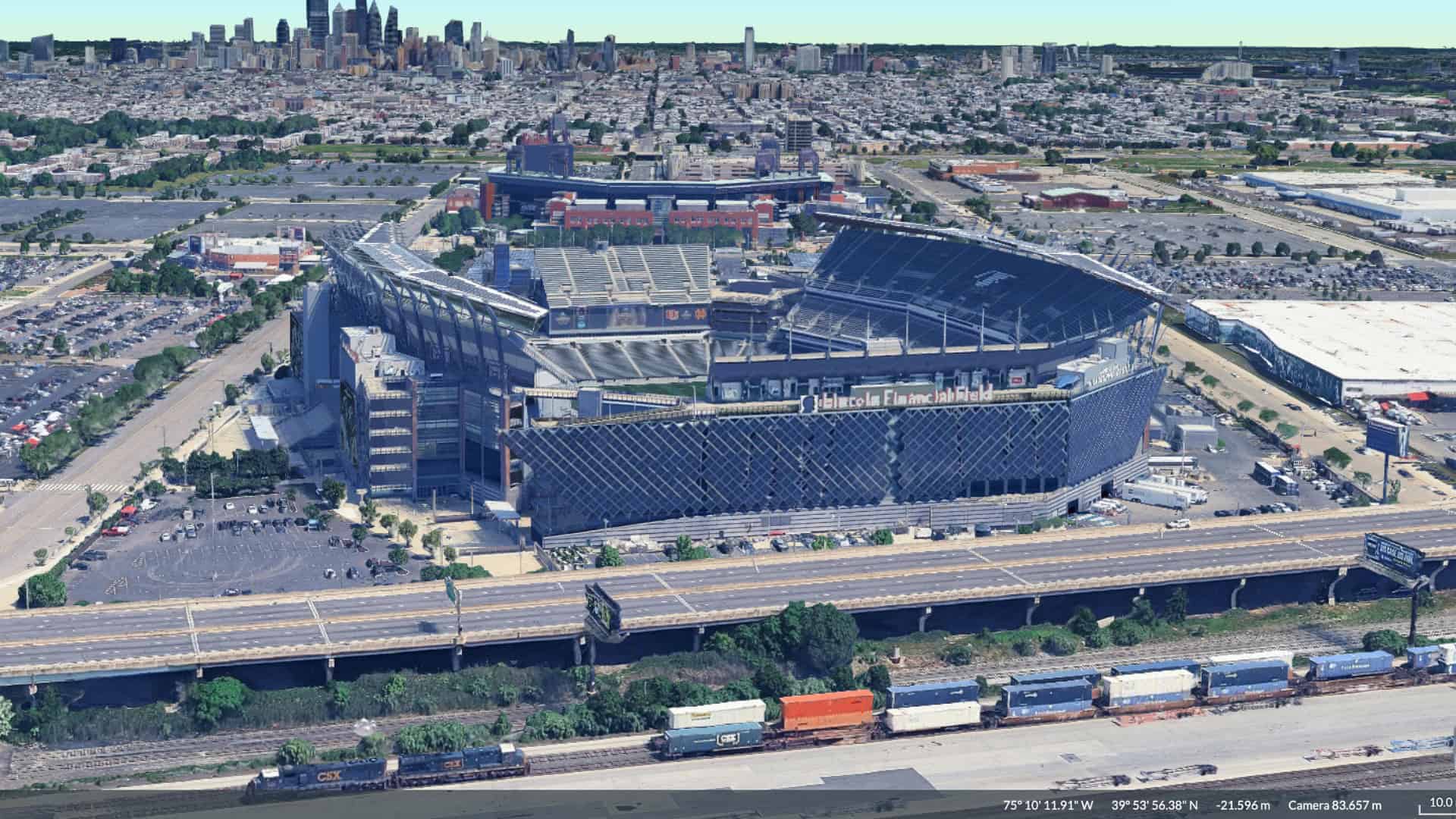
Home of the NFL’s Philadelphia Eagles since 2003, Lincoln Financial Field has become one of the more recognizable sports venues in the U.S., partly for the intensity of its crowds, but also for its commitment to green energy. The stadium runs on thousands of solar panels and has received LEED certification for its sustainability program. It can hold 69,000 for the 2026 World Cup tournament.
San Francisco Bay Area Stadium
Located in Santa Clara, California, just south of San Francisco, Levi’s Stadium was designed with sustainability as a core feature. It has solar-paneled pedestrian bridges and the NRG Solar Terrace, and is one of the first NFL stadiums to be LEED Gold-certified. Home to the San Francisco 49ers since 2014, the stadium can hold 71,000 and previously hosted Super Bowl 50 in 2016.
Seattle Stadium
Few stadiums in North America match Lumen Field for crowd noise. The steep seating bowl and partial roof help channel sound back onto the field. Fans of the NFL’s Seattle Seahawks have twice set Guinness records for loudest outdoor stadium roar. Also home to Sounders FC and Reign FC since 2002, the stadium can hold 69,000 for World Cup 2026 and previously hosted matches during the 2016 Copa América Centenario.
FAQ:
The Dallas Stadium (AT&T Stadium) is by far the largest venue on the 2026 World Cup roster, boasting a FIFA-listed capacity of 94,000. It is built for massive spectacle, and engineers actually used Bentley’s PLAXIS 3D software to simulate and validate the building’s foundation design before construction.
The 2026 World Cup final will kick off on July 19 at the New York New Jersey Stadium, known locally as MetLife Stadium. Located in East Rutherford, New Jersey, this 82,500-capacity venue serves the tournament’s largest metropolitan market.
Both the Kansas City Stadium (GEHA Field at Arrowhead Stadium) and Seattle Stadium (Lumen Field) are legendary for their crowd volume. Kansas City currently holds a Guinness-recognized outdoor stadium noise record of 142.2 decibels, while Seattle fans have twice set their own Guinness records for the loudest outdoor roar.