A Warning From 20 Feet Below
In 2010, workers rebuilding the World Trade Center in New York City uncovered an unexpected piece of the past. About 20 feet below ground, excavation machinery struck weathered timber buried at the edge of the site. It turned out to be part of an 18th-century sailboat, or sloop, that once sailed the Hudson River and was later used as landfill as Manhattan expanded.
For historians, it was a remarkable find. For engineers, it was a reminder of a more practical problem: Infrastructure is at times still designed with incomplete knowledge of what lies below the surface, and that uncertainty can be expensive.
“Sometimes design has to proceed without the required high-quality subsurface data, and we make refinements and pivots as we go along. We take measured risks but may still find things that are massive, and we might end up blowing the budget and schedule,” said Rizwan Baig, chief engineer of the Port Authority of New York and New Jersey. “Not knowing the surprises under our build-environment before breaking ground and third party risk is what concerns me.”
That concern framed one of the clearest messages at the Transforming Infrastructure Performance (TIP) NYC Summit 2026. First hosted a decade ago by the UK government and now organized by Bentley Systems’s Infrastructure Policy Advancement team and partners, TIP has become an important global event for industry professionals dedicated to rethinking the future of infrastructure delivery and performance. The takeaway from NYC: Better infrastructure outcomes start with better information, captured early enough, structured well enough, and shared widely enough to influence real decisions.”

A $100 Billion Challenge
Held in mid-April, the second annual TIP NYC Summit brought together more than 170 infrastructure leaders from engineering, government, finance, and technology. The conversation ranged from permitting and project finance to mega-project delivery, fragmented information, and the growing role of artificial intelligence (AI).
The backdrop was hard to ignore. The New York City metropolitan area is expected to see roughly $100 billion in infrastructure work over the next decade. The Port Authority alone is managing a $45 billion project budget spanning airports, terminals, rail, and bridges.
Connected data was the dominant theme. The industry knows that information should cleanly move from planning through design, delivery, operations, and maintenance. The deeper issue is that too little of that data becomes operational intelligence that decision-makers can use in time.
“There’s trillions of dollars’ worth of infrastructure assets across the U.S., but you go to a lot of states and local governments, and they don’t even know what infrastructure exists in the first place,” said Rory Linehan, director for infrastructure policy advancement at The Infrastructure Policy Advancement, Bentley’s in-house global think tank. “We need to find a better way to capture that data people can trust and use in real time, and leverage it to inform better decision making. Otherwise, the outcome is friction, rework, delays, and lost value.”
Money Follows the Data
That outcome matters not only to engineers and operators, but also to investors.
As public budgets tighten, private capital is taking a larger role in infrastructure finance, and private investors prize predictability. They want evidence that projects will be delivered on time, on budget, and with credible governance around risk.
“Everything we do is grounded in data,” said Anmay Ditman, managing director and head of the Climate Finance Partnership at investment company BlackRock.
Ditman moderated a panel on funding next-generation transit that included Allison L.C. de Cerreño, chief operating officer for bridges and tunnels at the Metropolitan Transportation Authority in New York; Sabrina Sussman, chief program officer for Choose How You Move, Nashville’s transportation improvement program; and Samantha Biddle, deputy secretary of transportation at the Maryland Department of Transportation.
The examples were real. De Cerreño described how data and advanced algorithms supported Manhattan’s congestion-pricing program. Biddle is helping oversee the reconstruction of Baltimore’s Francis Scott Key Bridge after its collapse in 2024.
What linked the panelists was not simply a belief in data, but a belief in evidence-backed delivery supported by stakeholders. New financing models and ambitious infrastructure programs work only when leaders can show the basis for decisions and build confidence across institutions and communities.

From One Time Collection to Operational Intelligence
For Biddle, the issue is not just better data. It is faster decisions.
“We have to get beyond one-time data collection,” she said after the panel discussion. She said data collection has to be operational in a way that impacts decision-makers, impacts stakeholders, and drives the business forward.
That is a useful test for the industry. If data does not improve the speed and quality of decisions, it is not solving the right problem.
Biddle’s point was blunt: Costs are constantly rising. Teams may have the right people and the right intent, but performance depends on whether the information ecosystem is integrated enough to let those teams act quickly.
“We are in this climate right now where every minute, every hour, things are costing more,” Biddle said, adding that efficiency is key. “We have great teams. We have the right talent. It is just a matter of having all the pieces together and letting them run.”
AI Is Only As Smart as it's Data
No infrastructure conference in 2026 can avoid AI. But the discussion in New York was notably grounded.
For now, most practical AI use cases in infrastructure are focused on productivity, decision support, and visualization. That is important. But it is not yet the same as fundamentally reshaping how infrastructure is planned and delivered at system level.
David Goldwater, senior vice president for public policy at Stantec, told an AI panel that the “technology could be transformative for the sector, provided it comes with quality control and human oversight.”
“The prospect of AI designing a bridge on its own sounds a little terrifying. AI can create efficiencies and be effective in design work, but it will always require human management and ingenuity,” he said.
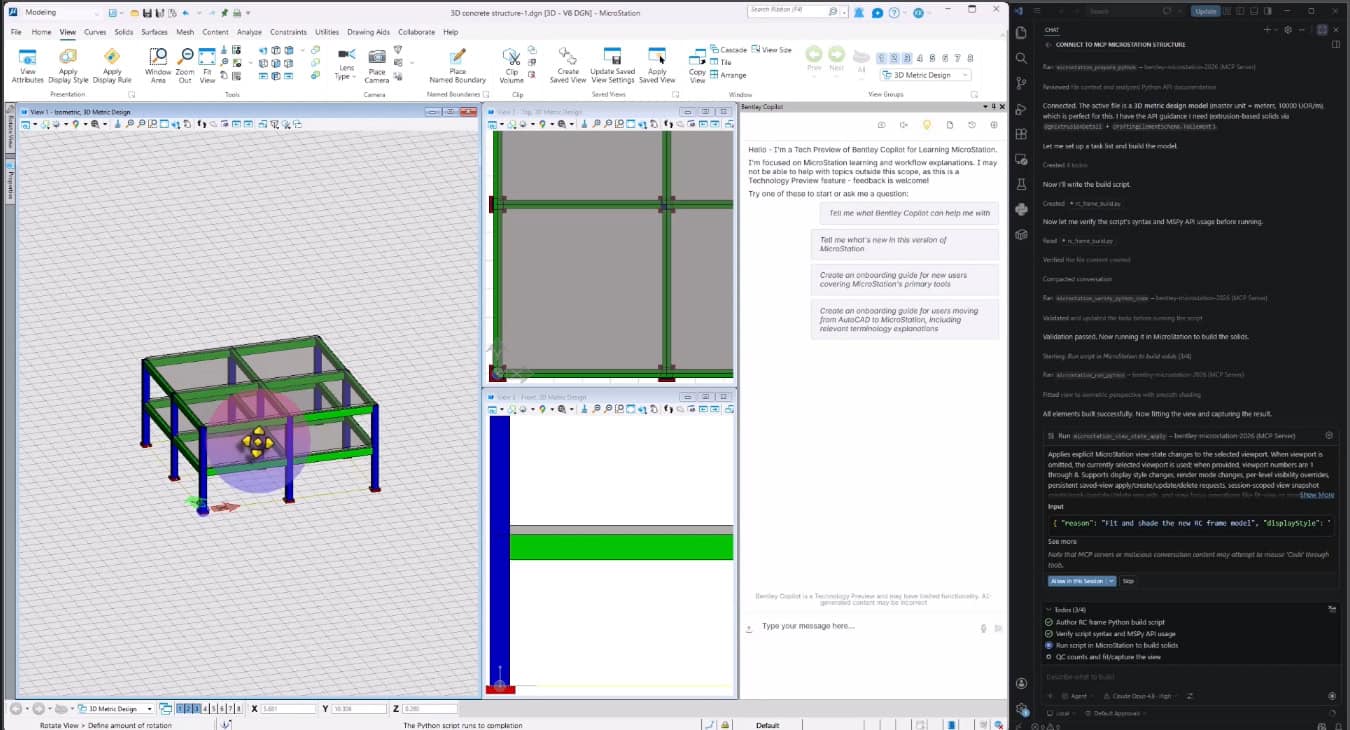
Stantec is already applying AI to accelerate project delivery, predict soil conditions from sample data, streamline permitting, and improve public engagement through faster 3D modelling and visualization.
“If we can get better data, we can make significant efficiencies”, Goldwater said. “We can better communicate with the public because we can quickly create 3D models and visualizations for public outreach.”
Panellists also argued that faster delivery does more than cut cost. Rather than replacing human labor, AI can widen economic benefit in infrastructure delivery.
“By automating and streamlining and expediting the pain points along the way to that construction start, we as a society will have more and better infrastructure. We will also create a lot more jobs that way,” said David Gilford, infrastructure strategist and managing partner at PolicyAlpha, who moderated the AI panel.

The Unexpected Early Adopters
Gilford pointed to a notable pattern:
The sectors facing the steepest talent shortages — power generation, water infrastructure — are turning out to be among the earliest adopters of these tools, Gilford said. When the workforce is aging and there aren’t enough people coming in to replace them, the incentive to use technology that extends expertise and reduces repetitive work is immediate and concrete.
It is a counterintuitive finding. But delivery pressure, it turns out, is a more reliable driver of adoption than an organization’s technological sophistication.
Still, the AI conversation kept circling back to the same prerequisite: data discipline.
Robert Kumapley, chief of the enterprise asset management division at the Port Authority, said “the agency is piloting AI and natural-language search to analyse maintenance records and identify root causes of repairs on the 94-year-old George Washington Bridge.”
But without standardisation, he warned, AI will struggle to generate reliable insight.
This is why data structure standardisation is important, because if you do not have that data structure, AI is not going to tell you anything, Kumapley said. We have maybe 50 consultants doing inspections. We do not want some to say rust and others to say corrosion. That is not going to work. They all have to use the same acronym, the same nomenclature.
It was one of the most practical observations of the day. Clean data is not an administrative exercise. It is the condition for scale.

Breaking Silos Is The Start, Not the finish
The summit’s value was not only in the subjects covered, but also in the mix of people in the room. Engineers, financiers, public officials, operators, and technology leaders rarely get enough time together to understand each other’s constraints, incentives, and blind spots.
“So few times do we ever come together as an entire infrastructure industry to better understand what the challenges are and how we can work together to solve them,” Linehan said. “If we do not do events like this, we cannot break down our silos, we cannot learn from each other, and ultimately, we cannot deliver better outcomes for our communities.”
Biddle agreed. For her, one of the most useful signals was that industry wanted to seriously engage with public-sector problems.
“Industry wants to be part of the equation,” she said. ”What I really enjoyed this morning is that they are willing to listen and really understand where our challenges are, what our problems are, and how they can be part of bringing to market projects that are going to succeed.”
That matters. But discussion alone is not enough.
The summit put engineers, investors, and officials in one room. That is an important step, but it is not the finish line. The real challenge, and the real opportunity, is converting infrastructure insight into execution.
That is a central part of the mission for Bentley’s Infrastructure Policy Advancement team. Through the global summits—the company also hosts Transforming Infrastructure Performance events in London, Toronto, and Melbourne—the Bentley team is working to move the conversation beyond diagnosis and toward practical reform in how infrastructure is designed, delivered, and operated.
The message from the New York City summit was clear: AI may help the industry move faster, but it will not modernize infrastructure on its own. The latter depends on whether leaders can build the data foundations required to make better decisions earlier and with more confidence.
FAQ:
According to experts at the TIP NYC Summit 2026, the U.S. infrastructure sector currently has a massive volume of data, but it is often fragmented, outdated, or unstandardized. For AI to be transformative, the industry must prioritize data discipline.
In 2026, AI is mostly focused on productivity, decision support, and 3D visualizations rather than completely reshaping system-level planning. Engineering firms are currently applying these tools to accelerate project delivery, predict soil conditions from samples, and streamline the permitting process, creating significant efficiencies.
Private capital prizes predictability above all else, requiring evidence that infrastructure projects will be delivered on time and within budget. Since everything investors do is “100% grounded in data,” maintaining clean and trusted data frameworks is the only way to build the confidence needed to secure funding for next-generation transit.