The American story is, at heart, a building story. It’s 250 years of believing that what looked impossible was merely difficult. Crews strung bridges across straits deemed uncrossable, raised towers that shattered records year after year, and pushed water hundreds of miles across the desert.
Now you can explore that story through a virtual 3D tour. Built with Cesium, the open-source geospatial technology, the tour maps the engineering feats that physically united and powered a growing America, from harbor to desert to skyline.
Here’s your roadmap:
1. The Statue of Liberty
Designed by French sculptor Frédéric-Auguste Bartholdi and dedicated in New York Harbor in 1886, the Statue of Liberty hides its engineering in plain sight. Beneath the 151-foot figure’s 62,000-pound hammered-copper robe is an internal iron framework engineered by Gustave Eiffel. This flexible skeleton lets the statue sway and expand in high winds and shifting temperatures. The entire monument was built in Paris, disassembled into 350 pieces, packed into 214 crates, and shipped across the Atlantic before being reassembled on its concrete pedestal—a triumph of 19th-century structural engineering and international logistics.
Fun fact: The statue wasn’t always green. Her copper attire and skin, roughly two pennies thick, were once the shiny, reddish-brown color of a new penny. But decades of exposure to the harbor’s salty air oxidized the statue’s surface, product the protective blue-green patina we now consider her signature color. The Statue of Liberty essentially weathered her own paint job.
2. The Capitol Building
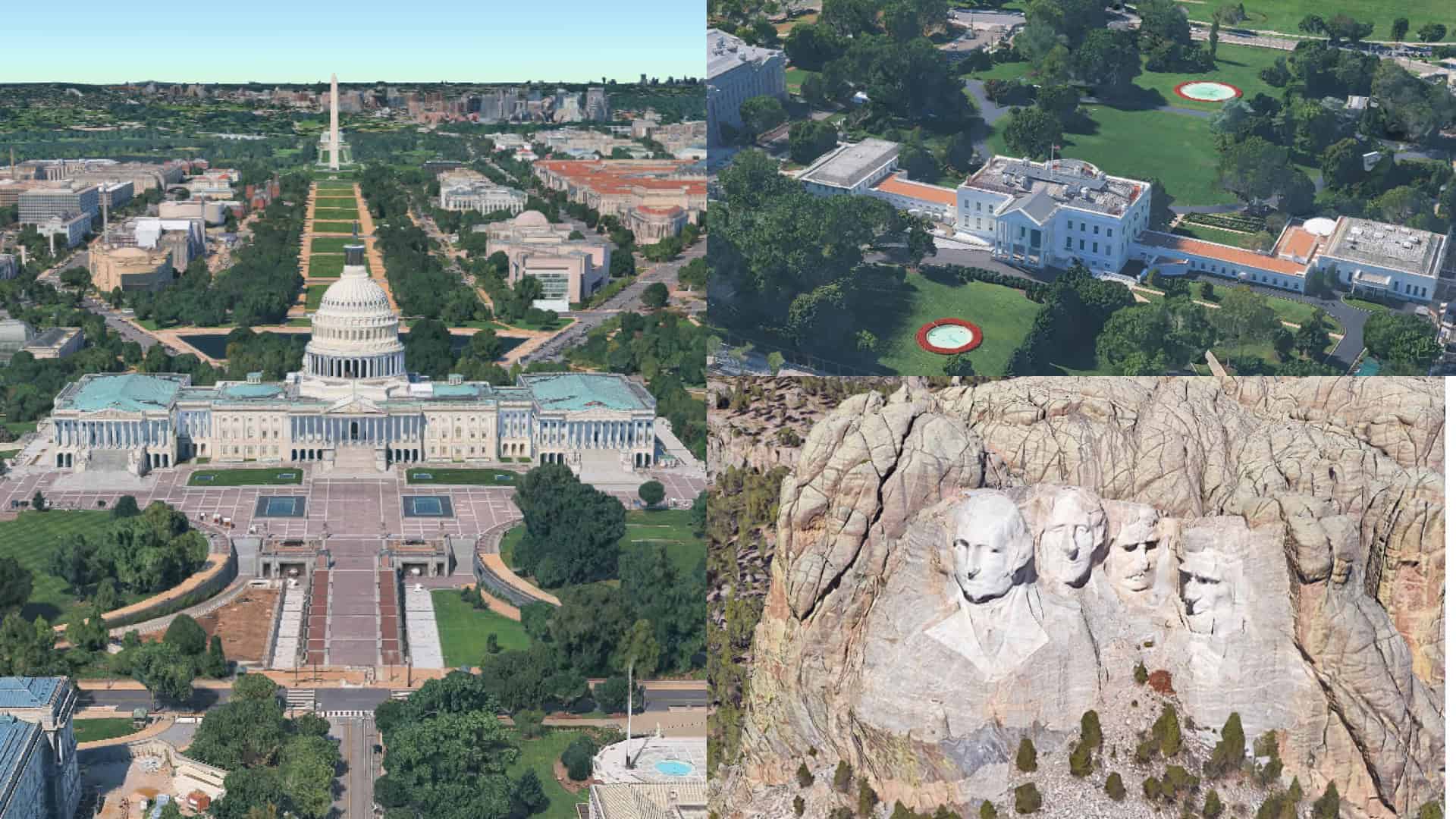
The U.S. Capitol has been repeatedly expanded and rebuilt since George Washington laid its cornerstone in 1793. Partially burned by the British in 1814, it was restored and enlarged to keep pace with a growing government. The building’s defining engineering feat is the cast-iron dome designed by Thomas U. Walter and completed in 1866, during the Civil War. Weighing nearly 9 million pounds, it replaced a smaller wooden dome and uses an innovative double-shell design that delivers immense strength while framing the rotunda below.

3. The Washington Monument
Towering 555 feet above the National Mall in Washington, D.C., the Washington Monument remains the world’s tallest predominantly stone structure. Architect Robert Mills designed it as an unreinforced masonry obelisk. Construction began in 1848 but stalled for two decades—from 1854 to 1877—amid funding shortages, political feuds, and the Civil War. The pause is permanently visible as a distinct change in the marble’s color about a third of the way up. Before the monument’s 1884 completion, the U.S. Army Corps of Engineers had to reinforce the monument’s original foundation with concrete to safely support the tower’s 81,000-ton weight.
4. Independence Hall
Built in the mid-18th century in Philadelphia, Independence Hall is the structural and ideological cradle of the United States. The Georgian-style brick building once housed the 2,080-pound Liberty Bell, a global symbol of freedom famous for its crack. Today, as the centerpiece of Independence National Historical Park, it preserves the very rooms where the Declaration of Independence and the U.S. Constitution were debated and signed—anchoring the birth of a nation to a few historic city blocks. (It’s also a short walk from Bentley Systems’ new office in the city.)
5. The Empire State Building
Designed by Shreve, Lamb & Harmon architects, the Empire State Building was completed in just one year and 45 days, opening in May 1931. An assembly-line approach to material delivery helped a workforce of up to 3,400 builders erect the 57,000-ton steel frame at a record clip: four and a half stories a week. Rising 1,250 feet above New York City, it was the first building in the world to top 100 floors, and its 102 stories held the title of the world’s tallest building for nearly 40 years—until the World Trade Center’s North Tower surpassed it in 1970.
6. Willis Tower
Completed in Chicago in 1973, the Sears Tower (now Willis Tower) rewrote the rules of skyscraper engineering through the work of structural engineer Fazlur Rahman Khan and architect Bruce Graham. The tower’s “bundled tube” system, composed of nine square tubes of varying heights clustered together, gave it unprecedented resistance to high winds while using significantly less steel per square foot than conventional designs. Rising 110 stories to 1,450 feet, it stood as the world’s tallest building for 25 years and set a structural blueprint that continues to shape supertall construction today.
7. Mount Rushmore
Carved into the granite of South Dakota’s Black Hills, Mount Rushmore was sculpted by Gutzon Borglum and his son, Lincoln, between 1927 and 1941. The project removed nearly 450,000 tons of rock to shape the 60-foot faces of four U.S. presidents. Workers used dynamite for roughly 90% of the excavation, then finished with pneumatic hammers and hand tools while dangling in bosun chairs. Despite years of suspended blasting and drilling, the 14-year project was completed without a single worker fatality.

8. The Hoover Dam
Built between 1931 and 1936 during the Great Depression, the Hoover Dam was so vast that crews first had to reroute the Colorado River through four diversion tunnels. Engineered by the Bureau of Reclamation along the Nevada-Arizona border, the 726-foot concrete arch-gravity dam swallowed more than 3.25 million cubic yards of concrete—so much that engineers embedded a novel network of cooling pipes in the poured blocks to dissipate chemical heat that would otherwise have taken an estimated 125 years to cool on its own. The dam tamed floods, generated hydroelectric power, and created Lake Mead, remaking the water infrastructure of the American Southwest.
9. The Alamo
Originally built in the 18th century as the Misión San Antonio de Valero, the Alamo was raised from local limestone by Spanish missionaries and Indigenous laborers. As it evolved from religious outpost to military fortress, it became the focal point of the 13-day siege during the 1836 Texas Revolution. Yet its most iconic feature—the curved parapet roofline—wasn’t there for the battle. The U.S. Army added it during renovations years later, making the surviving chapel and Long Barrack a layered timeline of colonial expansion and frontier conflict.
10. The Space Needle
Built for the 1962 World’s Fair in Seattle, the Space Needle was designed by Edward E. Carlson and architect John Graham Jr. The 605-foot tower went up in roughly 400 days atop a foundation that required 467 concrete trucks pouring continuously for 12 hours. Engineered to withstand 200-mph winds and a 9.1-magnitude earthquake, the building consists of a central elevator core and three steel legs supporting a top dome with an observation deck and a rotating restaurant.
11. The Golden Gate Bridge
Proposed in 1921 and designed by structural engineer Charles Alton Ellis, the Golden Gate Bridge spanned a strait long considered too treacherous to cross because of its deep water and ripping currents. Construction began in 1933, demanding massive concrete anchorages and the perilous placement of a south pier about 1,100 feet offshore. Under chief engineer Joseph Strauss, the project pioneered safety measures, including mandatory hard hats and a safety net that saved 19 workers, the so-called Halfway-to-Hell Club. Completed ahead of schedule in 1937, the bridge’s 4,200-foot main span held the world record until 1964, and its “International Orange” color, chosen by architect Irving Morrow, still glows through the San Francisco fog.

12. The Gateway Arch
Completed in St. Louis in 1965, the Gateway Arch is the world’s tallest arch at 630 feet. Designed by architect Eero Saarinen and structural engineer Hannskarl Bandel, it’s a weighted inverted catenary curve clad in stainless steel over a carbon-steel core. The two legs were built simultaneously and had to converge at the top within a margin of just 1/64 of an inch. To carry visitors up the curved interior, engineers invented a unique tram that works like a cross between an elevator and a Ferris wheel.
13. The Kennedy Space Center
NASA established the Kennedy Space Center in Florida in 1962 for the Apollo program. The site’s Vehicle Assembly Building is a 525-foot structure anchored to bedrock to survive hurricanes. From there, crawler-transporters, each weighing some 6 million pounds and capable of hauling loads up to 18 million pounds, creep along gravel roadways to ferry rockets to the launch pads.
14. The Brooklyn Bridge
Completed in 1883, the Brooklyn Bridge links Manhattan and Brooklyn across the East River in New York City. Designed by engineer John A. Roebling, it was the first suspension bridge built with steel-wire cables. To anchor the bridge’s limestone and granite towers, builders excavated the riverbed using pressurized pneumatic caissons, which are watertight working chambers to help laborers excavate soil. Some laborers working in the chambers, including Roebling’s son, Chief Engineer Washington Roebling, were afflicted with debilitating decompression sickness known to deep-sea divers as “the bends.” This is when rapid ascension causes nitrogen bubbles to form in the blood. Over 100 workers faced complications, sometimes fatal, and it seriously affected the leadership structure of the building team. At completion, the bridge’s 1,595-foot main span made it the longest suspension bridge in the world.
Fun Fact: Roebling practiced for the Brooklyn Bridge in Cincinnati by building the John A. Roebling Suspension Bridge over the Ohio River. The bridge still connects Ohio and Kentucky.
15. The Pentagon
Completed in 1943 after just 16 months of construction, the Pentagon in Arlington, Virginia, is the headquarters of the U.S. Department of Defense. The five-sided building holds 6.5 million square feet of floor space. To conserve scarce wartime steel, builders made concrete from 680,000 tons of sand and gravel dredged from the Potomac River. The building’s concentric-ring design is so efficient that a person can walk between any two points in the building in under seven minutes.
16. The Fort Peck Dam
Built between 1933 and 1940 on the Missouri River in northeast Montana, Fort Peck Dam is the largest hydraulically filled dam in the United States. Crews used dredges to pump more than 100 million cubic yards of earth and water during construction. Stretching 21,026 feet, the dam regulates navigation and flooding along the upper Missouri River.
17. Los Angeles Aqueduct
Completed in 1913, the Los Angeles Aqueduct runs 233 miles, delivering water from the Owens River in the Sierra Nevada mountains to Los Angeles. Engineered by William Mulholland, the aqueduct relies entirely on gravity—it has no pumping stations—to move water. The project required 142 tunnels and massive steel siphons strung across deep canyons, effectively making Southern California’s explosive growth possible.
18. The White House
Concluding our tour of American infrastructure is the White House. The executive residence was originally designed by architect James Hoban and was constructed from Aquia Creek sandstone between 1792 and 1800. British forces burned the structure in 1814, but it was reconstructed and eventually included the South and North Porticos. In 1902, contractors built the West Wing to separate the executive offices from the residential quarters. Between 1949 and 1952, engineers executed a structural overhaul under President Harry S. Truman, gutting the wooden framework and replacing it with load-bearing steel beams and concrete floors to stabilize the building.

FAQ:
The entire monument was built in Paris. It was then disassembled into 250 pieces, packed into 214 crates, and shipped across the Atlantic before being reassembled.
The Willis Tower, formerly known as the Sears Tower, utilizes a “bundled tube” system made of nine square tubes of varying heights clustered together. This design gave the building unprecedented resistance to high winds while using significantly less steel per square foot than conventional designs.
The Brooklyn Bridge, which was completed in 1883.