Home / Insights and Inspirations Posts / Cities & Campuses / Infrastructure’s AI Future Runs on Connected Data—And Human Trust

Infrastructure’s AI Future Runs on Connected Data—And Human Trust

At Illuminate 2026 in Sydney, engineers, project managers, and government officials found that smarter infrastructure requires both better data and stronger relationships.

Tomas Kellner Profile Image

Tomas Kellner

Aerial view of Sydney Harbour Bridge and Opera House at sunset, with boats on the water and city skyline in the background.
Sydney, one of the most beautiful and vibrant cities in the world, served as a stellar location to host our latest Illuminate event.

Share

Sydney is famous for the billowing roof of its Opera House and the graceful curve of the Harbour Bridge. Less visible, but no less essential, is the infrastructure that keeps cities like it running: the tunnels, ports, water mains, and power grids. This week, more than 500 engineers, project managers, and government representatives from across Australia, New Zealand, and beyond came to Sydney’s Fullerton Hotel for Illuminate 2026 Sydney, the first event in Bentley Systems’ 2026 conference series bringing together the people who plan, build, and operate the world’s infrastructure. Illuminate moves to Mumbai and Berlin in April.

The theme driving the conversations between packed sessions was straightforward: The best infrastructure projects run on connected data, artificial intelligence (AI) is only as powerful as the data beneath it, and neither yields results without trust and human relationships.

When data lives in silos and systems do not talk to each other, information that took years to generate goes to waste. Craig Dunningham, digital engineering lead at Arcadis, the global engineering and consultancy firm, put it plainly. “At the moment, we don’t really capitalize on what information is available,” he said. “By being able to connect that data, there’s a lot of power to it.”

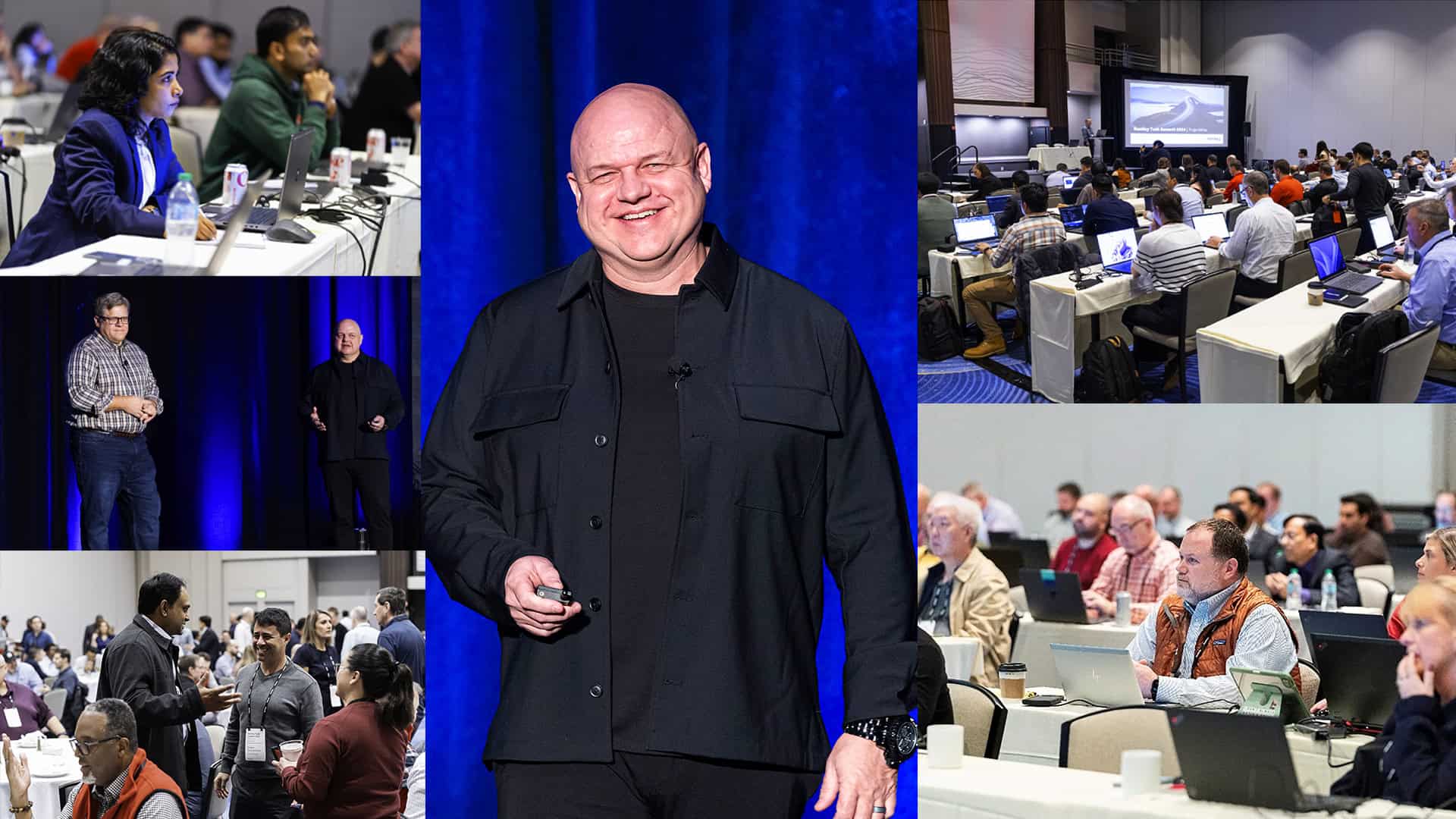
A collage of conference scenes featuring speakers on stage, attendees networking, and people listening in an audience. One person holds a bag reading, "The future is yours to shape.
“The future is yours to shape.” Illuminate Sydney 2026.

That is happening now. Dunningham pointed to a panel discussion on the North East Link Program in Victoria, Australia, a freeway upgrade and tunnel project threading through suburban Melbourne with a budget of more than AU$20 billion (about US$14 billion). Brett Taig, the digital engineering manager at VIDA, the state of Victoria’s infrastructure delivery agency, described how his team used Bentley’s ProjectWise software to automatically move roughly a thousand digital files between project teams every night into a shared data environment, eliminating email chains and what he called “an army of document controllers” in the middle. “It was very interesting, from a government perspective, how they are starting to appreciate how important the structure of data is,” Dunningham said. “Because for many, many years now, we’ve been producing lots and lots of data, but we haven’t been able to reuse it or capitalize on it.” Dunningham said connected data helps Arcadis better understand and match project requirements and assess design maturity and provide feedback, for example.

Connected data provides visibility and new insights, cuts waste, and enables new AI applications across the sector. François Valois, Bentley’s senior vice president for open applications and its AI strategy leader, made the stakes plain: In infrastructure, approximation is not an option. A bridge design, for example, is not an answer generated by an AI assistant like Claude or ChatGPT. “Applying AI, we cannot sacrifice on precision, accuracy, and exact results,” Valois said. He noted that the philosophy at Bentley, the infrastructure engineering software company, is that the data belongs to the customer. “Our customer data, our user data, is their data, not our data. We’re there to make it as easy as possible to aggregate it, transfer it, manage it, and AI-enable it in the context of their work to really support the digital transformation and things that are happening in this industry.”

A collage of business professionals at a conference, including panel discussions, a man giving a presentation, and an attendee filming with a smartphone.
Illuminate Sydney 2026.

Valois said the conversations he had at Illuminate Sydney kept returning to the same question: Where is AI going to take infrastructure next? His answer centered on AI agents that take on the work of generating and comparing options and freeing engineers to focus on reviewing results and making decisions. “These agentic workflows and connectivity tools are really what’s going to enable us,” he said.

But for all the talk of data platforms and AI models, it was the human dimension that left the strongest impression on many attendees at the conference. Daniel Easter, digital engineering manager at Acciona, which is also involved in the North East Link project, said the conversations after his panel captured something essential. “A lot of people came up to us and were really receptive to the story,” he said. “What came across is the building of relationships. The data is the data, and it does what you need it to do. But it’s the relationships you build that lower the barriers and create trust, not just in the data, but in the person providing it. Our journey has been one of good collaboration on a personal level, not just sitting behind a computer and hoping it all works.”

That trust, Easter said, is built face to face. “When we have a conversation, we’re building a level of trust and understanding. Without that, you can’t expect to get the outcomes you want, whether on a small project or a major infrastructure program. When you come to places like this, you’re in an environment to make that happen.”
Relevant Tags

Straight lines may be efficient, but in Barcelona, they’re practically a provocation. The chaotic and curvy forms of the city’s ...

Some engineering marvels were once highly controversial projects. As the Empire State Building grew above Manhattan during the Great Depression, ...

A blood-red helicopter swooped low over a French village at the foot of Mont Blanc, dangling what looked like a ...

Subscribe to The Bentley Brief

Stay ahead of the curve with the latest infrastructure news and insights.