Illuminate 2026 Berlin, April 28-30 at the Hotel Adlon Kempinski, is the third stop in Bentley Systems’ 2026 infrastructure conference series after Sydney and Mumbai. Hundreds of engineers, government officials, contractors, and technology leaders will gather in Berlin—the teams who plan, build, and manage roads, power grids, water systems, and other critical infrastructure. The three-day event centers on real project case studies and presentations covering connected data, open standards, interoperability, AI innovation in the sector and much more. There’s still time to join.
The timing couldn’t be more critical. We’re seeing an unprecedented wave of infrastructure investment across EMEA, with Germany’s own 500 billion-euro fund acting as a major stimulus for Germany and its neighbors. (In December, Bentley held its Tech Summit here.)
Berlin isn’t just a backdrop—the city itself is a case study in rebuilding and reconnecting. Explore the interactive 3D visualization we built for you in Cesium, now part of Bentley Systems.
1. Siemensstadt Square
Siemensstadt Square is where Berlin’s electropolis past plugs into its digital twin future. It’s also where German tech company Siemens, with Bentley’s help, is effectively building a city district twice—first in a shared 3D model, then in bricks, steel, and streets. On more than 70 hectares of former factory land, historic industrial fabric and UNESCO-listed modernist housing are being rewoven into labs, offices, and homes for around 35,000 people, including social housing with CO₂-neutral operation as the goal. A district-scale digital twin will let teams simulate roads, utilities, and buildings before construction and later monitor energy, water, and maintenance in operation. The project is turning Siemensstadt Square into a living lab for climate-ready, data-driven urban infrastructure.
2. The Reichstag
The Reichstag is Berlin’s ultimate retrofit story: a 19th-century parliament shell re-engineered into a transparent, low–carbon hub at the heart of the federal government quarter. Inside the historic stone walls, a lightweight steel and concrete frame supports the iconic glass dome, designed by star architect Norman Foster, where twin ramps spiral around a mirrored cone that channels daylight into the debating chamber and helps exhaust warm air. Beneath the complex, a biofuel–fired heat and power plant works with underground aquifer thermal storage, forming part of a shared energy system that also supplies neighboring government buildings. Visitors strolling through the dome enjoy panoramic views of Berlin’s skyline while walking above a sophisticated piece of infrastructure.
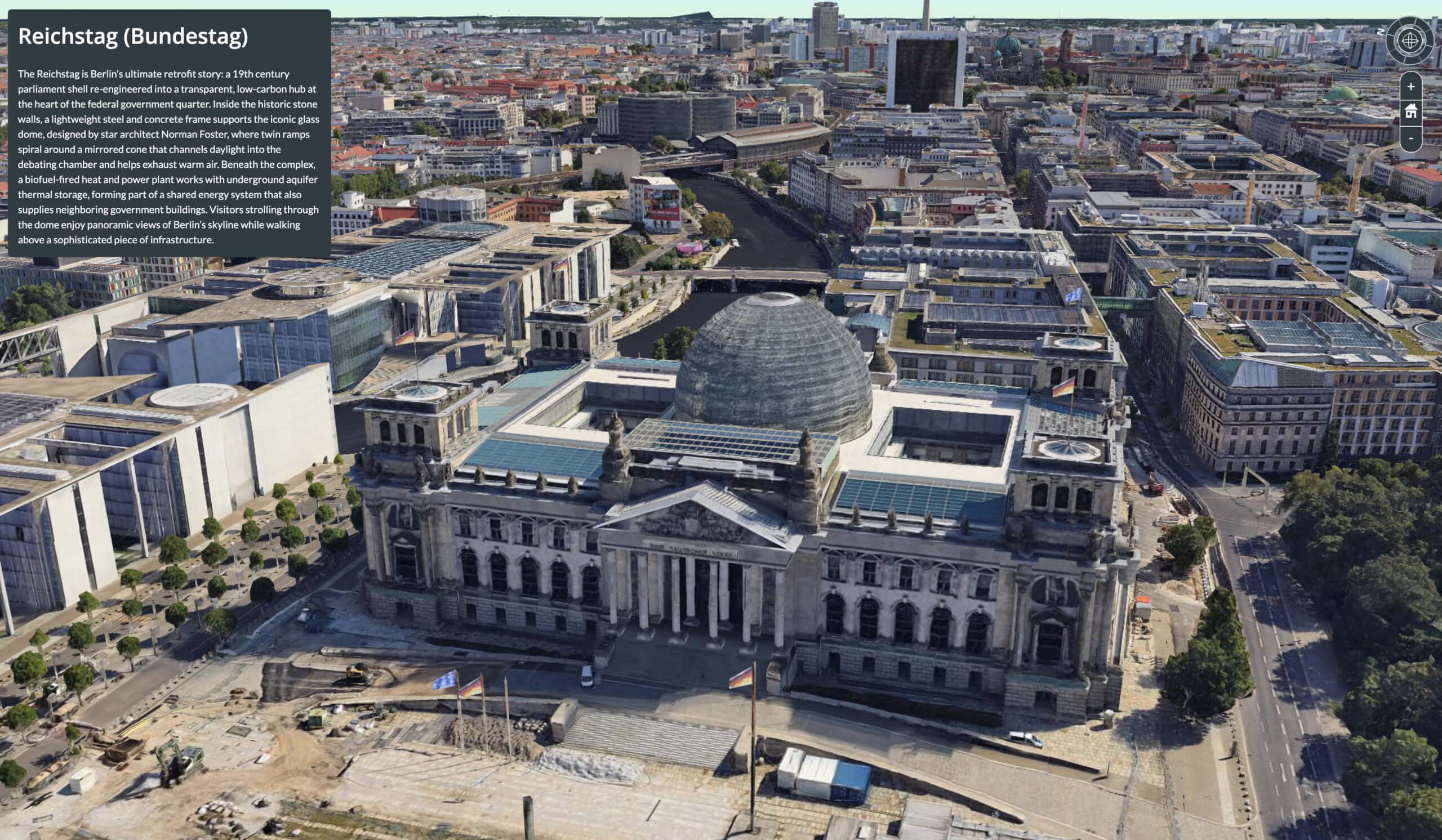
Aerial view of the Reichstag building in Berlin, Germany.3. Potsdamer Platz
Potsdamer Platz is where Berlin rebuilt a post-war wasteland, one carved out of the city by the Berlin Wall and frozen in place by the Cold War, into a dense, engineered new city center. After reunification, this no-man’s-land became Europe’s largest building site, with 19 buildings, 10 streets, and two squares constructed under one integrated masterplan. Beneath the plazas, a stack of underground levels handles parking, water management, and building services, while overground and underground trains intersect in the station below. At street level, architect Renzo Piano’s red-brick offices and housing blocks sit alongside Helmut Jahn’s Center Potsdamer Platz, its tensile glass roof creating a moderated microclimate over the plaza. Together, they form the heart of a high-density district planned for energy efficiency, light, and services. A replica of Europe’s first traffic light nods to Berlin’s long-standing role as a proving ground for new ideas in urban mobility.
4. Berlin Central Station
Berlin Hauptbahnhof is where the city’s railways go vertical by stacking long-distance, regional, and local S-Bahn lines across multiple levels. The lines directly link to the city’s U-Bahn underground subway system in a five-level glass canyon alongside the river Spree and the government quarter. Opened in 2006, the station reorganized Berlin’s post-reunification rail network into a north–south, east–west cross that connects major European routes through a single dynamic hub. Above the tracks, a lattice of steel and thousands of bespoke glass panels, with integrated solar panels, forms a vaulted shell that floods platforms and concourses with daylight. Trams, buses, bikes, and shops cluster around the station, turning this “glass armadillo” into a 24/7 civic engine, where engineering spectacle and everyday commuting meet.
5. Siegessäule
Berlin’s Siegessäule was originally erected in the 1870s as a war memorial in front of the Reichstag. Starting in 1938, it was dismantled and relocated 1.5 kilometers west to the Großer Stern, where it was extended in height and set on a new base. The 67-meter column has therefore been structurally engineered twice, including the current foundations that hold its 8-meter, 35-tonne “Goldelse” statue steady in Berlin’s winds. Today, it is the monumental center of the multiarm Großer Stern roundabout in the middle of the Tiergarten, Berlin’s famed urban park, and acts as a powerful wayfinding landmark. Pedestrian tunnels safely feed visitors under fast traffic into the monument’s base, where a tight spiral staircase climbs to a viewing platform about 50 meters above ground that offers a 360-degree view of Berlin’s east–west axis, green canopy, and the government quarter.
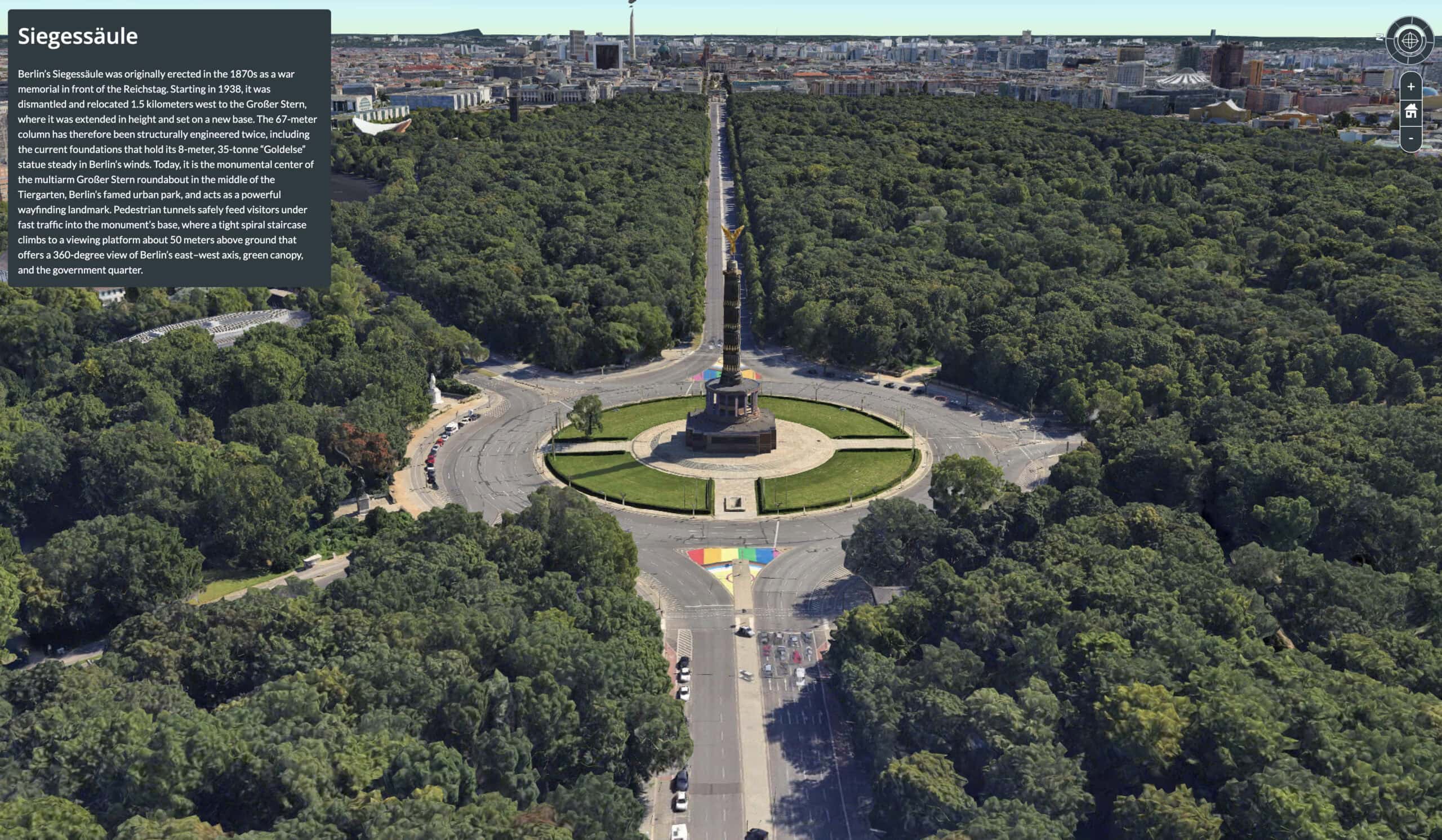
Aerial view of Berlin’s Siegessäule (Victory Column).6. Schloss Bellevue
The Schloss Bellevue palace sits between the Tiergarten, the river Spree, and Berlin’s government quarter. This 18th-century structure now functions as a subtly strategic node in the city’s political and green infrastructure. Built in the 1780s as Berlin’s first major neoclassical residence, the palace’s robust masonry shell survived war damage and was reinvented as the Federal President’s official home. The surrounding 20-hectare park works as a security buffer, riverside microclimate, and event platform that regularly hosts large civic and environmental gatherings.
7. Museums Island
Perched on a sliver of island in the Spree, Museumsinsel is Berlin’s cultural acropolis and a live engineering lab all in one. Five world-class museums sit on complex ground where the stable, load-bearing strata range in depth from about 3 to 40 meters, which means every restoration, tunnel, and basement must be engineered with surgical precision. Beneath the neoclassical colonnades, the underground Museumsinsel station brings in metro passengers under a vaulted “starry sky” ceiling, and engineers have begun threading an underground “archaeological promenade” to link four museums at basement level. The connection will fully open when the long-running Museum Island renovations are complete.
8. Brandenburg Airport BER
This is the comeback story of German infrastructure: a nearly complete “ghost airport” that stood idle for years amid design, coordination, and regulatory challenges before finally opening in 2020 as the region’s main air hub. Beneath its glass-and-steel Terminal, a 3.1-kilometre rail tunnel and multi-level station bring long-distance, regional, and S-Bahn services directly into the terminal complex, turning arrivals into a straightforward train hop into Berlin and beyond. The airport has become a testbed for solar-covered parking, LED retrofits, and apron and turnaround management systems assisted by artificial intelligence (AI) that aim to increase efficiency, cut emissions, and fine-tune performance in near real time.
9. Berlin TV Tower, Alexanderplatz
Taller than the Eiffel Tower and rising 368 meters above the Alexanderplatz public square, Berlin’s TV Tower is both the city’s tallest structure and its most conspicuous piece of communications infrastructure, still broadcasting radio and TV across the capital. Built by the German Democratic Republic (GDR) between 1965 and 1969, its tapering concrete shaft, hyperbolic base, and stainless steel sphere were engineered with climbing formwork. It’s relatively shallow but robust ring foundation anchors the revolving restaurant, observation deck, and transmission plant in the sky. On sunny days, the geometry and paneling of the sphere reflect sunlight as a bright cross that can be seen across the city. Because the avowedly secular GDR suppressed religious practices and institutions, West Berliners jokingly dubbed this stubborn Christian symbol on a socialist showpiece “The Pope’s Revenge.”
10. Checkpoint Charlie
Checkpoint Charlie looks like a small hut in the middle of Friedrichstrasse, but for three decades this crossroads was one of the most tightly controlled choke points on the planet. It was the third Allied border crossing in Berlin, and “Charlie” refers to C, the third letter in the NATO phonetic alphabet. From 1961 to 1990, multilane inspection sheds, barriers, watchtowers, and lighting systems turned an ordinary junction into a calibrated border crossing machine for cars, buses, foreign visitors, and Allied diplomats, while escape attempts probed every weakness. Today, the replica guardhouse, cobblestone strip marking the Berlin Wall, and open-air exhibits sit in a normal mixed-use streetscape, folded back into Berlin’s everyday traffic, shops, and tour groups.
11. The Berlin Wall Memorial
Along Bernauer Strasse that once cleaved East and West Berlin, the Berlin Wall Memorial turns a former “death strip” into one of Berlin’s most revealing pieces of linear infrastructure. With the memorial over 1.4 kilometers long, you can study the last remaining stretch of the East-West border in its full cross-section—outer and inner walls, patrol track, watchtower, and no-man’s-land—almost like a three-dimensional engineering drawing left in place. Landscape designers used Corten steel bands to trace lost façades and escape tunnels, while the rammed-earth Chapel of Reconciliation embeds fragments of the demolished church in its walls. Redesigned between 2008 and 2014, this 4.4-hectare corridor now doubles as a walking path—a green space where a hard barrier once stood.
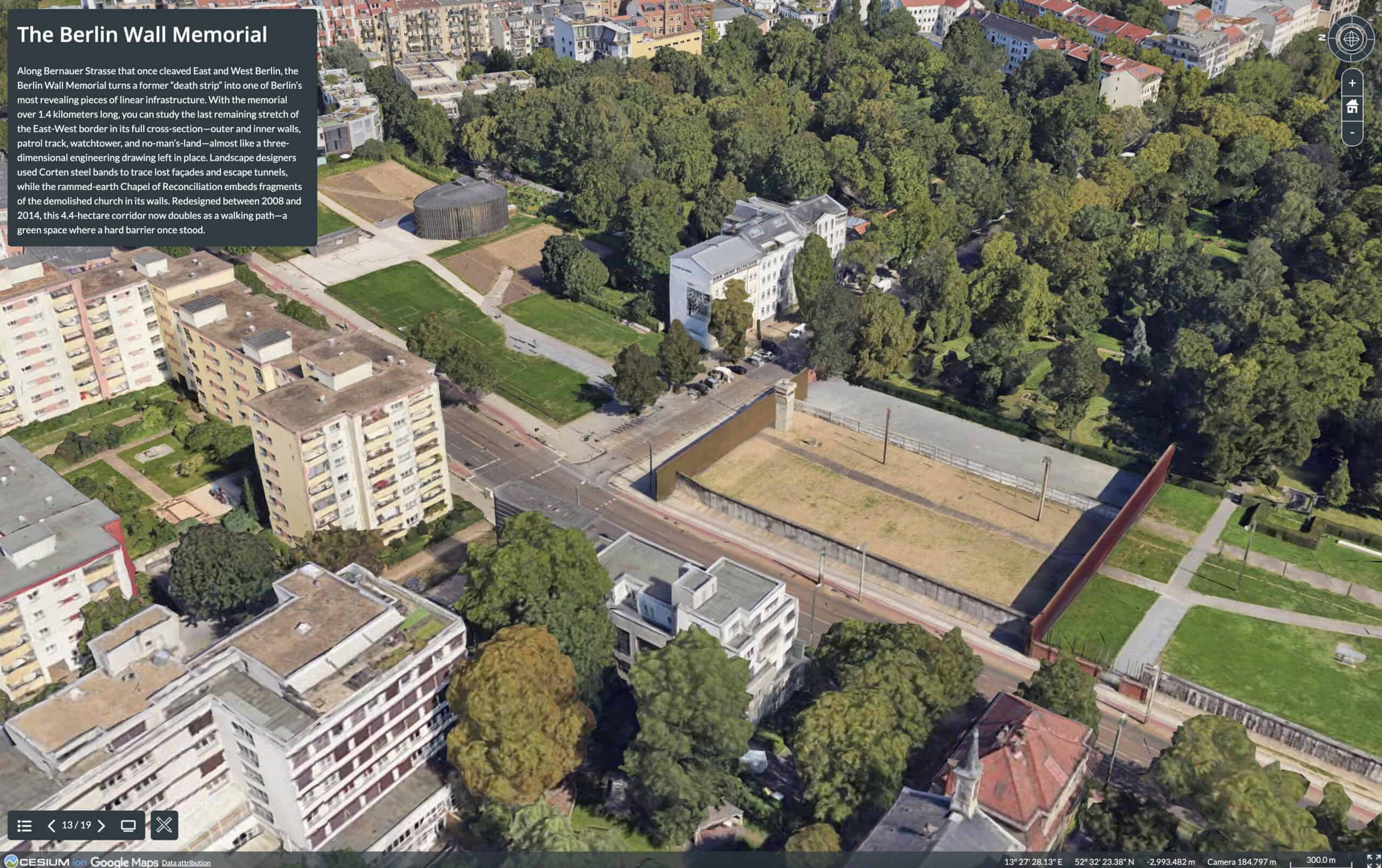
Aerial view of the Berlin Wall Memorial, showing preserved wall sections, nearby buildings, green spaces, and informational displays in an urban park setting.12. The Brandenburg Gate
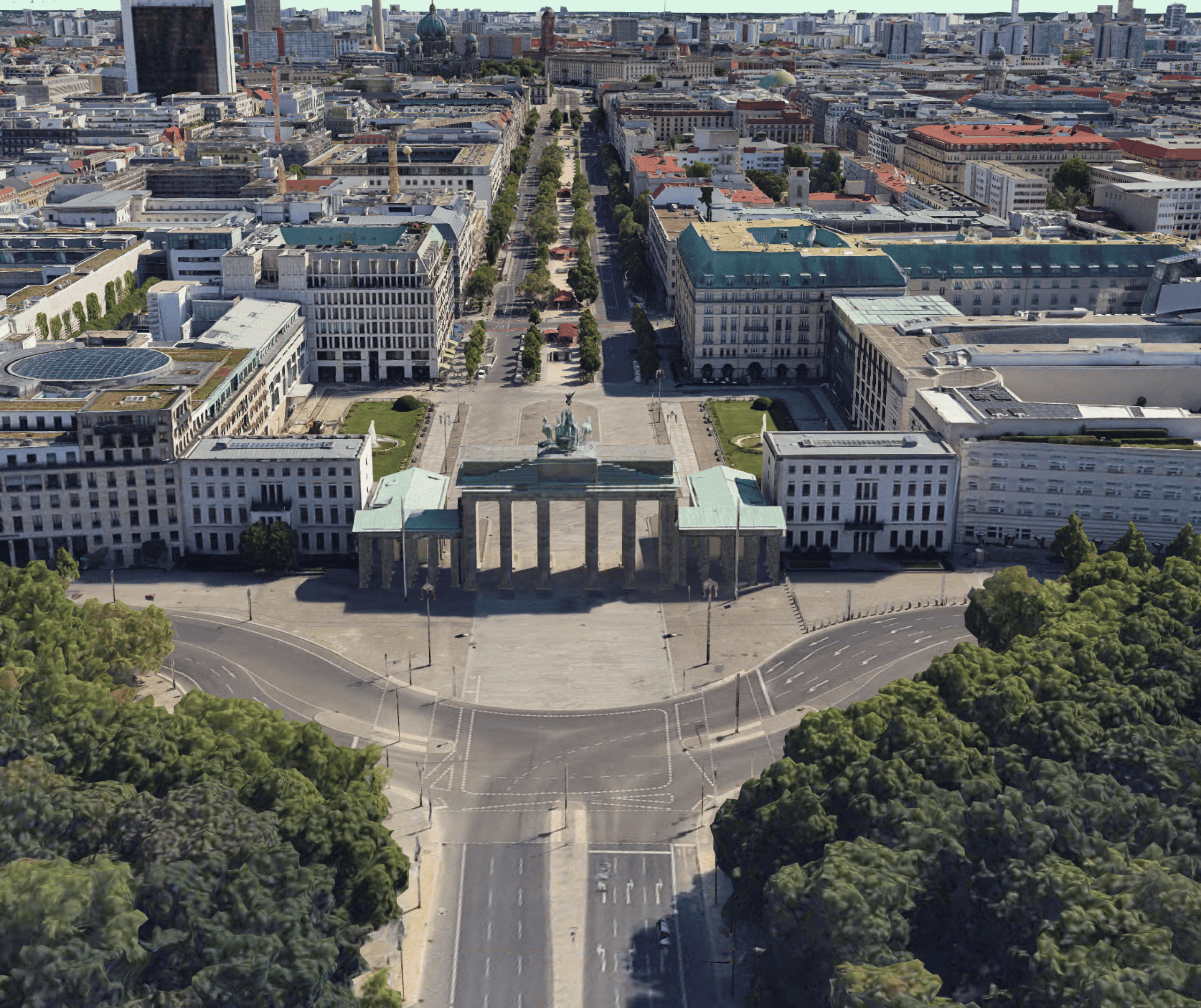
The Brandenburg Gate is Berlin’s hardest-working piece of heritage infrastructure. This 230–year–old gateway anchors Berlin’s main East–West axis. Its 26–meter–high sandstone colonnade managed carts and customs with its 12 Doric columns forming five passageways, once part of the old city wall. It has since had its stone fabric cleaned by lasers and its ageing frame stabilized so it can live with constant crowds and the stresses of major public events all around it. Today, motor traffic is kept to the surrounding streets, while Pariser Platz underneath it is largely calmed. The gate itself acts as a pedestrian filter and wayfinding beacon. It also serves as a canvas for large-scale light shows and Earth Hour illumination switch offs to raise awareness about climate change and environmental protection. For engineers, it is less a static monument and more a long–running upgrade project disguised as a classical temple.
13. The Holocaust Memorial
A short walk from the Brandenburg Gate is The Memorial to the Murdered Jews of Europe, Germany’s central monument remembering the 6 million Jews who perished in the Holocaust. The memorial is a somber field of 2,710 unmarked concrete steles separated by narrow passageways that slowly rise from Berlin’s street grid and swallow visitors within an undulating, disorienting maze. “Today, an individual can no longer be sure of dying an individual death, and architecture can no longer be reminiscent of life as before,” writes Peter Eisenman, who designed the memorial. “The markings that used to be symbols of an individual death now need to be changed, and this has a significant impact on the idea of memory and the memorial.” Says Eisenman: “In our monument there is no goal, no end, no way in or out. The time of the experience of the individual does not grant further understanding, because understanding is not possible.”
14. Cecilienhof
Cecilienhof is the Tudor-style wildcard in the palace landscape in and around Berlin. Nestled in the neighboring city of Potsdam, Cecilienhof is an English country house scaled up for royalty and completed in 1917 amid the turmoil of World War I, then pushed into the diplomatic spotlight three decades later at the close of World War II. Behind its half-timbered façades sit 176 rooms arranged around five interlocking courtyards, a modular layout that in 1945 accommodated the Potsdam Conference, where Stalin, Truman, and Churchill (later Attlee) met to decide how to manage a defeated Germany and shape Europe’s post-war order. Border fences and Berlin Wall infrastructure later cut through the surrounding New Garden until reunification. Today, major refurbishments and new visitor infrastructure are turning Cecilienhof into a diplomatic time capsule.
15. Sanssouci Palace
Sanssouci isn’t just Frederick the Great’s Rococo daydream—it is a hillside palace pinned into place by some of the most sophisticated landscape engineering in Europe. Its six south-facing vineyard terraces act as a climate machine, with brick retaining walls and 132 steps stabilizing the slope, and 168 glazed niches in those walls serving as tiny greenhouses for figs and vines. Below is a 19th-century pump house famously disguised as a Turkish mosque—with a minaret-style chimney—that once used a steam engine to blast the Great Fountain’s water jet 40 meters into the air. Today, the wider 500-hectare UNESCO palaces-and-parks landscape is grappling with drought and climate-stressed trees, while new eco-workshops and nurseries support its upkeep, turning the location into a live laboratory for resilient heritage management.
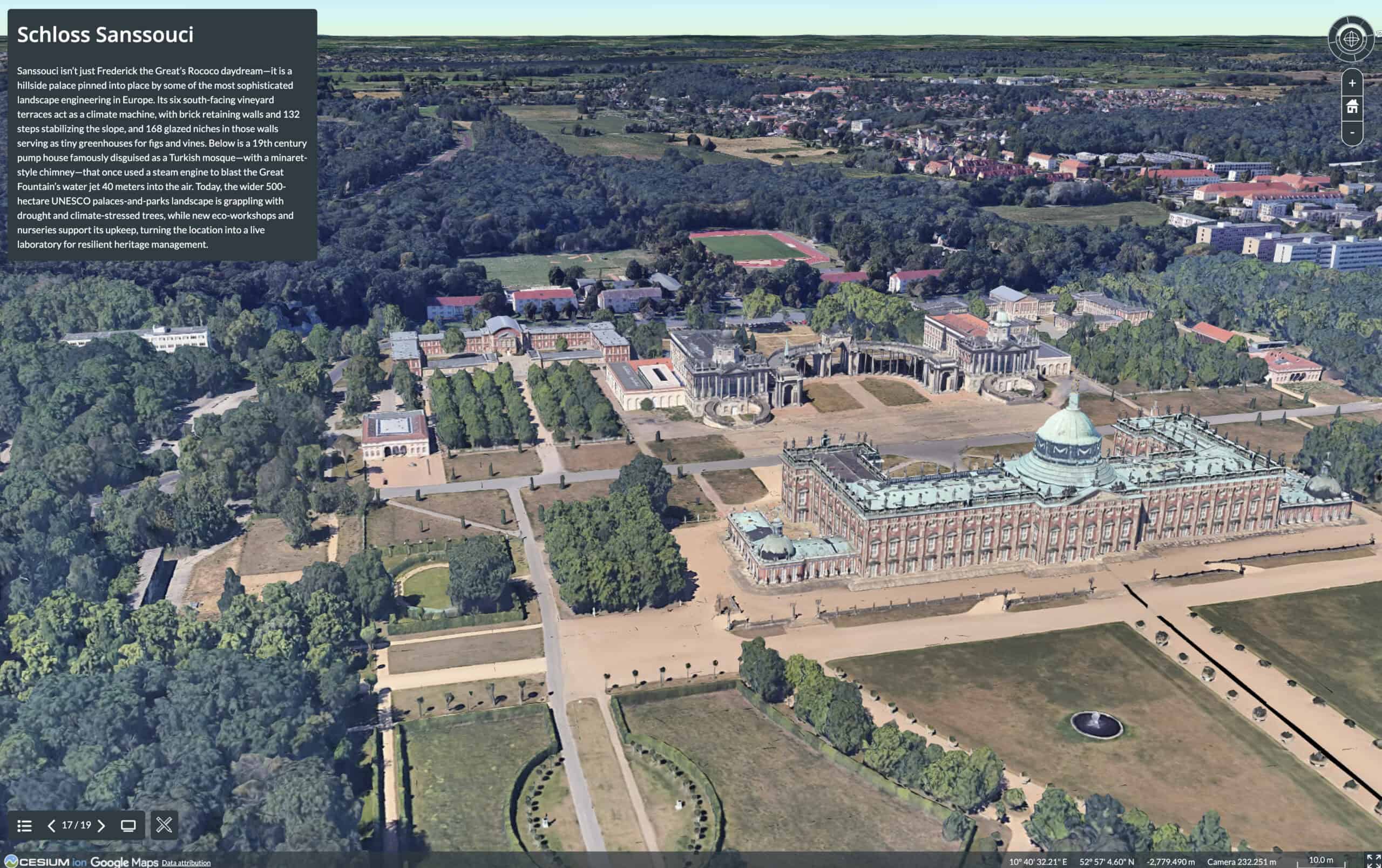
Aerial 3D view of Schloss Sanssouci and surrounding gardens in Potsdam, Germany, with park grounds, pathways, and adjacent buildings visible. Informational text box shown on the left.16. Olympic Stadium
Berlin’s Olympic Stadium is a 1936 showpiece commissioned by the Nazi regime, surgically re-engineered into a 74,000‑seat, 21st-century venue without shedding its monumental stone shell. Set in a shallow bowl in Westend, it was stripped back and rebuilt between 2000 and 2004. Engineers lowered the pitch, re‑angled the lower tier, and threaded new services through the stadium’s historic fabric. Above, a lightweight steel‑and‑membrane cover managing weather, light, and sound is internally supported by a ring of slender columns, keeping sightlines clear. Plugged into Berlin’s transport networks, the stadium—known locally as the Olympiastadion—now performs as a heavily used civic venue for World Cups, Euro football tournaments, concerts, and other events for a forward-looking city with a very different idea of public life.
17. Sachsenhausen-Oranienburg concentration camp and museum
Engineering, like other disciplines, can be abused. Sachsenhausen–Oranienburg was laid out in 1936 as the Nazi SS’s “model” concentration camp, with its isosceles-triangle plan and central Tower A engineered so guards could survey almost the entire prisoner compound from a single axis. Forced-labor industries were involved, from SS workshops inside the camp to the nearby Klinkerwerk brickworks and satellite armaments lines. They plugged the camp’s barracks, industrial yard, and roll‑call ground into the logistics of supplying monumental Nazi building projects in Berlin. After 1945, the German Democratic Republic reshaped the surviving prisoners’ triangle into a national anti‑fascist memorial, including a 40-meter obelisk adorned with red triangles that represent political prisoners, inaugurated in 1961. Today, preserved barracks, reconstructed exhibits, and fire‑scarred remains sit beside the former SS barracks area, now reused as a police training campus.
FAQ:
The Reichstag is a premier “retrofit story” that transformed a 19th-century shell into a transparent, low-carbon hub featuring a famous glass dome designed by Norman Foster. It utilizes a sophisticated energy system, including a biofuel-fired plant and underground aquifer thermal storage, to provide power to the parliament and neighboring government buildings.
Siemensstadt Square is being built “twice”—first as a shared 3D model and then in physical form—to transform a 70-hectare former factory site into a climate-ready district. This district-scale digital twin allows teams to simulate roads and utilities before construction and monitor energy and water usage during operation.
Rising 368 meters, the Berlin TV Tower is the city’s tallest structure and was built by the German Democratic Republic (GDR) between 1965 and 1969. Its tapering concrete shaft and stainless steel sphere were engineered using climbing formwork and are anchored by a robust ring foundation. Amusingly, because sunlight reflects off the sphere in the shape of a cross, West Berliners cheekily dubbed the secular socialist tower “The Pope’s Revenge.”