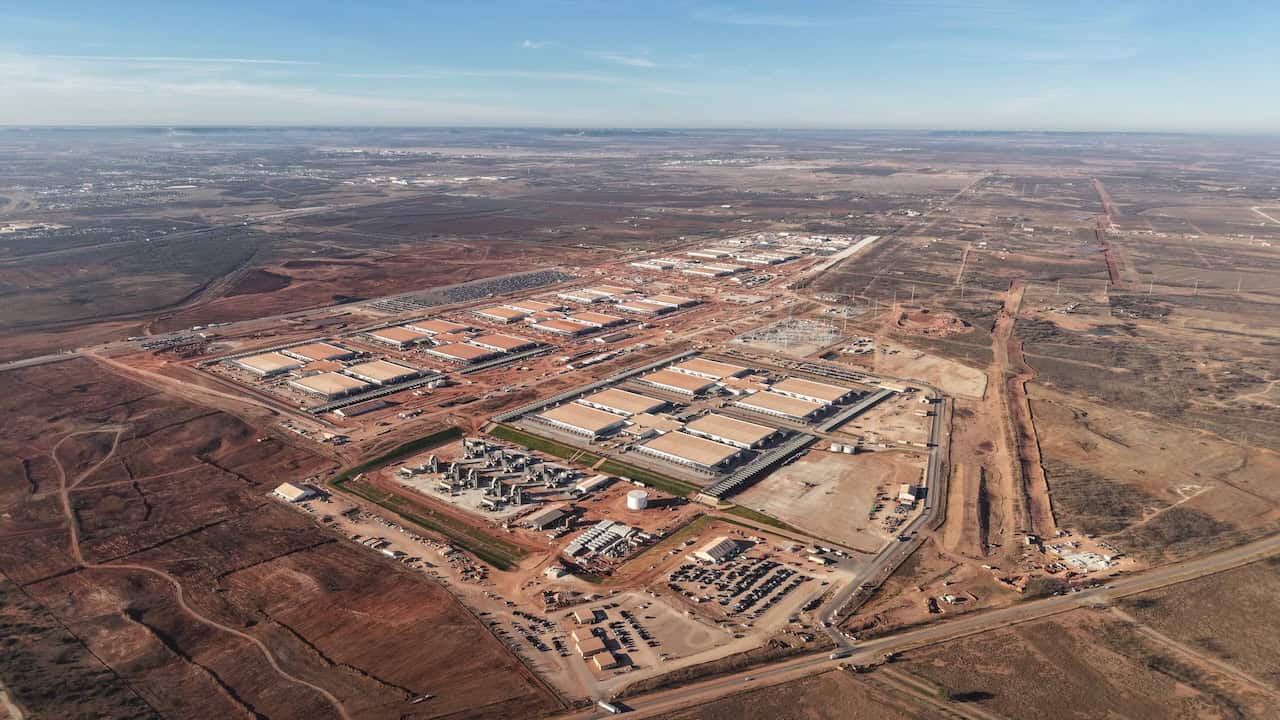
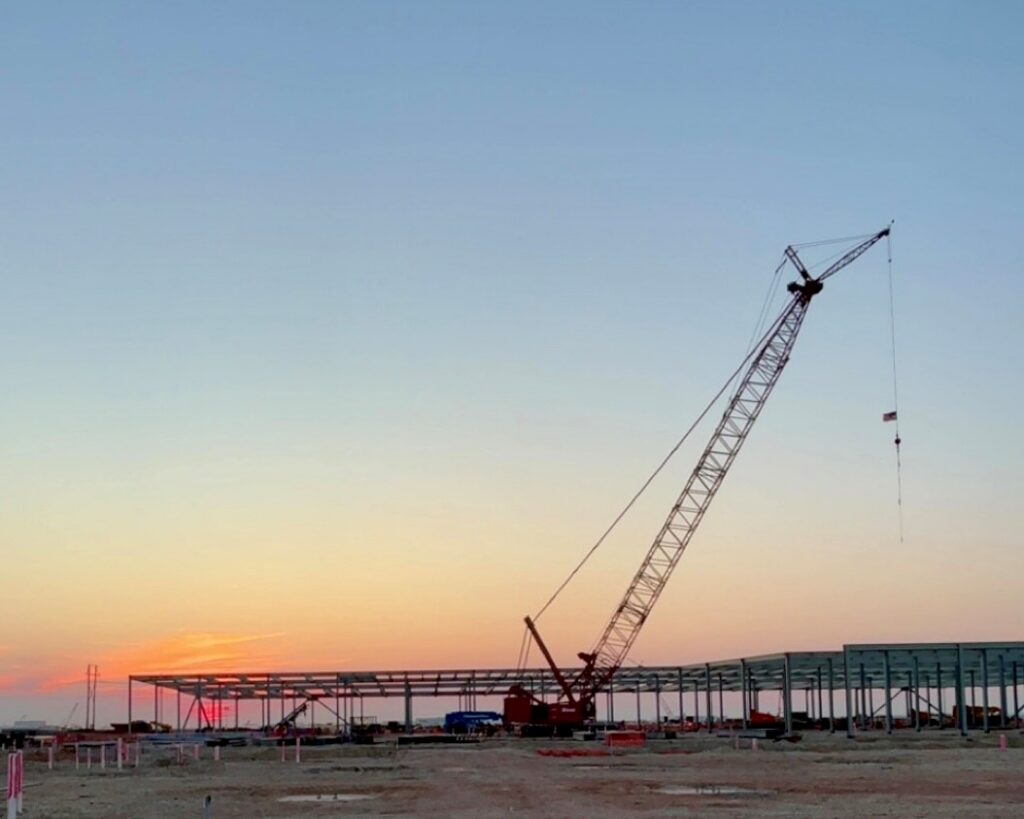
The sun never seems to fully set in Abilene, Texas. During the day, the West Texas sky is broad and blue, but when night creeps in, darkness never quite swallows the northern edge of town. That’s where crews are building 10 massive buildings of what is currently the world’s largest data center construction site. Work goes around the clock.
When the data center is complete, its warehouse-like buildings—each the size of several football fields—will house a total of 400,000 Nvidia chips and draw electricity from a dedicated 1.2-gigawatt natural-gas power plant.
The first two buildings in Abilene are already operational. Two more are going up now, and the pursuit to build the rest is relentless.
DPR Construction, one of the nation’s top technical builders, is in charge of all construction site logistics and operations, overseeing $10 million worth of work installed on a typical day. The request from Crusoe, the AI data center operator, is simple: Safely deliver quality at high velocity. Every day of schedule slippage has the potential to lead to millions of dollars in lost economic value to the project.
“These mega projects are essentially a sequence of sprints within a marathon,” said Hannu Lindberg, DPR’s construction technology leader who manages DPR’s project planning and execution technology solutions. “The expectation is to deliver quick wins while sustaining performance over the long haul.”
That challenge is making DPR reimagine how it approaches the construction of hyperscale data centers. DPR’s drive for learning, innovation, and speed is also reshaping the AI infrastructure market—and the firm is treating Abilene as a live case study for continuous improvement. Each process is tested to its limits and improved as needed; every tool is perfected, and every lesson is captured in a repeatable playbook for further refinement. DPR intends to carry these learnings to future data center jobs—and apply transferable lessons in its other core market sectors.
The Data Problem
Keeping a job this large on a fast-track schedule requires many things, including solving a deceptively simple problem: How do you monitor, at any given moment, what has been built and where?
Construction projects organize work in two ways. There is the work breakdown structure (often referred to as WBS), which describes what is being built: foundations, steel, mechanical systems, and electrical systems. Then the location breakdown structure (or LBS) describes where assets are being built: Building 7, Floor 3, Grid section C. On a project with 10 identical buildings and hundreds of overlapping trades, these two systems must speak the same language.
The consequences of shifting sequence and work priorities are not trivial. Schedules can be impacted every time the design changes or a work zone shifts due to an unforeseen constraint. Delays can compound when schedule information is siloed, maintained offline, or disconnected from the 3D models being used to validate and optimize the construction sequence. If knowledge lives only in people’s heads, when work goes wrong—or right—the lessons rarely make it back to the schedule.
“Everyone should be speaking the same language and be aligned on the same end goal,” said Jack Millea of Trillium, a construction technology firm working alongside DPR on the project.
The Integrated Planning Workshop
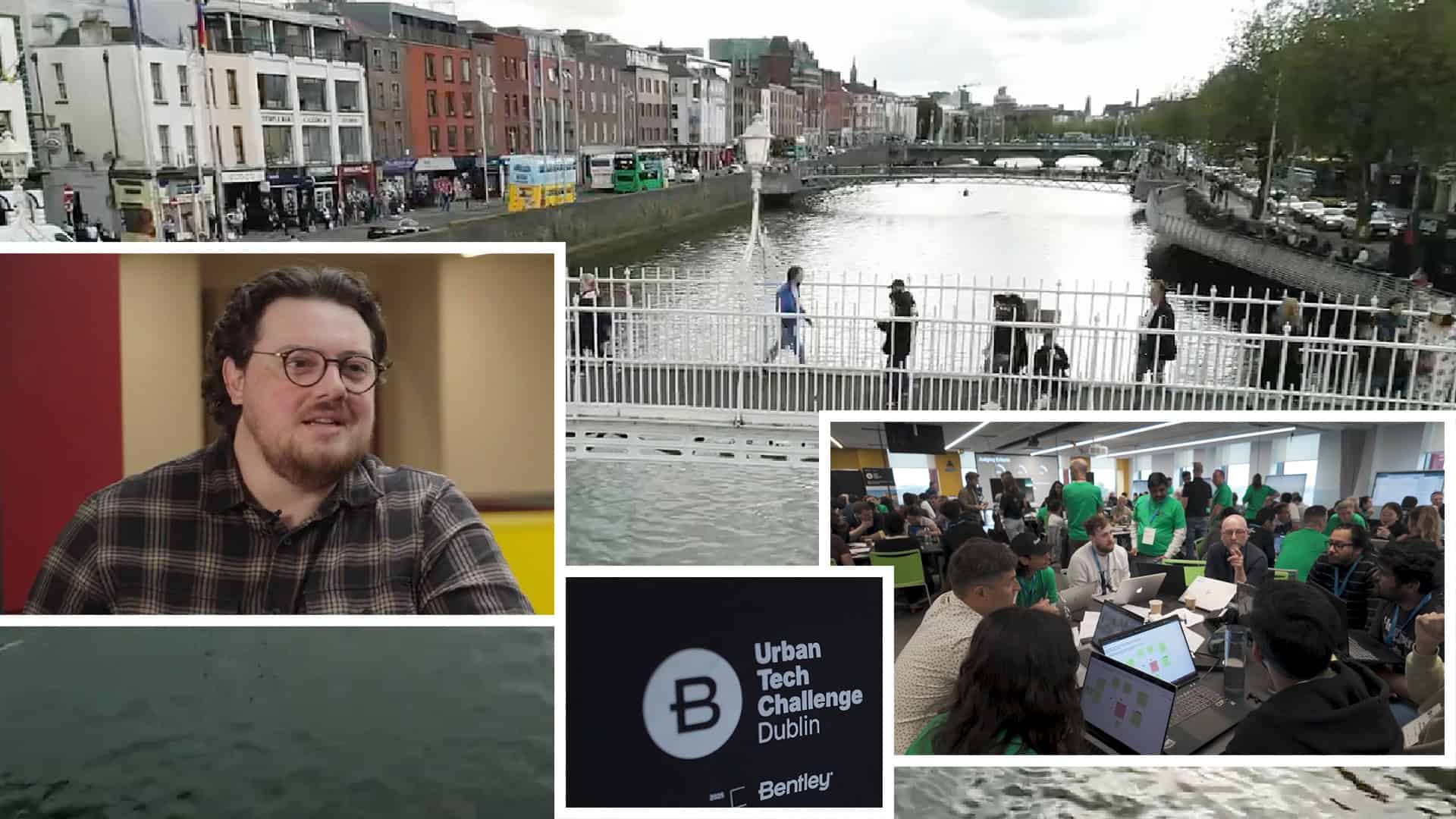
In November 2025, DPR invited a group of software engineers, product managers, and construction technology specialists to Abilene for a two-day working session. DPR hosted its strategic vendor partners to build what participants framed as a “reference architecture”—a standardized digital delivery framework that could be tested on the Abilene project and then exported to other projects.
Among the attendees was a team from Bentley Systems, the infrastructure engineering software company, whose SYNCHRO platform serves as the backbone of DPR’s visual planning at Abilene. Also present were representatives from Trillium, Bentley partner Agile Handover, and Oracle Construction & Engineering. Together, they mapped the project’s challenges for integrated planning for the various planning phases and levels of detail and attempted to align on which schedule integration challenges to attack first.
Two problems rose to the top. The first was how to connect the project’s schedule data and progress documentation—including schedule updates, drone imagery, progress reports, and field notes—into a coherent, real-time view of the job without forcing everyone to use a single monolithic system. The second problem was how to untangle WBS from LBS to distill schedule discipline and vertical integration, so schedules are easier to maintain, and update based on field progress.
The group chose to tackle the second problem first. They could build, test, and validate with a working solution during the workshop and immediately take it into the field.
Four Steps to an Integrated Schedule
The group developed a methodical, practical solution that begins with data standards and governance. Before anyone develops a model or schedule, every discipline on the job needs to agree on a common naming convention and the sequence and flow of work. Teams document the rules in a shared execution plan, and everyone uses the same nomenclature from day one.
Planners can use the model metadata to classify three-dimensional building models, use Bentley’s SYNCHRO 4D software to associate each element with the proper activity based on its location, and automate the linking of model elements to the schedule. The result is a visual plan that can answer sequencing questions in real time. What work scope falls within Building 7, Grid C, Floor 3? SYNCHRO can instantly provide that answer. What activities occurred in that zone yesterday? The integrated system knows and provides the spatial context for time, which is typically missing from traditional schedules.
The foundational platform for SYNCHRO is Bentley’s iTwin. It functions as an infrastructure cloud, a digital container that holds every model for the project, keeps them geospatially located, and makes them accessible to everyone on the team. Whether a field engineer is pulling up a model on a tablet at the construction site or a project executive is reviewing a progress dashboard in a DPR office, they are looking at the same data. The iTwin platform brings the data together without forcing everything into a single database or requiring anyone to manually synchronize files.
In the Abilene jobsite offices, SYNCHRO is already changing how DPR runs its weekly project planning meetings. Rather than distributing paper schedules or walking through static Gantt charts, project managers pull up three-dimensional visualizations of the site on their computers and ruggedized tablets that show, zone by zone and day by day, the exact sequence of work. The model will animate the construction sequence so that supervisors, foremen, and subcontractors can see their own work in context and catch conflicts before they happen in the field.
The improvements between Buildings 1 and 2, which are already complete, and Buildings 7 and 8, which were under construction in November, are real. DPR has not publicly shared exact project acceleration specifics, but they are keen about the direction: Visual planning is providing more predictable sequencing, schedule buy-in from trades, fewer coordination failures, and a reduction in rework. The goal, they say, is to continue improving with every new building that goes up.
The Hyperscale Race
Beyond the data center itself, what DPR is building in Abilene is a new approach to construction. The tools that once felt futuristic are now reshaping how we work, implement workflows, make decisions, and even deliver projects.
The contractors and software firms that prove they can build these facilities faster and more reliably stand to deliver more value for their customers, and while data center projects have been the proving ground, other project types stand to benefit.
That is why the Abilene workshop was more than just a construction site visit. It was a live product development session. Bentley engineers sat beside DPR planners and field supervisors, listening to the friction points in the daily workflow, and went back home with a better understanding of what the software needs to do next. DPR provided invaluable feedback for Bentley’s forthcoming AI-enabled SYNCHRO+ platform before the product is even generally available. The workshop helped shape its development alongside Bentley in a series of workshops and hackathons. Another AI-enabled software from Bentley, OpenSite+, which speeds up civil site development, also turned heads in Abilene.
“We can’t assume that all users, even users that are highly engaged, know how the new tools will solve daily workflows,” said Morgan Hays, Bentley’s senior director of product management for construction and Bentley Infrastructure Cloud. “It’s really valuable to have these hands-on workshops.”
In the intervening months, the collaboration deepened. In February 2026, teams met again, this time online, to review progress on the SYNCHRO application programming interface—the technical handshake that enables DPR’s data systems to automatically communicate with SYNCHRO. The goal is to ensure that schedule updates flow in real time rather than requiring a planner to manually re-enter data at the end of each day. “When we have a baseline, SYNCHRO should just automatically update,” Lindberg said. “Real-time updates should be transparent.” Bentley is now building that capability.

What Comes Next
The next generation of Bentley’s tools, all built on the iTwin platform, goes further still. SYNCHRO+ uses AI and machine learning to accelerate production planning and surface schedule risks before they become delays. OpenSite+ applies AI to site design, automating grade optimization, drainage design, and utility layout that currently requires hours of manual engineering work. Substation+ brings the same approach to the power infrastructure that data centers require in enormous quantities, helping engineers design and de-risk the electrical systems that feed buildings that draw tens of megawatts each.
There is a pattern in all of this new development. The software being used to build AI data centers is itself becoming AI-enabled. The future machine learning models running in the finished buildings were trained, in part, on the compute infrastructure that earlier facilities like this one helped make possible.
For DPR, the ambition is explicit. Abilene is not an endpoint; it is the beginning of an evolving methodology. The firm intends to take what it learns here—the coding standards, the scheduling templates, the digital delivery workflows, the model-based field instructions—and explore how to apply them to projects across its portfolio.
In a business where a single day of delay costs a fortune, the firm that wins eliminates the most delay and speeds up the process. DPR is betting that the answer is not more workers or faster equipment—it is better information, flowing faster, to the right people at the right time.
FAQ:
DPR Construction is overseeing the massive task of building 10 football-field-sized structures that will house 400,000 Nvidia chips to power hyperscale AI. To keep the lights on for all that processing power, the site features its own dedicated 1.2-gigawatt natural-gas power plant.
The iTwin platform functions as a digital “infrastructure cloud,” storing every project model in a geospatial container accessible to the entire team. It allows the project to stay synchronized without forcing everyone into a single database or requiring manual file swapping.
Speed is the name of the game, and DPR wins by using Bentley’s SYNCHRO 4D platform to turn static schedules into interactive 3D visualizations. This “visual planning” allows supervisors and trades to see the exact sequence of work on ruggedized tablets, catching conflicts before they ever become headaches in the field.