Water utilities are under increasing pressure to meet regulatory compliance while managing aging infrastructure and rising operational costs. A proactive water utility strategy using Bentley’s water utility digital twin solutions helps unify data, improve visibility, and enable predictive maintenance across the network.
Is your utility still using a patchwork of spreadsheets, outdated maps, and institutional memory to manage your water network? This reactive approach, where skilled operators spend their days chasing main breaks and critical data is scattered across disconnected systems, is not just inefficient—it’s a high-stakes gamble with regulatory fines, infrastructure failure, and eroding public trust.
Water utilities can and should move beyond a reactive, high-risk approach to regulatory compliance. The intense pressure from mandates like the EPA’s Safe Drinking Water Act and the EU’s Water Framework Directive is not just a burden; it’s a powerful catalyst for transformation. By addressing foundational operational challenges with an integrated digital strategy, the weight of regulation can be converted into an engine for achieving greater efficiency, resilience, and reliability.
The examples in this article reflect common, real-world situations reported by water utilities—such as fragmented data, aging infrastructure, reactive maintenance cycles, and growing regulatory pressure and illustrate what utilities often experience. It outlines how a digital twin approach can help teams move from reactive response to proactive, compliance-ready operations.
Part 1: Water utility regulations are increasing operational risk
For leaders in the water sector, regulatory compliance is more than a line item; it is a relentless, high-stakes pressure shaping daily operations and long-term strategy. Around the world, governments are tightening standards. Whether it’s complying with the EPA’s Lead and Copper Rule updates in the United States or adhering to the EU’s Drinking Water Directive, the message is clear: the margin for error is shrinking. These are not abstract goals—they are strict legal requirements tied to significant financial penalties, potential legal action, and the foundational trust of the communities you serve.
Navigating this complex environment with traditional tools and fragmented processes is becoming increasingly untenable. The constant threat of aging infrastructure—with some U.S. water systems losing 6 billion gallons of treated water daily—the unpredictability of climate events, and the demand to do more with less create a perfect storm of operational risk. Simply keeping up is a challenge; getting ahead seems nearly impossible.
But what if the burden of regulation could be reframed? What if the same data required for compliance reports could also unlock unprecedented operational efficiency?
At Bentley, we believe the path to mastering regulatory challenges lies in embracing a more unified, intelligent, and predictive approach. It’s time to move beyond reactive problem-solving and build a system that is compliant by design and resilient by nature.
In many utilities, compliance pressure becomes urgent when teams must assemble time-sensitive inventories and reports—often by reconciling decade-old spreadsheets, inconsistent GIS layers, and paper as-builts. When data ownership is unclear and records don’t match across systems, routine reporting can turn into weeks of manual validation, last-minute field verification, and uncertainty about whether the final submission is complete and defensible. The risk isn’t only fines; it’s the possibility of discovering—too late—that the organization can’t answer basic questions about materials, locations, or the operational history of critical assets.
Part 2: Why traditional water utility operations fail
A common breaking point comes during a high-impact event—such as a summer heatwave, a severe storm, or a major main break in a high-traffic area—when fragmented systems slow down response. Field crews may be working from maps that don’t match current conditions, engineering may be referencing different as-builts, and customer service may have limited visibility into isolation plans, outage boundaries, or restoration timelines. When valve status, pipe attributes, and customer impact can’t be validated quickly, a repair that should be straightforward can extend into hours of additional outage time, higher costs, and avoidable reputational damage.
For decades, the water sector has relied on established but increasingly outdated practices. Using them today exposes utilities to significant financial, operational, and reputational risks. The core of the problem lies in three fundamental areas:
1. Fragmented information and lack of visibility
In most utilities, critical network information is scattered across disconnected systems:
- Engineering designs are in CAD files
- Customer data is in a billing system
- GIS provides geographic context
- SCADA reports operational pressures
- Maintenance records are in separate spreadsheets
This fragmentation creates a state of near-constant data fog.
The consequence: When a regulator asks for a comprehensive report on lead service line inventories to comply with new mandates, assembling the information becomes a painful, manual exercise in data archaeology. Teams spend more time hunting for and reconciling conflicting data than they do analyzing it. With more than 60% of utilities reporting that they collect data but don’t leverage it effectively, it’s clear that without a single, trusted view of the network, it is impossible to have full confidence in compliance reports or to provide auditors with a clear, defensible record of operations (Forrester Research).
2. A cycle of reactive maintenance and emergency response
The old mantra, “If it isn’t broken, don’t fix it,” has forced utilities into a perpetual reactive cycle. This “break-fix” approach turns skilled operators into emergency responders, rushing from one main break to the next.
The consequence: This model is incredibly expensive. An emergency repair can cost 10 to 50 times more than a planned one, turning a potential USD 500 scheduled job into a USD 15,000 crisis involving water damage restoration and overtime labor. An unexpected pipe failure can lead to service interruptions, boil water advisories, and environmental contamination—all of which carry severe regulatory consequences and erode public trust. Responding to these events, rather than preventing them, means the utility is always on the defensive, unable to control its own operational destiny.
3. Uncertainty in strategic decision-making
Utility leaders must make multi-million-dollar decisions on capital improvements with incomplete information.
The consequence: Without the ability to accurately model the hydraulic impact of replacing a specific set of pipes, or to simulate how the system will respond to a new pump schedule, decisions are based on experience rather than data-driven prediction. This decision-making process leads to misallocated capital, where money is spent on projects that don’t deliver the expected return. It is especially critical when a third of the water sector workforce is expected to retire in the next decade, taking their institutional knowledge with them and leaving a data-reliant generation in their place.
Part 3: How digital twins enable proactive water management
The pressures of modern water regulation are intense, but they do not have to be a barrier to success. Relying on fragmented data, reactive maintenance, and uncertain decision-making is a path of ever-increasing risk and cost.
There is a clear path forward. The journey begins by confronting these challenges with a new, intelligent approach.
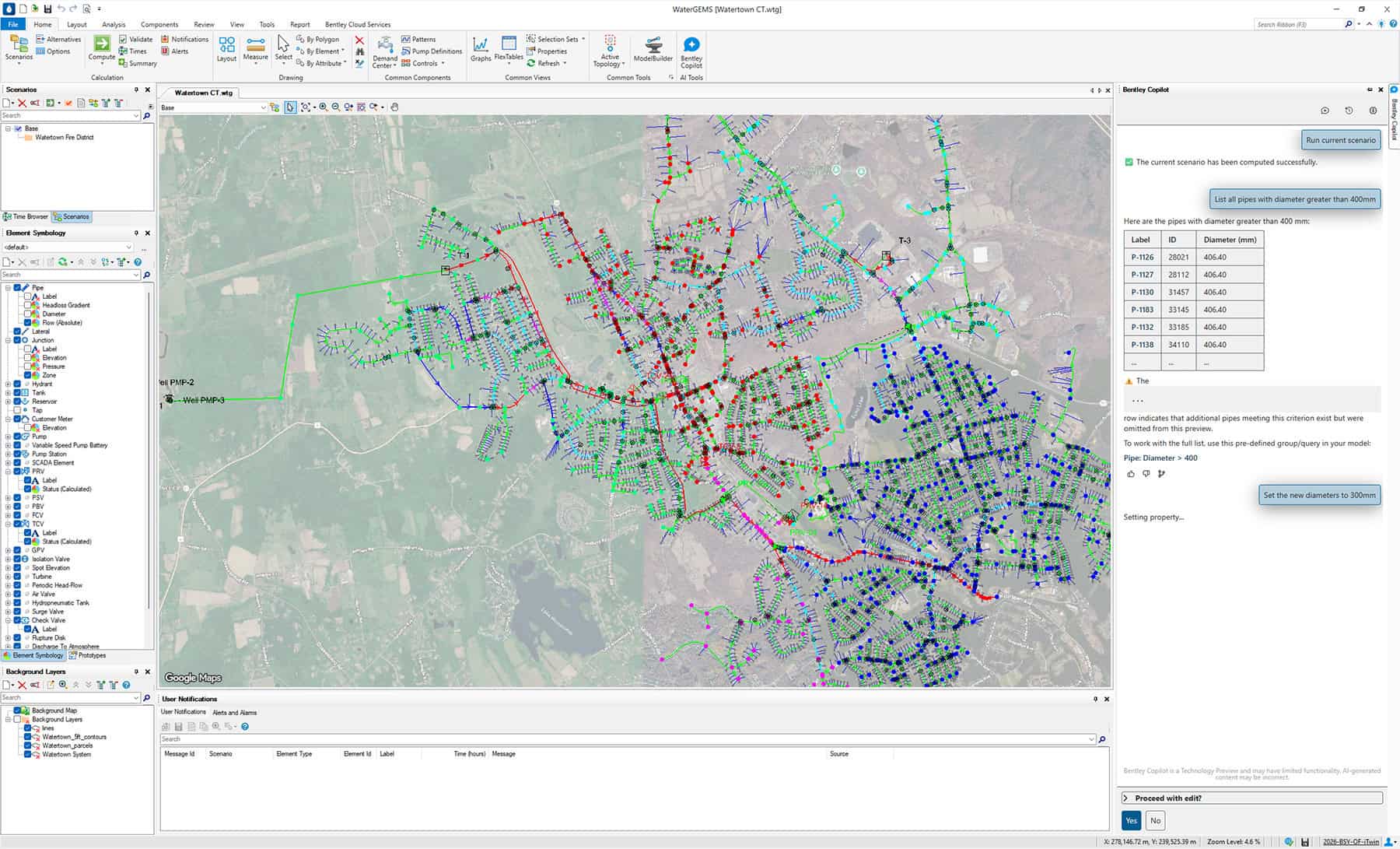
When utilities take a proactive turn, the work often starts by unifying disparate data sources into a single operational view—connecting GIS, SCADA/telemetry, maintenance histories, work management systems, and engineering records. With a digital twin foundation in place, teams can run “what-if” scenarios to understand how pressure fluctuations, demand shifts, asset age/material, soil conditions, and operational changes interact. Many utilities use these insights to identify higher-risk mains and valves, prioritize targeted renewals, and plan isolations and response playbooks before emergencies occur—shifting the organization from reactive defense to data-driven risk management.
By unifying your data, you gain clarity. By leveraging simulation, you become proactive risk managers. And by embedding predictive analytics, you replace guesswork with foresight. Bentley provides integrated solutions to make this transformation a reality. Stop letting regulation dictate your operations. It’s time to take control.
Over time, utilities that operationalize this approach often see measurable improvements: higher confidence in asset inventories and compliance submissions, faster isolation and restoration planning during incidents, and fewer surprise failures as risk-based programs mature. Instead of relying on ad hoc data pulls, reporting can become repeatable and auditable because the underlying information is maintained as part of day-to-day operations. Teams spend less time reconciling records and more time optimizing performance—using analytics to guide capital planning, schedule lower-disruption repairs, and steadily improve resilience.
| Core challenge | Action | Benefit |
|---|---|---|
| 1. Fragmented information and data fog | Achieve total system visibility by unifying disparate data sources (SCADA, GIS, etc.) into a single, comprehensive digital model. | Eliminate data chaos, enabling confident, auditable compliance reporting and giving all teams a shared, accurate view of the network’s health. |
| 2. The high-cost “break-fix” cycle | Master system performance with simulation by creating a digital twin of the network to test “what-if” scenarios in a risk-free virtual environment. | Break the expensive cycle of emergency repairs, enabling you to proactively identify and mitigate risks, design resilient systems, and prove the effectiveness of emergency plans. |
| 3. Uncertainty in strategic decisions | Enable proactive, predictive operations by applying advanced analytics and AI to network data to forecast failures and optimize performance. | Replace guesswork with data-driven foresight, leading to predictive maintenance, optimized operational efficiency, and smarter, risk-based capital investments. |
Take control of water utility compliance and performance with Bentley’s water digital twin solutions that unify data, reduce risk, and enable predictive operations.