In early February, the Khronos Group, the open standards consortium which counts Google, Nvidia and Apple among its members, released a candidate for a new extension that could reshape how the world captures and shares three-dimensional reality. The extension, called KHR_gaussian_splatting, would for the first time enable storing 3D Gaussian splats inside glTF 2.0—the most widely used format for delivering 3D content across the internet.
If that sounds technical, here’s what it means in plain language: there is now a path toward a universal, open format for a breakthrough 3D imaging technology that is poised to change how we experience the real world online. This format has the potential to dramatically improve everything from how engineers design, build and inspect bridges, factories and telecom networks, to how we experience sports, entertainment and everyday reality.
The extension standardizes Gaussian splatting, a technique that turns ordinary photographs into stunningly realistic 3D scenes. Traditional models turn 2D images into 3D models by wrapping a hollow polygonal “skin” around objects.
“KHR_Gaussian_splatting marks a major milestone for glTF, extending the format to support an entirely new class of geometric representation,” said Neil Trevett, president of the Khronos Group. The acronym glTF stands for graphics language transmission format. It’s been described as the “JPEG for 3D.” Trevett said that by “bringing the Gaussian splatting community together around a standards-based approach, Khronos is helping ensure this powerful new rendering technique can scale across tools, platforms, and the web.”
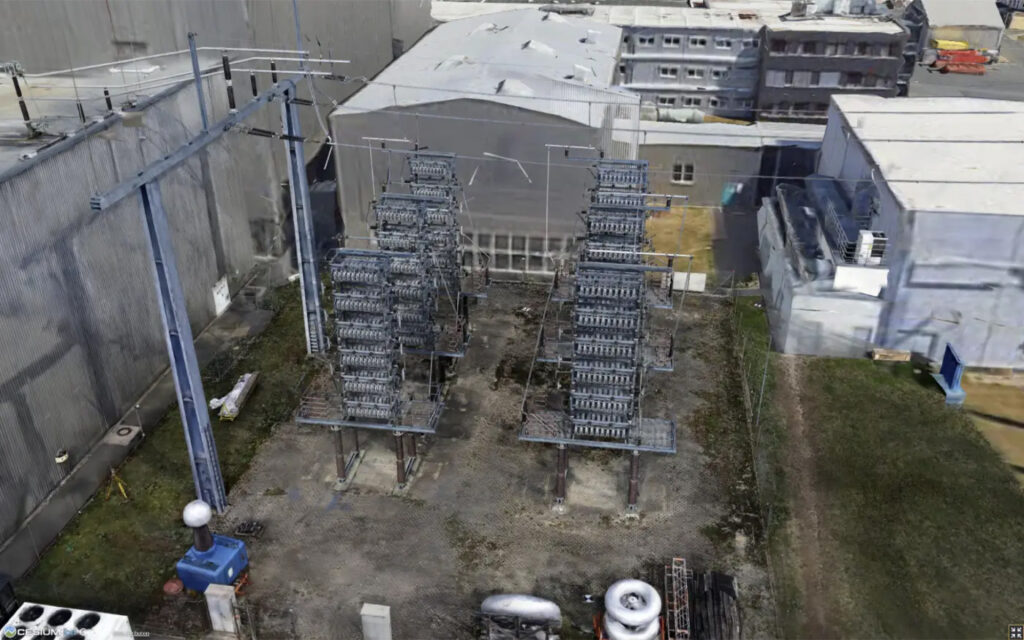
Researchers like Marc Levoy at Stanford and Lee Westover at the University of North Carolina have been experimenting since the late 1980s with representing surfaces as tiny bits of volume—think millions of little snowballs floating in space. The idea took off in recent years when George Drettakis of France’s National Institute for Research in Digital Science and Technology (INRIA) and his PhD student Bernhard Kerbl introduced Gaussian functions into the mix. Named after Carl Friedrich Gauss, the mathematician who “invented” the bell curve, these functions describe each point as a soft, fuzzy blob rather than a uniform dot. Each “Gaussian splat” carries information about its position, color, size, transparency, and orientation. Layered together, millions of these splats can reconstruct a 3D scene with striking realism—capturing thin wires, reflections, and even glass that changes appearance as you move around it, details that traditional polygon-based graphics often miss.
The extension matters because without a shared, open format, developer would build their own proprietary ways to store and share Gaussian splats. That fragments the market, locks users into single vendors, and slows adoption and scaling. Think of the early days of digital photography before JPEG became universal—camera makers like Canon, Nikon, Sony and others each had its own format, and sharing images could be cumbersome.
“Standardizing Gaussian splatting in glTF is a major step forward for the 3D ecosystem,” said Patrick Cozzi, chief platform officer at Bentley Systems, the infrastructure engineering software company, and founder of Cesium. Cozzi is also one of the creators of glTF. “This extension gives developers, creators, and platform providers a common foundation for sharing realistic, real-world scenes at scale.”
Bentley, which champions open standards and data, played a central role in making the new development happen. Amanda Morgan, Bentley’s senior director for open standards, co-chairs the Khronos 3D Formats Working Group. Adam Morris, a principal engineer at Cesium, led much of the technical development of the specification. And Renaud Keriven, a distinguished engineer at Bentley whose career in computer vision stretches back three decades—and who was once a research neighbor of Drettakis, the INRIA scientist whose 2023 paper launched the Gaussian splatting revolution—contributed deep expertise in reality capture.
The effort is also notable for its cross-industry collaboration. Bentley worked not only within Khronos but also with the Open Geospatial Consortium and OpenUSD to ensure the standard would serve industries as diverse as infrastructure engineering and geospatial visualization, e-commerce, gaming, entertainment and others. The extension was developed with contributions from Autodesk, Esri, Huawei, Niantic Spatial, NVIDIA, and XGRIDS.
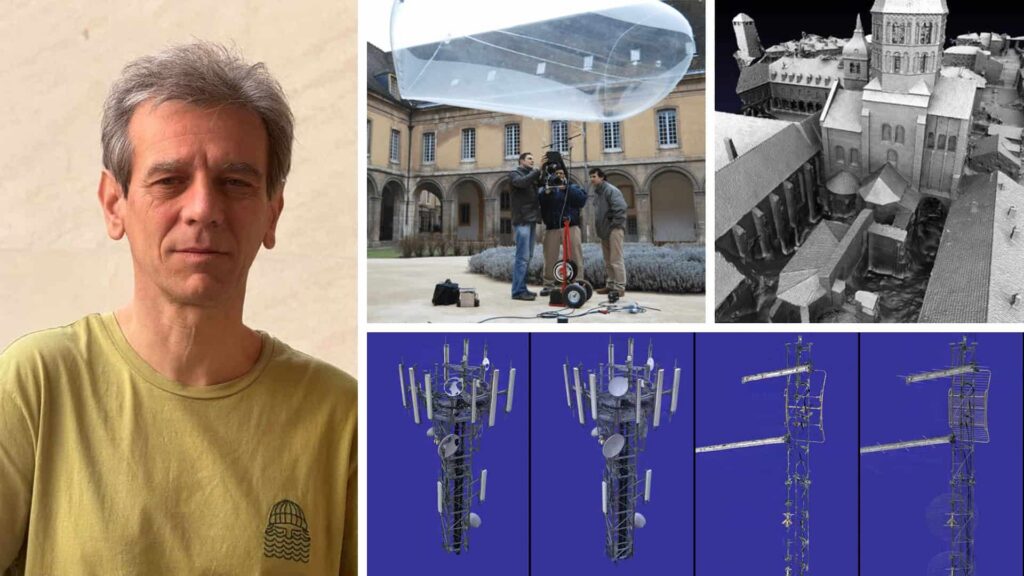
To understand why this matters—and what comes next—we sat down with Keriven and Morgan for an interview. Below is an edited version of our conversation.
Bentley Insights: You co-chair the Khronos 3D Formats Working Group. Why does the Gaussian splats extension for glTF matter?
Amanda Morgan: glTF is a key transmission format used extensively across the 3D community—from e-commerce to infrastructure to geospatial applications. It lets anyone create, share, and display three-dimensional content. The working group I co-chair brings together companies from across the industry to agree on a common baseline for new features. The Gaussian splatting extension is the latest—and possibly the most exciting—one we’ve worked on. We started almost two years ago, holding town halls to get input from across the industry on what everyone was looking for. Then Adam Morris and Renaud’s team, working alongside Niantic Spatial and Esri, built out the technical details. We also worked with OpenUSD and the Open Geospatial Consortium to make sure the standard aligned across industries well beyond the companies in glTF—which was itself new and cutting edge.
BI: Why is having an open standard so important? Gaussian splats already work—what changes?
Renaud Keriven: It’s not just about making things easier—it’s about making them standard. Without a standard, you end up with what happened before with meshes and point clouds. Some companies had their own proprietary formats for streaming, and implementing those was, frankly, a nightmare—a reverse-engineering exercise. That’s why ten years ago we turned to what were then called Cesium 3D Tiles, because they were open. With an open standard, you can produce with one solution and consume with another, instead of being locked into a single company.
BI: Can you give us an example of what that means for users?
Keriven: Sure. We could have created our own proprietary format at Bentley—where only iTwin Capture produces it and only iTwin-based solutions can read it. But with this open format, anyone can produce Gaussian splats in this format—and potentially do it better than we can. That’s open competition, and it’s good news for users. At the end of the day, it’s good news for everyone—like open source is for software.
Morgan: And it goes beyond just one industry. Our group initially focused on geospatial visualizations. But what we discovered is that what we need from Gaussian splats is different from what Meta needs, which is different from what Huawei needs, which is different from what IKEA needs. And all of those companies are part of our group and contribute to the standard. So instead of a single-industry or single-company solution, we build the baseline together, agree on it, and then compete on implementation. When we have an agreed-upon baseline, the competition makes all of our products better—which ultimately benefits the user. That’s where we build our business: providing value beyond the open standard.
BI: Renaud, you were literally a research neighbor—your offices were next to each other— of George Drettakis, the scientist whose 2023 paper launched the Gaussian splatting revolution. How fast has this technology moved?
Keriven: It’s insane how successful Gaussian splats have been. Going from a research paper to an industry standard in three years—that’s something that has never happened before. Think about JPEG. I remember when JPEG was just a hardware standard—people tried to build their own hardware cards to produce it, telling everyone it would never be fast enough without specialized hardware. It took maybe ten to fifteen years for JPEG to become a true standard. Gaussian splats? Three years from the research paper. It’s a record.
(For more on Keriven’s career in computer vision—including the early experiments that helped launch reality capture—read his profile on the Bentley Blog.)
BI: What drove that extraordinary speed?
Keriven: Gaussian splats do a lot of things people across different industries are looking for. If you’re in movies, you can use them. If you’re in gaming, same thing. In our industry, with engineers wearing hard hats in the field, we need Gaussian splats not just for photorealism but to capture fine details—power lines, cables, cranes. Everyone finds something useful in them.
But there’s something else. A lot of people think Gaussian splatting is about AI. It’s not. It uses AI tools—GPUs, optimization techniques from that ecosystem—but it’s not AI itself. What happened is that the AI revolution changed the culture of research. You can no longer just publish a paper and claim your method is better without sharing your code. You have to publish the code so others can verify your claims. George Drettakis did exactly that. And because everyone could start from his published work and build on it, the pace of innovation accelerated enormously.
BI: What are the engineering applications? How is Bentley putting this to work?
Morgan: One key aspect of getting an open standard through ratification is that you have to show it works in the real world. Renaud’s iTwin Capture team and the Cesium JS team worked extensively together to implement Gaussian splats in our own applications—so we could stand up and say, “Look, we know this works.” At last year’s Cesium Developer Conference, we put it out there and literally launched it for everyone on the open Cesium JS platform the first day. By the next day, NVIDIA came and presented at the conference using our Gaussian splats. By the end of the conference, people were already building with it.
Keriven: At Bentley, we now have Gaussian splats in multiple places—in our cloud services, in the iTwin Capture desktop client, and in Cesium ion. And anyone who wants to use Gaussian splats in their own application can use our cloud services to do the processing. Engineers can also choose how they work, whether they prefer hands-on local control or the scalable power of the cloud.
BI: Amanda, you mentioned that the specification and schema are now stable. Can you explain what those terms mean in plain language?
Morgan: Think of the specification as the user manual—it lays out how to implement the code, what fields and elements you need, what you should and shouldn’t do, and what we didn’t include. The schema is the machine-readable definition that produces the outcome. We’re now in release candidacy, which means the spec and the schema are stable and won’t change unless we find a major issue. After that comes ratification.
One important thing: the baseline extension we released does not include compression. Many applications need compression to handle Gaussian splats efficiently—imagine trying to stream millions of those particles over the internet. There are several candidate compression standards: Niantic Spatial has one we’ve been working with, Qualcomm just released another. We’re letting the industry experiment and decide which compression approach works best before we standardize that layer too.
BI: Looking ahead, what excites you most about where this is going?
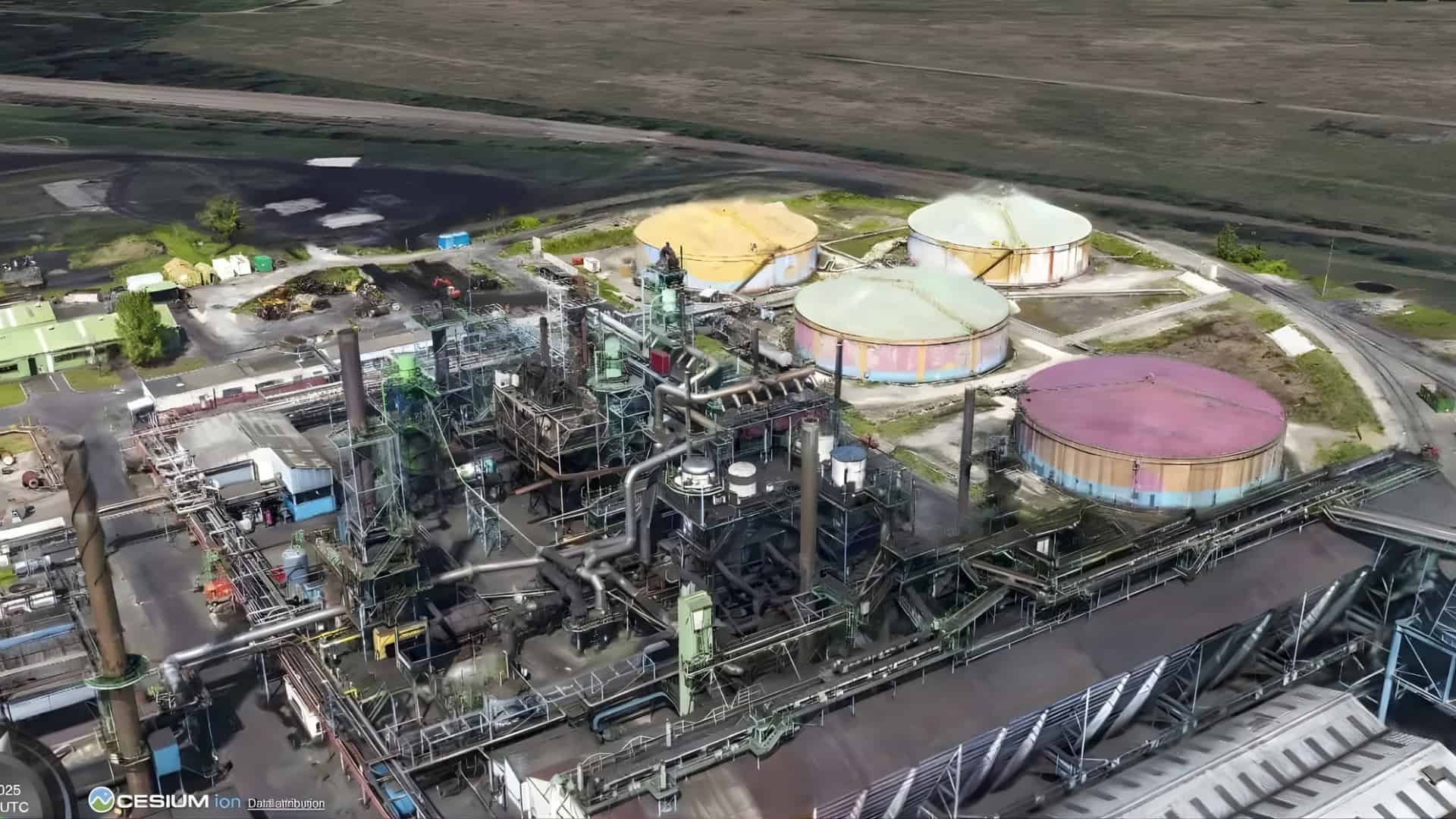
Keriven: Adding time to the format. That’s so important for engineers. You need to monitor construction sites, detect changes, track what’s happening over weeks and months. My team is currently working on using Gaussian splats plus time to do exactly that—monitoring construction sites and detecting changes. We have a massive data set from a large facility that’s been captured by drones every week for nearly a decade. I’m working on applying Gaussian splats with a time dimension to that data. Stay tuned—I may have a great story to tell soon.
Morgan: Gaussian splatting is one of the key features going into 3D Tiles 2.0, the upcoming standard from the Open Geospatial Consortium. That standard will also include time-dynamic tiles, voxels, and other extensions. The industry is ready for it.
Keriven: The bottom line is this: by adding a time dimension, Gaussian splats move from capturing a single moment—what something looks like today—to tracking how it changes over time. For infrastructure, that’s the leap from design and construction to operations: from building something and moving on to the next project, to actually monitoring assets over their entire lifecycle. If you can handle and store and stream those changes efficiently, that would be a big change for the industry.
The Khronos Group expects to ratify the KHR_gaussian_splatting extension in the second quarter of 2026. Community feedback can be submitted via Khronos GitHub.