Home / Insights and Inspirations Posts / Perspectives / The Man Who Opens Everything

The Man Who Opens Everything

Since he cracked open his calculator as a teenager, Bentley CTO Julien Moutte never stopped removing barriers. It turns out that's a pretty good business strategy.

Tomas Kellner Profile Image

Tomas Kellner

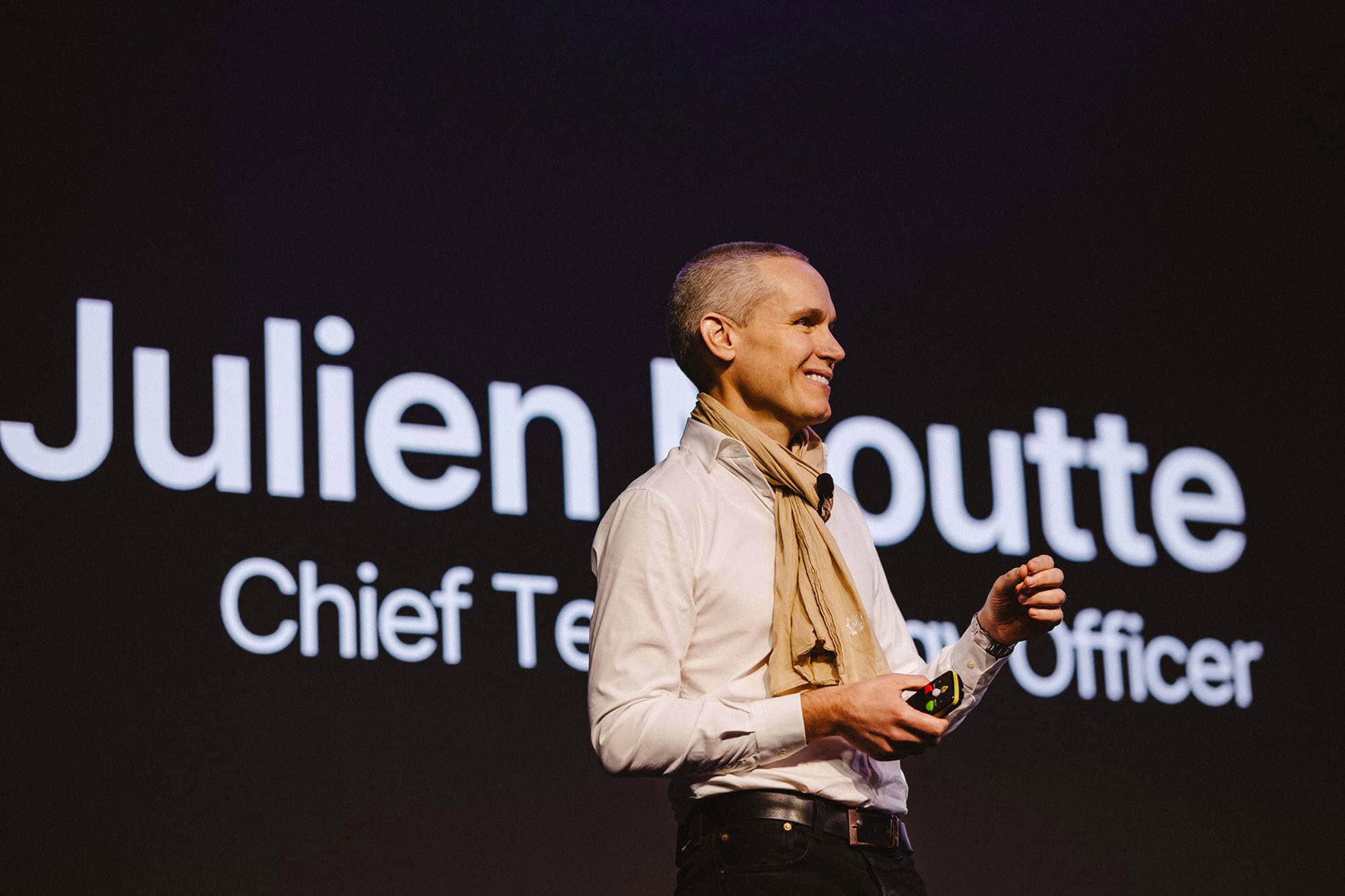
Bentley Systems CTO Julien Moutte at the Bentley Tech Summit.
Bentley Systems CTO Julien Moutte

Share

When you walk into Bentley Systems’ Dublin office on most weekdays, you’ll likely find Julien Moutte exactly where you expect him: at a desk, made from light wood, located in the middle of the open-plan floor. There’s no corner office, no closed door. Instead, he’s surrounded by a beehive of software developers, productĀ  managers, and other colleagues building Bentley’s civil engineering software.

The symbolismĀ of theĀ setupĀ is intentional.

As Bentley’s chief technology officer, Moutte believes in removing barriers—and in leadership that’s accessible and visible. He typically arrives before 8 a.m. and is often the last to leave. His long hours aren’t meant to signal authority; he wants to be present and available. ā€œAt any point in time, people can see that I am here, I am working, doing everything I can to make us and our customers win,ā€ he says. ā€œDoing this hidden in a room ruins most of the benefit.ā€

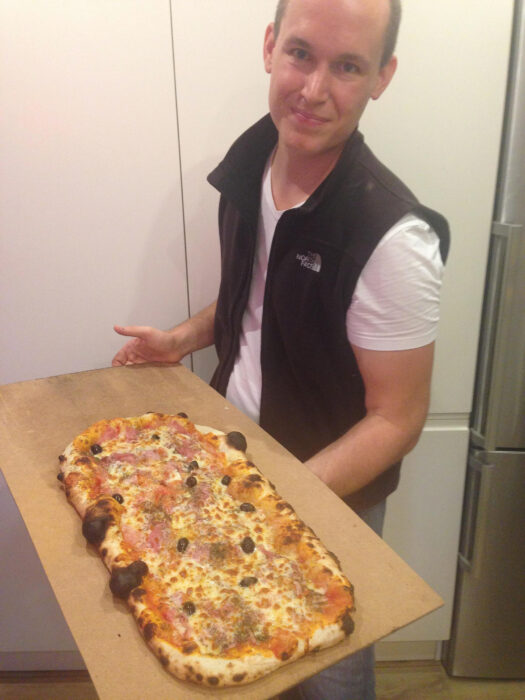
Bentley CTO Julien Moutte holding a rectangular pizza on a wooden board in a kitchen.
Besides software, sourdough is another of Moutte’s great passions. In the spirit of open source, he shares his starter with anyone who asks — the wood-fired pizza in his hands is proof.

His desk serves as an invitation, and colleagues often stop by with questions or to kick around ideas about artificial intelligence (AI), infrastructure engineering, and other topics. ā€œI want people to be able to engage me, ask questions, debate,ā€ he says. ā€œNo hidden agenda; I want to create clarity about where we are headed and how we get there.ā€

Every Friday, he reinforces that clarity in writing. He sends a note to his team that reflects on the week’s progress, his travels, innovation, and the challenges keeping him up at night. But he doesn’t stop at his work. He often writes about his personal life: the trail he hiked, the book he read, the bread he baked, or the joy of the Christmas morning 40 years ago when he and his siblings unwrapped their first computer. The email is part status update, part declaration: Everything that matters should be visible. This includes strategy, his way of thinking, and even the hobbies that energize him and allow him to recharge.

The mindset applies whether he is talking about software development or urban flood monitoring: information works best when it’s shared, systems improve when people can see inside them, and barriers — whether physical, technical, or organizational — are to be examined and, when possible, removed.

Anyone with a YouTube account can now see his mindset in action. Last November, Moutte walked through Dublin’s Docklands with a camera crew for a film produced for Bentley by BBC StoryWorks Commercial Productions. The film, which was just released, follows him and Dublin City Council’s Nicola Graham through the city’s Docklands neighborhood as they talk about flood sensors, digital fire response maps, and open data systems that most citizens never see but depend on every day. “Technology and infrastructure can have a massive impact on the world,” he told the crew. “But you always do that for the benefit of the citizens.”

The Town of Bridges

Moutte has been opening things his whole life. It began with a calculator.

He grew up with a brother and a sister in Digoin, a small French manufacturing town of about 9,000 people northwest of Lyon, best known for stoneware, beef, and rugby. His father was a doctor, his mother a nurse. They talked medicine at dinner every night, but engineering was never far away. ā€œThe town is surrounded by rivers and canals,ā€ Moutte says. ā€œIt’s one of the unique cities in France where you have to cross a bridge to get in.ā€

His curiosity about how things worked extended indoors. When he looked under the Christmas tree and found a computer, the French-made Thomson TO8D machine with the hardware inside the keyboard, he connected it to the TV and quickly moved past the games. “I imagined the possible and wanted to start controlling the machine.” His first program drew rectangles on the screen. When he heard about something called “Windows,” he tried to make his program draw windows, literal boxes. “I had no idea back then what Windows was,” he laughs.

The real turning point came in high school, when he saved every franc he could spare to buy an HP-48 scientific calculator, the kind real engineers used. Most students used it to crunch numbers and solve problems. Moutte cracked it open.

“That calculator was beautiful because you could program it,” he recalls. “But you could move beyond the safety of the user-level interface, start accessing the memory and the CPU, and write code directly using its assembly language, the machine language the calculator itself speaks.”

The process was gruelingĀ and risky. He prepared programs by hand on paper, lines of letters and numbers,Ā and entered them manually. One wrong character couldĀ wipe out the memory orĀ destroy the device entirely. “The amount of anxiety was huge,ā€ he says. ā€œAny mistake was potentially fatal. You wipe off the sweat, you run it, and you’re exuberantly happy when it works and almost crying when it doesn’t.”

The compulsion to unlock and open the machine, and to gain control over its memory and hardware, was stronger than his anxiety. He pushed deeper, tapping into hidden APIs, unlocking capabilities the manufacturer never intended users to find. “That fascinated me, the way you could get out of the comfort zone that was defined for you,” he says. ā€œI realized I wanted to study this.ā€

Into the Trenches

Moutte took that fascination with him to study computer science in Lyon, one of France’s largest cities. It was a big shift for him, but his high school hobby prepared him well. At theĀ university, he and his classmates went straight ā€œto the trenchesā€ and began learning about hardware, CPU architecture, memory structure, bus speeds, and machine code.Ā In high school, Moutte was earning mediocre grades, but in college, he finished at the top of his programming class. ā€œI was spending all of my time working with computers,ā€ he laughs. ā€œThose first two years went by really fast.ā€

Those two years gave him skills he thinks are becoming increasingly rare. “Many people are learning how to do programming, but they don’t understand how that language is translated into what the hardware actually does,” he says. Compared to the hard drive, he says, the CPU is working at the speed of light. ā€œAnd when you need to access data, you need to talk to a bus. It’s like posting something to a different country with snail mail. It takes forever.” It helps to know that, he says.

At this point, his classmates were getting internships at large companies like IBM. But Moutte and a friend hacked the system. They launched their own company and hired themselves as interns. They set up shop in a high school where the friend’s father worked, with the receptionist posing as their supervisor whenever the university called to check. “You were not supposed to do that!” he laughs.

They crammed into a small room and coded around the clock. The dot-com boom was in full swing, and the company grew fast enough that Moutte decided to skip the remaining three years of his computer science education. His parents told him that since he was an entrepreneur now, he would be on his own economically. But for Moutte, there was no turning back.

Four young men pose together in an office setting, surrounded by boxes and computers, as featured in a French newspaper article.
Moutte and his co-founders surfing the heady days on the Dot.com boom in the late 1990s. He started Accelance while still in school.

Give Before You Receive

Around this time,Ā MoutteĀ fell deep intoĀ Linux,Ā a computer operating system like Windows or MacOS, but built by the open source community, not a large company. In the beginning, he was tapping the community to advance his ā€œpet projects.ā€ One of them was a media center for his TV that allowed him to manage and navigate his collection of movies and photos, and play his favorite music by Radiohead, the Red Hot Chili Peppers, and Muse. But his progress was halting.

“When you do something with open source, it kind of works, but at some point you encounter a problem,” he says. “But the community helps you fix it and provide a patch.” That insight turned him from an open source code user into a contributor. He realized that recognition, not money, was the community’s currency. “People were providing their work to others, and others were celebrating and recognizing them. I wanted to participate. I wanted to be part of this.”

He had an epiphany when he spotted a business opportunity in the friction between open source and proprietary patents. The multimedia world — MP3, Dolby, Windows Media — was controlled by patents. Open source users who wanted to play music were technically infringing. Moutte co-founded Fluendo in 2004, offering the open technology freely while selling patent licensing as a service.

His first licenses came from Microsoft, which controlled the Windows Media patents and was actively fighting Linux. He found a lawyer involved in EU anti-monopoly cases and used Microsoft’s own arguments to ask for a license. “If you’re saying you’re not a monopoly and you’re interoperable, you surely have to give us a license to make it truly interoperable with Linux.” Microsoft agreed. Fluendo became one of the first companies to license Windows Media for Linux.

The Open Office

By now, the pattern was clear. The teenager who cracked the calculator. The student who hacked the internship system. The entrepreneur who used openness to get the attention of a global juggernaut. Every chapter followed similar logic: remove the barrier, share what you find, trust that more comes back than goes out.

“You have to start by giving before you can receive,” he says. “You need to embrace the risk and the fear of releasing stuff out there in the open and then let it take its own life. You have no idea the kind of crazy ideas people will be able to derive from it. That’s the beauty of it.”

At Bentley, where he leads the teams building software that engineers and other customers use to design and manage roads, bridges, and other infrastructure, Moutte has applied that philosophy at scale. His first keynote at Bentley’s flagship event, Year in Infrastructure, used the word “open” 60 times. It wasn’t accidental. Infrastructure, he argues, makes openness not just a philosophy but a practical necessity.

ā€œThe next big thing that people are going to realize is that you don’t want to get that data trapped somewhere where you don’t have control over it, because an infrastructure asset is going to live for decades,ā€ he says. “The data you’ve curated over the years — you want to be able to use it 10, 15, 100 years from now. How do you do that without open standards? Without open source and open APIs?”

Walking through Dublin’s Docklands,Ā MoutteĀ pointed out thatĀ the city was full of monitoring technology that most peopleĀ couldn’tĀ see:Ā IoT sensors in buoys, river-flow monitors under bridges. A quiet, invisible infrastructure ofĀ open and connectedĀ data, keeping the city saferĀ and more resilient. “It’s difficult for citizens to appreciate how much progress has been done on monitoring these things,” he says, “until you realize that the data is openly available.”

After he got backĀ to his office, heĀ satĀ down at his desk in the open office. No door to close. Exactly the way he likes it.

A collage of various baked breads and rolls, a single rose with petals, and a cloth with the text "Eat more of what makes you happy," inspired by The Man Who Opens Everything.
"Eat more of what makes you happy" | A collection of sourdough bread made by Julien Moutte.

Relevant Tags

More than 500 engineers, service technicians, product managers, and industry experts came together for a hands-on, fast-moving, problem-solving event built ...

In this Bentley Talks episode, Chief Storyteller Tomas Kellner meets Bentley Systems CTO Julien Moutte at the Bentley Tech Summit ...

Set against the backdrop of the country’s historic half-trillion-euro investment in modernizing its transport, energy, and public-works systems, the Tech ...

Subscribe to The Bentley Brief

Stay ahead of the curve with the latest infrastructure news and insights.