In a room full of software engineers, Mary Bloswick always stands out. Just look for the cat ears.Ā
Theyāre a playful nod to the avatar sheās used for years on Bentley Systems’s community forums for users of its engineering software. Like the Bat-Signal, they telegraph to fellow users that the person whoās helped them countless times online is right there in front of them.
If you’ve posted a question on the MicroStation or OpenRoads boards in Bentley Communitiesāāonline groups where architects, designers, engineers, and other professionals from around the world come to share ideas and best practices, and learn more about Bentley Systems softwareāBloswick may have answered it. Her contributions span decades and include thousands of responses that have helped users around the world troubleshoot challenges, such as working around MicroStation text node markers, and learn new techniques and master their craft. In fact, sheās responded to more questions than anyone else in the history of the forums.
“I don’t do what I do to get recognition,” Bloswick says. “I do it because I love being part of the community, and I love being able to help people.”
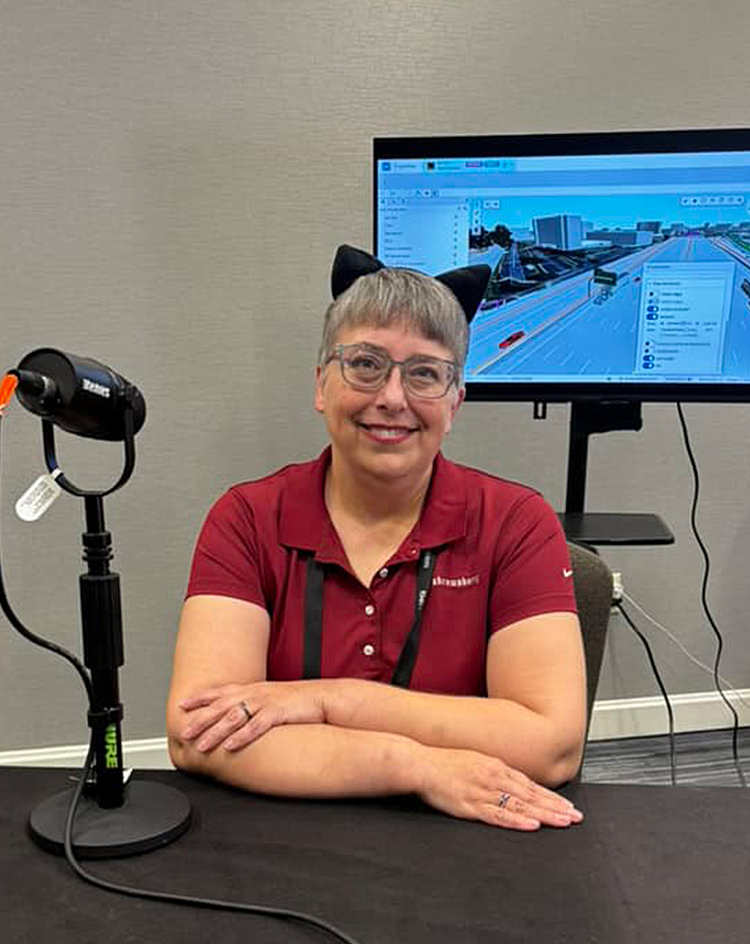
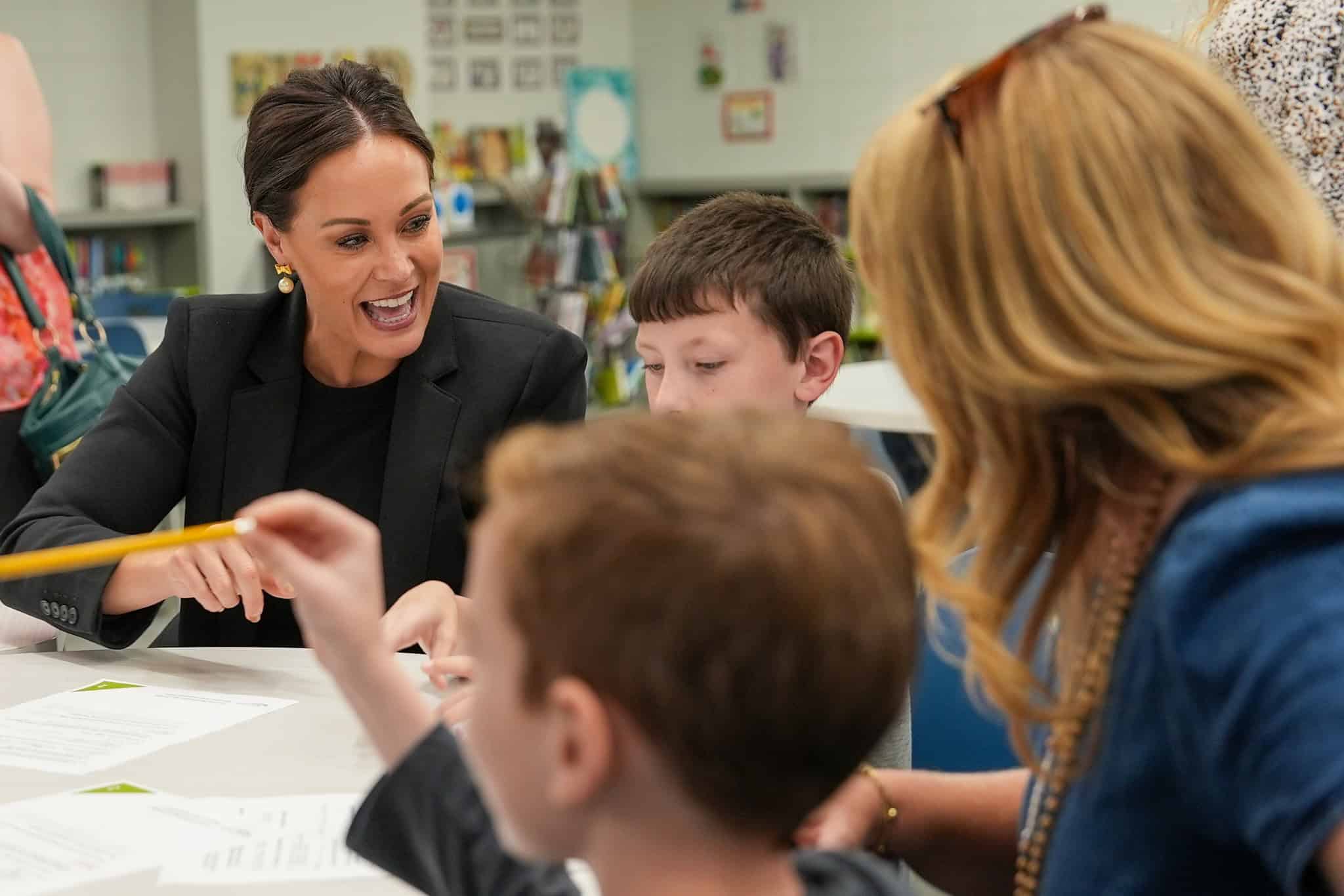
Ā Mary Bloswick filming an episode of the Table Podcast with Kelsey Click at the Denver User Conference.Growing up in Lansing, Michigan, Bloswick was taught and encouraged to pursue tough problems from an early age by her father, an electrical engineer with the stateās Department of Transportation. āI showed a natural aptitude toward math and science and learning, and my dad was determined that his little girl could be anything she wanted,ā recalls Bloswick, a veteran computer-aided drafting (CAD) designer with the Indianapolis-based engineering and consulting firm Shrewsberry & Associates. She remembers sitting on her fatherās lap as he taught in a creative way.
āHe had his calculus book out, explaining some of the concepts,ā she says, noting that one of those concepts was rate of change, or dX. āHe had an apple and a knife, and heād cut small slices representing a dX. If we knew how to do the numbers, we could see how Xāthe appleāwas changing by dX with each slice.ā
What followed was a curiosity-fueled education and a 30-year career that not only defined Bloswickās professional path, but helped her become a pillar within Bentley Communities. Like Bloswick, many members are not Bentley employees but use the software in their work.
Bloswickās engineering journey is a testament to her curiosity, passion, and unwavering commitment to helping others succeed. She left college before completing her coursework in electrical engineering because she was enjoying the civil field so much.
āI had a semester of paper-based drafting in high school, but computer-aided drafting barely existed when I graduated,ā she said. āI consider myself self-taught. I had people around me who could help, but most of what I know came from the help files, MicroStation Manager, magazines, and simple experimentation.Ā If I wanted to see how something worked, IĀ triedĀ it. I have a deep curiosity and a willingness to take rationalĀ chances.ā
Community Leader
Bloswick’s Ā involvement in Bentley Communities began as a personal curiosity to customize and optimize MicroStation, the software that launched Bentley Systems in the global infrastructure engineering software industry. Soon, helping fellow users evolved into a calling. Bloswick began sharing her knowledge on early platforms like CompuServe, and when Bentley Communities launched, she was among the first professionals to join. She now spends 20 to 30 minutes daily answering questions during breaks and lunch hours, seamlessly weaving community engagement into her work schedule.
āI can pop on and see if there’s a question I can answer,ā she says. āIt costs nothing to be kind and make othersā lives easier. I love the regulars on the Programming board. Theyāre always beneficial. But the MicroStation board is my home. Thatās where I learned so much of what I know and where I have the most to give to the community.ā
Drafting her own path
Mary Bloswick chats with Kelsey Click during the Denver User Conference.Sharing knowledge is a matter of principle rooted in Bloswickās upbringing. āMy high school was right next to the GM (General Motors) factories, and on the other side of town was Michigan State University,ā she recalls. āI had classmates whose parents either worked for the university or the state, and others whose fathers, uncles, and grandfathers had worked at the factories forever. You got an outstanding balance of everything it takes to make things work.ā
She took a few drafting classes in high school, and she sketched parcel plats and land diagrams for a real estate company. In college, she studied electrical engineering and optical physics. āBut the further I went down the career path, I was less enamored of where it was taking me,ā she recalls. āI realized Iām a technician, not a theoretician. I prefer to be hands-on, making things.ā
Guided by the conviction and confidence instilled by her father, Bloswick pursued a male-dominated field: computer-aided design. āNobody told me I couldnāt,ā she says.
For the love of Software
Bloswick got a part-time job at a civil engineering firm and, after a few weeks of filing documents and making copies, her supervisor handed her a copy of MicroStation (version 4) and its user manual, and said, āLetās see what you can do.ā
The bridge rehabilitation project had dozens of detail sheetsāabutments, bearings, beams, deck, railingsāall done by hand on the computer. āWe used the computer to do the same tasks we did on the drafting board, except we could draw to true size, then scale the detail up or down onto the border,ā Bloswick explains.
A submittal was approaching, with a stack of marked-up plan sheets awaiting correction. āI got about an hour of training,ā Bloswick says. Thankfully, MicroStation came naturally to her. āThe more I did, the more I learned, and the more I enjoyed it,ā she adds.
āThe administrative side also captured my attention. The number of simple ways I can customize MicroStation to function the way I work best has always appealed to me. I like to say that efficiency is simply constructive laziness,ā Bloswick says. āThe goal of both is to do as much work with as little effort as possible. If I can spend a couple of hours developing a quick tool or a new procedure that will save everyone on my team 15 minutes on every project we work on from now until I retire, itās worth the effort.ā
āI really enjoyed it and was good at it,ā she adds. āIt felt like Iād found what I was supposed to do.ā
Bloswick loves both the practical application of her work and the creative aspects of drafting.
āCivil engineers build civilization,ā she says. āYou can actually walk outside and see your projects being built. I am so fortunate to be in a career where I am useful in the world.”
Inside Bentley Communities, Bloswick serves as a bridge between Bentley and its software users. She’s seen how the communityās feedbackāboth positive and negativeātranslates into features, bug fixes, enhancements across software iterations, and even new product development. āI’m not shy about voicing my opinion,ā she says. āI love software. I believe in Bentley and want them to succeed. And sometimes that means hearing from and being held accountable by the people who use the software every day.ā
The Human Touch
Bently recently hosted the Bentley User Conference in Denver, which highlighted something that online forumsāno matter how vibrantāsimply cannot provide: human connection. Meeting fellow community members face-to-face after years of online interaction, users engaged with Bentley product leaders. They put names to online avatars, creating a layer of understanding that strengthens the entire ecosystem. āIt adds that little extra personal touch you’re never going to get on the other side of a screen,ā Bloswick says.
This convergence of online collaboration and in-person connection underscores the true value of the Bentley user communities. They’re not just repositories of technical knowledge; they’re networks of professionals who care deeply about helping each other succeed.
Bloswickās thousands of answers in Bentley Communities represent incalculable time saved across the industry, says Kyle Rosenmeyer,Ā a model-based design leader at the engineering firm VHB. Also a Bentley software superuser, Rosenmeyer says the cumulative time that Bloswick has saved users through her responses is staggering. Yet she does not do it for accolades.
āI’ve done this long enough that I’ve accumulated a wealth of knowledge, and I just love to be able to share that with other people,ā she says. āAnd I get back as much as I contribute ⦠it’s a give and take.ā
AI Training
As Bentley explores features assisted by artificial intelligence (AI), like co-pilots powered by large language models (LLMs), Bloswickās decades of knowledgeādocumented in her community postsāwill help train these systems and multiply her impact for years to come.
Bloswick embodies what makes professional communities thrive: authentic expertise, genuine generosity, and an unshakeable belief in collective growth. In a career defined by practical application and real-world impact, she has helped build something equally tangibleāa foundation of knowledge and goodwill that benefits everyone in the field she loves.
“Iām so fortunate to be in a career where I am useful in the world,” Bloswick says. “Nobody gets any smarter, better, or more experienced by hoarding and sitting on knowledge. I want everybody to know what I know, and to enjoy working with this software as much as I do.” Ā