How OpenRoads Designer 2026 arrives at the perfect moment for transportation Engineering
Forty-eight teams. 104 matches. Six million visitors. Thirty-nine days. This summer, sixteen cities across the United States, Canada, and Mexico are hosting the biggest international football tournament in history—or “soccer” as it’s known to our friends in the U.S.—and the roads, interchanges, and corridors behind it all depend on transportation engineers using connect road design software like OpenRoads Designer 2026.
The road infrastructure behind the beautiful game
Major sporting events have always been catalysts for infrastructure investment. This summer is no exception:
- Dallas invested approximately USD 180 million in road improvements and venue-area upgrades around AT&T Stadium.
- Atlanta committed USD 120 million in municipal infrastructure bonds for street resurfacing, improved lighting, and walkability enhancements, part of the city’s broader USD 1.2 billion BeltLine and MARTA expansion.
- New York/New Jersey transportation coordination costs for the MetLife Stadium area alone are projected to exceed USD 400 million.
- Mexico City Mayor Clara Brugada announced more than 70 permanent infrastructure works, including new electromobility corridors, a protected cycleway along Calzada de Tlalpan, and 334 kilometers of “Safe Paths” with 185,000 new streetlights.
- Vancouver has allocated CAD 532 million to 624 million for transit expansion, accommodation readiness, and venue upgrades at BC Place.
Behind every one of those numbers is a team of engineers designing alignments, grading surfaces, modeling corridors, and delivering construction documents, often under enormous time pressure and public scrutiny. That’s the environment OpenRoads Designer was built for. And the 2026 release is the best version yet.
Introducing OpenRoads Designer 2026: Faster road design workflows and greater reliability
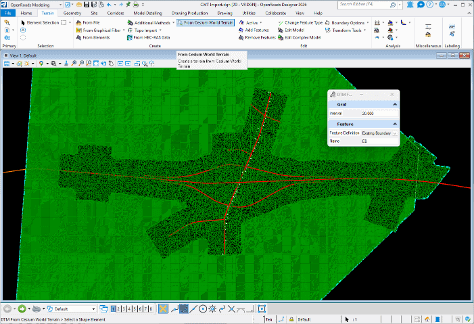
Faster terrain setup for road and highway design with Cesium World Terrain import
Early project setup just got faster. You can now import terrain directly from Cesium World Terrain in a single step, no additional subscription or third-party licence required. Whether you’re scoping access roads to a major venue or launching a greenfield highway project, you’re up and running before the first site visit.
Item type alignment pick lists
Manually typing alignment names leads to typos, protocol violations, and downstream clashes. Now, engineers select from a dynamic drop-down list pulled directly from project files—fewer errors, better standards compliance, less rework.
Regression points table
Previously exclusive to OpenRail Designer, this tabular view for editing and reviewing regression data is now fully integrated into OpenRoads. For teams establishing centerline geometry, right of way, property boundaries, or any regression need, it’s a more intuitive and connected workflow.
Enhanced site visibility and line-of-sight tool
Improved performance and mouse precision when adjusting line-of-sight analysis reduces friction on complex interchanges and roundabouts, exactly the kind of geometry that fills major venue access roads on match day.
Bentley Copilot for in-application road design guidance (technology preview)
Picture this: you’re mid-design, you need to set up superelevation, and instead of stopping to search documentation or wait for a colleague, you just ask. “How do I create superelevation?” Bentley Copilot gives you step-by-step contextual guidance right inside the application, in plain language, in the moment you need it. For onboarding new team members and keeping experienced engineers in their design flow, this changes the daily rhythm of the work.
More reliable road design files and civil workflows
This release delivers over 300 refinements across core workflows—from terrain and geometry to drainage and annotation, with particular focus on the areas that users told us mattered most. View set management is now handled by a new native tool, replacing the previous macro-based approach with more reliable, stable code that reduces friction and simplifies day-to-day use. A new DGN Checker utility validates file structure and model integrity before iModel creation, helping teams catch issues proactively rather than reactively. And civil file health auditing continues to evolve, providing greater confidence in the data underpinning every design.
OpenRoads Designer 2025 features worth revisiting
With the 2026 release front of mind, a few standout features from OpenRoads Designer 2025 deserve attention, especially if your team hasn’t had a chance to explore them yet:
- AI-empowered label organizer (technology preview): An AI model trained on how clear plan sheets look analyses and can reposition overlapping annotations automatically, saving hours of manual cleanup.
- Improved geometry engine: Modify geometry elements while preserving their core identity. All rules and references remain intact, with support for both horizontal and vertical geometry.
- Reimagined equal spaced points: Customize each point with unique properties and rules, with parametric cell support and named groups for reporting and annotation.
- Google Maps and Google 3D integration: Higher-resolution, more current geospatial context, including immersive 3D maps for stakeholder engagement, replacing the previous Bing Maps integration.
- GEOPAK and 12d survey import: Bring in survey data from legacy Bentley software and 12d, making cross-project and multi-tool work seamless.
- Civil file health monitoring: Automated version tracking and issue monitoring so you always know whether a file is trustworthy.
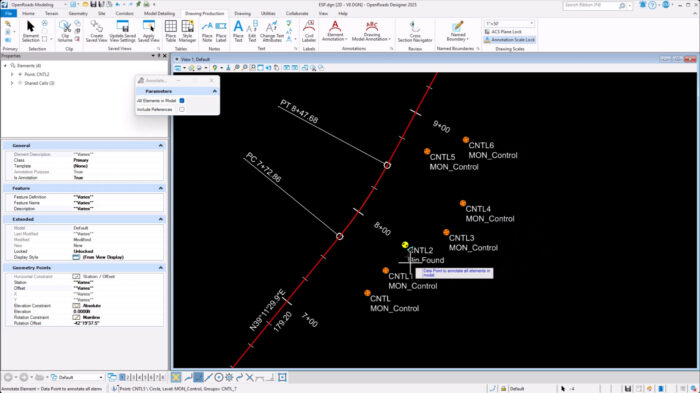
- Enhanced annotation tools: Text frames and leaders for bulk annotation, white space management, and automatic placement as points are created.
If your team is still on earlier releases like 2022 (10.12) or 2023, there’s never been a better moment to upgrade.
The road ahead for transportation engineering teams
Roads aren’t just lines on a map. They’re the connective tissue of communities, economies, and, for the next 39 days, the world’s biggest sporting celebration. Every fan who arrives at a stadium on time, every shuttle that runs as planned, every emergency route that functions as designed: it all starts with the work you do.
According to tournament economic projections, the event is expected to generate USD 40.9 billion in GDP impact across North America, supporting over 824,000 jobs alongside billions in road, transit, and urban infrastructure investments that will serve these communities for decades.
That’s the real beautiful game.
Ready to explore OpenRoads Designer 2026?
Watch the What’s New in OpenRoads Coffee Corner, check out the new features on YouTube and explore your free 30 day trial.
OpenRoads Designer 2026. Purpose-built for road and highway engineering. Proven at scale. Ready for whatever the road ahead brings.
Note: The opinion of the writer that the game is called football and not soccer is entirely her own.