Every time you drive over a bridge, turn on a tap for a glass of water, or flip a light switch, you are placing your trust in a complex system of infrastructure. You trust that the engineering was sound, the materials were correct, and the analysis was precise. This trust is the silent, foundational contract upon which modern society is built. It is also why the conversation about AI in infrastructure must be fundamentally different from any other domain.
The rise of generative-AI has been astonishing, but it has also introduced the concept of “AI slop”—outputs that are plausible-sounding but often imprecise, inconsistent, or flat-out wrong. In many fields, this is an acceptable tradeoff for speed and creativity: a door the wrong shade of blue may offend a design eye, but it won’t physically hurt anyone. The reality of the infrastructure sector is that there is no room for approximation, let alone hallucination. A model that is 90% right is a useful start; a structural analysis that is less than 100% right is a catastrophic liability. Would you drive across a bridge that is ‘hopefully’ designed right?
The gold standard of AI in civil engineering is not to provide a creative starting point, but to deliver precise designs that can be used for real world delivery.
I believe Bentley is uniquely positioned to deliver on the promise of AI for civil engineers: manage precision and ensure validation at every step. Our approach to AI is to build a new class of AI supported workflows that are grounded in the principles of engineering discipline. This approach creates a powerful partnership between engineers and AI as a tireless partner that can systematically explore design alternatives that a human might not have time to investigate. The engineer, freed from repetitive calculation, can focus on bringing their most valuable assets: judgment, experience, and intuition.
MCP: Giving AI an Engineering License
The key to enabling this human and agentic partnership is the Model Context Protocol (MCP), an open standard originally developed by Anthropic and now governed by the Agentic AI Foundation under the Linux Foundation. MCP is open and model agnostic by design, working across any AI platform that adopts it. It has quickly become the industry standard for AI agents to connect directly and reliably to external applications and trigger actions in those applications.
By building MCP servers for our core products, we are giving AI agents programmatic, access to the proven, validated engineering and simulation power that Bentley has built over 42 years. This is not about generating text about engineering; it’s about executing real, verifiable engineering workflows.
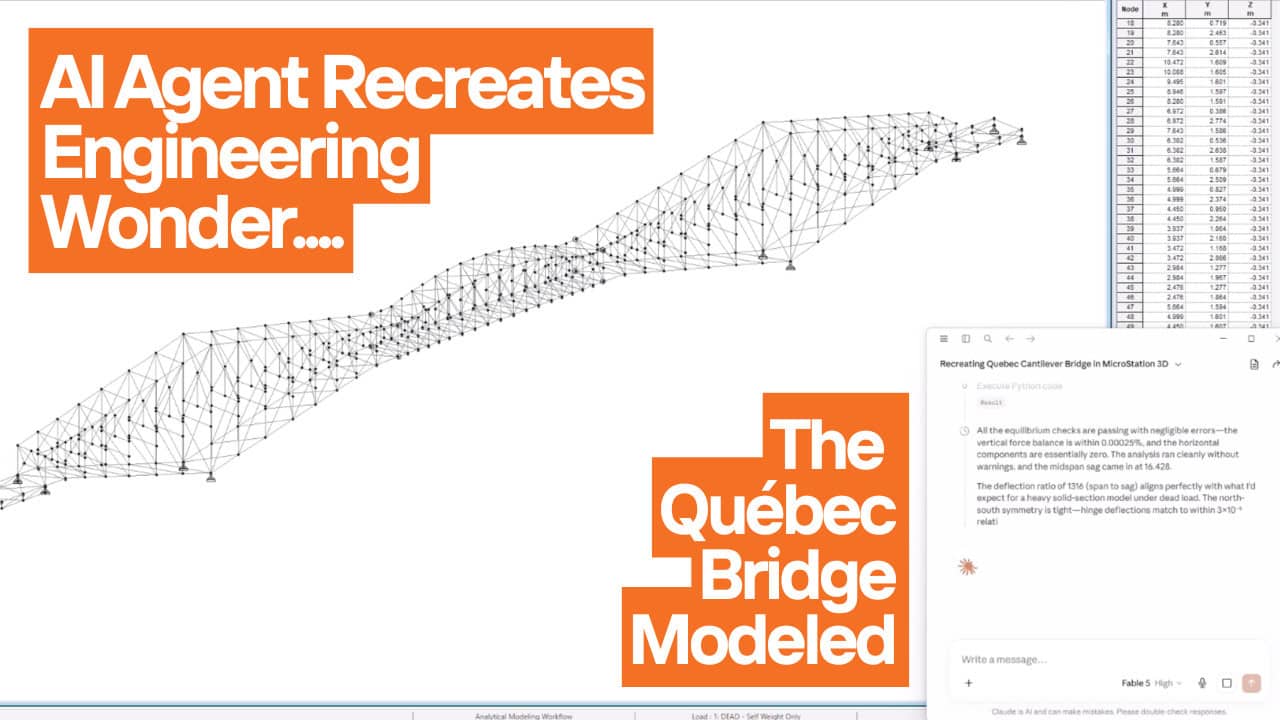
And because structural engineering tolerates no approximation, STAAD, one of the most widely used tools by civil engineers is a logical place for us to begin. STAAD is purpose built for real world structural engineering and has been used around the world for industrial and energy infrastructure, transmission towers and specialized structures with non-typical geometries. Its ability to transform physical models into analytical models, combined with built in compliance for global design codes, makes it an ideal proving ground for AI workflows where accuracy and regulatory confidence are non-negotiable.
To support an open and interoperable agent ecosystem, Bentley has published its STAAD MCP server to the MCP Registry as well as submitted it as a Claude Connector. The results are transforming our vision into reality:
- AI-Driven Optimization: Using the STAAD.Pro MCP server, an AI agent performed a full structural optimization on a production model. By varying geometry, section sizes, and materials, it found a design that achieved a 40% reduction in steel weight. This is not a theoretical saving; it translates directly to project cost reduction, all delivered from a single, AI-orchestrated workflow.
- Automating High-Skill Tedium: We automated slab-wall meshing, a notoriously tedious and error-prone task in structural engineering, entirely through a natural language prompt. This frees up hours of an expert engineer’s time to focus on more complex design challenges, while ensuring structural continuity is correctly modeled.
- The Human-AI Feedback Loop:In an internal test, we gave a team a large language model and our STAAD MCP server. With no programming experience, they performed a complete design-and-analysis workflow in a week. The most critical finding was that the AI’s output quality improved dramatically when the engineer’s expertise—their knowledge of code requirements, rules of thumb, and lessons learned—was embedded directly into the prompts. This proves the future isn’t a hands-off AI; it’s a collaborative loop where human expertise actively makes the AI smarter, safer, and more effective.
Your Data is Your Expertise. It Belongs to You.
This entire framework rests on one final, crucial pillar: data. An AI agent working from a single model file is working blind. The most powerful insights come when an AI can not only run an analysis but also reference how a comparable structure has performed over 20 years of operational data. Bentley’s iTwin Platform provides this “universal translator,” structuring fragmented lifecycle data into a single, AI-ready schema.
And this brings us to a non-negotiable point of trust. Your design and asset data, built over decades of work, represents your firm’s intellectual property. It is the digital embodiment of your expertise. We believe we are the stewards of that data, not the owners. Engineering firms should compete by leveraging their unique IP through AI, not by giving it away. At Bentley, your data is never scraped or used for AI training unless you choose to do so, and if you do, the resulting model is yours alone.
The race in infrastructure AI will not be won by the flashiest demo, but on the foundation of trust. By insisting on precision over plausibility and partnership over replacement, we can ensure that AI fulfills its promise: to help us design, build, and operate the infrastructure the world relies on—more safely, efficiently, and sustainably than ever before.