Around the world, Sydney is instantly recognizable from a single image: the white sails of the Sydney Opera House rising from the edge of a picturesque harbor. But the city is far more than a postcard. Built along one of the world’s largest natural harbors, Sydney functions as a complex urban system where infrastructure, cultural districts, working ports, beaches, and public spaces intersect to power the economic and social life of Australia’s largest metropolitan area.
Viewed in 3D, the city reveals how these layers connect. Architecture meets engineering. Tourism sits alongside global trade. Redevelopment unfolds beside historic neighborhoods. Together, these sites show how Sydney has grown into a metropolis defined by its relationship to water, transportation, and the shifting edge between nature and urban life.
Just in time for Bentley’s Illuminate 2026 Sydney conference, you can now join a 3D tour powered by Cesium to experience how Sydney functions as a connected system.
Check out the visualization of Sydney yourself. Here are some of the stops:
Sydney Opera House
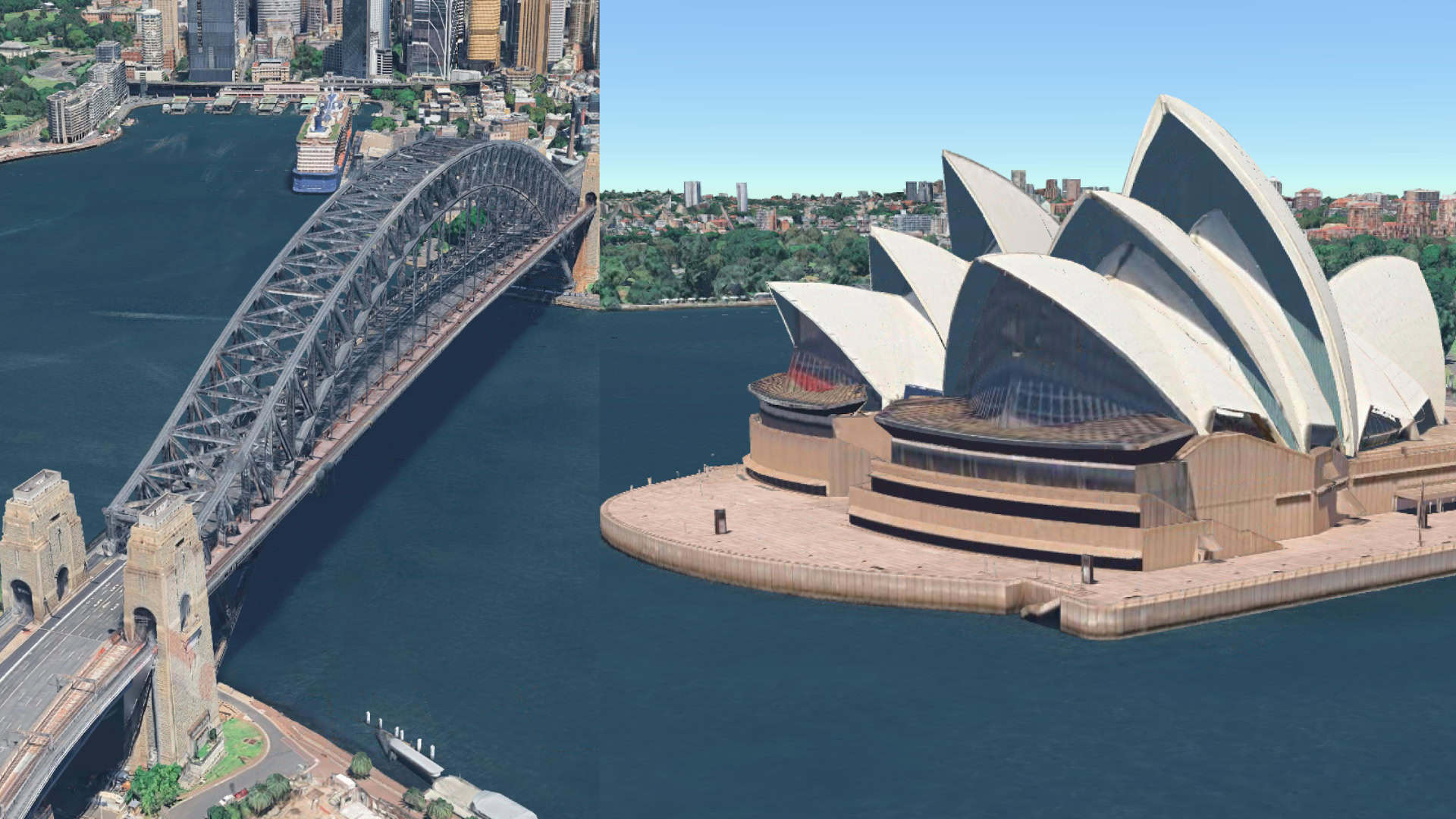
Few buildings are as recognizable as the Sydney Opera House, whose swooping rooflines appear to float above the harbor. Completed in 1973, the building is both an architectural icon and an engineering milestone. Its distinctive roof is formed from thousands of prefabricated concrete segments assembled into interlocking shell structures—a design that, at the time, required new geometric modeling and fabrication techniques that pushed the limits of architectural engineering. More than 50 years later, the Opera House stands as a reminder of how bold design can reshape a city’s global identity.

Sydney Harbour Bridge
Just across the water stands another defining symbol of the city: the Sydney Harbour Bridge. Opened in 1932, it connects Sydney’s northern and southern shores and remains one of the largest steel arch bridges in the world. Carrying cars, trains, cyclists, and pedestrians each day, the bridge is more than a transportation link—it illustrates the scale of infrastructure required to knit together a port city shaped by water. Seen alongside the Opera House and the surrounding shoreline, the Harbour Bridge reveals the engineering backbone that allows Sydney to function as a single metropolitan area.

Bondi Beach
While Sydney’s harbor defines its urban core, the city also faces the open Pacific Ocean. Bondi Beach, one of the world’s most famous stretches of sand, shows how coastal geography shapes daily life in the city. Beyond its role as a recreational destination, Bondi is also a frontline of climate adaptation, where rising sea levels, coastal erosion, and stronger storm systems require constant monitoring and management of shoreline infrastructure. The beach sits at the intersection of leisure, tourism, and environmental resilience, reflecting Sydney’s deep cultural and ecological relationship with the ocean.

Darling Harbour
Just west of Sydney’s central business district, Darling Harbour offers a different view of the city’s evolution. Once an industrial docklands area filled with warehouses, rail yards, and cargo wharves, the waterfront was transformed in the late 20th century into a major public and entertainment district. Today it is home to museums, convention centers, parks, and promenades that attract millions of visitors each year. The redevelopment reflects a global trend of former working waterfronts reimagined as civic spaces.

Barangaroo Reserve
Barangaroo Reserve demonstrates a more recent phase of waterfront transformation. Built on land once occupied by shipping terminals and container yards, the site was reshaped into a public park that reconnects the city with the harbor. Thousands of sandstone blocks were used to reconstruct the historic shoreline while integrating walking paths, green space, and habitat restoration. The project shows how modern cities increasingly combine ecological repair with urban development.

Port Botany
While parts of Sydney’s waterfront have been redeveloped for public use, other areas remain vital to global trade. Port Botany, located south of the city center, is one of Australia’s largest container ports and a key gateway for international commerce. Massive cranes, shipping terminals, and logistics facilities move millions of containers through the port each year, linking Australia to supply chains across Asia, Europe, and the Americas. The port is a crucial piece of industrial infrastructure underpinning the city’s economy.

Sydney Chinatown
No understanding of Sydney would be complete without its cultural neighborhoods. Sydney’s Chinatown, centered around Dixon Street near Haymarket, is one of the largest and most vibrant Chinese cultural districts in the Southern Hemisphere. The neighborhood reflects more than a century of immigration and exchange, with dense blocks of markets, restaurants, housing, and transit connections shaping everyday life. In a compact area, commerce, culture, and residential life exist side by side, contributing to the diversity that defines modern Sydney.
A City Defined By Connections
Taken together, these sites reveal Sydney not as a collection of isolated landmarks, but as an interconnected system where architecture, infrastructure, culture, and environment converge across the harbor and coastline. The Opera House and Harbour Bridge showcase engineering and design, while Bondi Beach reflects the environmental forces shaping the shoreline. Redeveloped districts such as Darling Harbour and Barangaroo demonstrate how cities reinvent their waterfronts, while Port Botany anchors Sydney in the global economy, and Chinatown highlights the cultural networks that give the city its character.
Seen in this broader context, Sydney becomes more than a beautiful harbor city—it emerges as a living system where geography, infrastructure, and people continuously shape one another.
FAQ:
Completed in 1973, its iconic shells required revolutionary geometric modeling. The 3D tour shows how this bold architectural feat redefined Sydney’s shoreline and pushed the boundaries of structural engineering.
It is the idea that Sydney isn’t just a collection of buildings, but a network where transportation, trade, and culture intersect. The 3D tour highlights how the Harbour Bridge, Port Botany, and the CBD work together to power the city.
The tour serves as a digital twin showcase for Bentley Illuminate 2026, highlighting how Cesium and Bentley Systems software bring geography to life. It explores the city’s evolution, from historic tunnels to sustainable landmarks like the Quay Quarter Tower.